Bajrangbali: The Eternal Servant Who Became the Supreme Devotee
On this auspicious Tuesday under Nakshatra Hasta and Yoga Siddhi, we turn to Anjaneya — the one in whom strength and surrender became one.
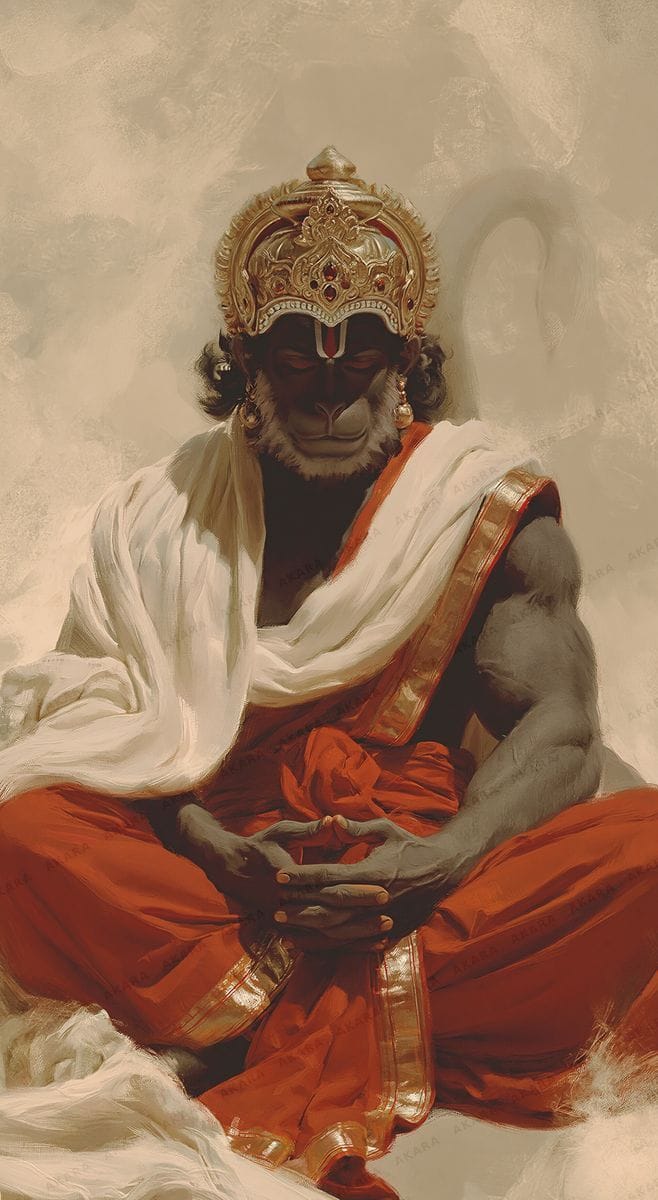
There is a deity in the Sanatana tradition who carries a mountain in one hand, tears open his own chest with the other to reveal the Lord within, and yet bows so completely before his beloved Rama that the very gesture of his prostration has become a teaching. Hanuman is not simply a figure of power — he is power perfected by love, strength consecrated entirely to devotion. On every Tuesday across the world, in small shrines smeared with sindoor, in large temples ringing with bells, in quiet rooms where a single lamp burns before a small image, millions of seekers turn to him and find, somehow, exactly what they need.
Who Is Hanuman? Name, Lineage, and Essence
Hanuman goes by many names, each a doorway into his nature. He is Anjaneya — son of Anjana, his devoted mother. He is Vayuputra — son of Vayu, the wind god, which explains his preternatural swiftness and the breath-like quality of his grace: invisible, essential, everywhere at once. He is Bajrangbali (bajra — thunderbolt or diamond, ang — body, bali — the powerful one), whose limbs are said to be as indestructible as the vajra itself. And he is Mahavira, the great hero, a title that points not merely to martial prowess but to the supreme courage of absolute self-surrender.
In the Valmiki Ramayana, Hanuman first appears before Rama and Lakshmana on the slopes of Mount Rishyamukha. His opening words are so perfectly composed, so clear in grammar and expression, that Rama turns to his brother and says: *
Hanuman tears open his own chest — not as drama, but as the most honest answer a devotee can give: there is nothing inside me but my Lord.
मनोजवं मारुततुल्यवेगं जितेन्द्रियं बुद्धिमतां वरिष्ठम्। manojaваṃ mārutatulyavegaṃ jitendriyaṃ buddhimatāṃ variṣṭham।
swift as thought, wind-fast, master of his senses — hanuman showing us what true focus looks like.
Questions & answers
Why is Tuesday considered Hanuman's day?
Tuesday (Mangalavar) is traditionally associated with Mars (Mangala), a planet of energy and courage. Hanuman, as the embodiment of strength, fearlessness and devoted action, is naturally aligned with Tuesday's energy. Temples dedicated to Hanuman observe their most important weekly worship on this day.
What is the significance of applying sindoor to Hanuman's image?
The tradition comes from a story in which Hanuman saw Sita applying sindoor as an expression of love and devotion for Rama's long life. In his characteristic completeness of devotion, Hanuman covered his entire body in sindoor to multiply the prayer. Devotees continue this practice as an act of participatory bhakti.
What is the Hanuman Chalisa and how should it be recited?
The Hanuman Chalisa is a 40-verse hymn in Awadhi composed by Goswami Tulsidas. It is recited by devotees daily or especially on Tuesdays and Saturdays, ideally in the morning after bathing, facing a lamp or image of Hanuman. Even a single sincere recitation is held to be protective and auspicious.
What does 'Om Hanumate Namah' mean and how is it used?
'Om Hanumate Namah' translates as 'I bow to Hanuman' — a salutation that invokes his qualities of strength, devotion, and grace. It can be chanted in multiples of 11 or 108 on a mala (rosary). It is considered particularly effective for dissolving fear, removing obstacles, and cultivating courage.
What is dasya bhava and why is Hanuman its supreme exemplar?
Dasya bhava is one of the five principal moods of devotion in Sanatana Dharma — the mood of the servant. It involves complete dedication to the Lord's will, with no trace of personal agenda. Hanuman is considered its supreme exemplar because every action of his life, from the crossing of the ocean to the carrying of the mountain, was done purely in service of Rama, with no desire for personal glory.