Hanuman Chalisa: Meaning, Benefits, and How to Chant
From Tulsidas's prison cell to the hearts of millions — a definitive guide to the forty verses that move mountains.
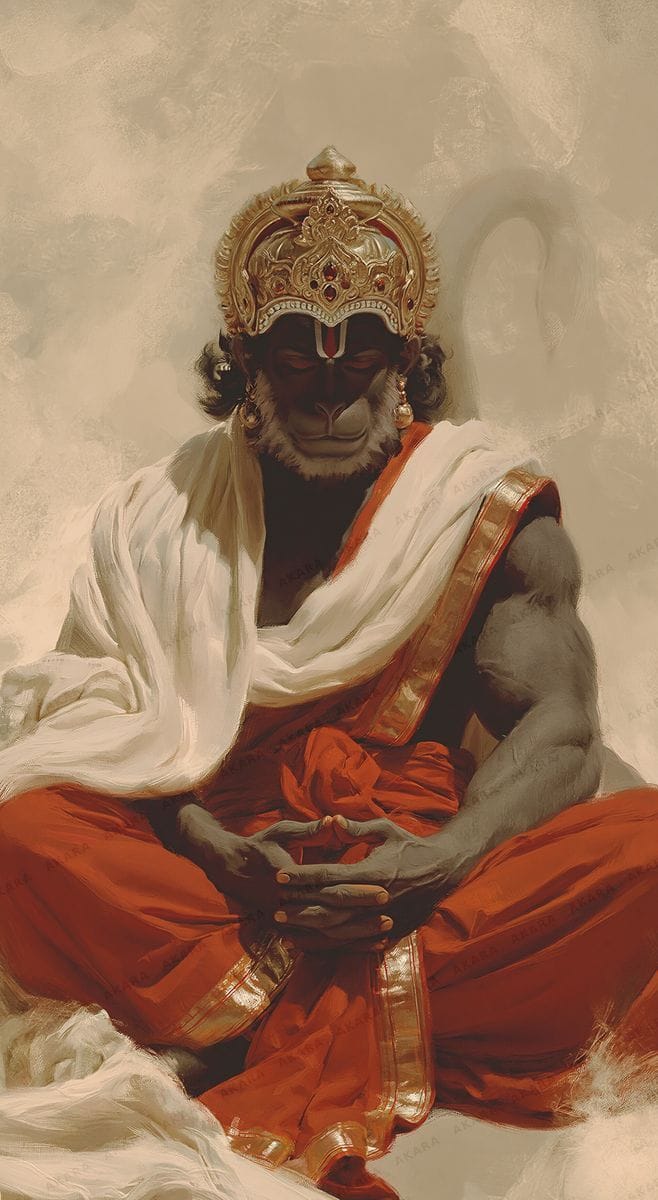
There is a verse so compact it fits on a single page, yet so vast it has sheltered devotees through wars, illness, grief, and ordinary Tuesday mornings for nearly five centuries. The Hanuman Chalisa — forty chaupais composed by the poet-saint Goswami Tulsidas in sixteenth-century Awadh — is arguably the most recited devotional hymn in the living tradition of Sanatana Dharma. It is chanted in temples on the Ganges and in apartments in Toronto; by scholars who parse every syllable and by children who have only just learned the melody. To know it well is to carry a lamp that never goes out.
Who Wrote the Hanuman Chalisa, and When?
Goswami Tulsidas (c. 1532–1623 CE) composed the Hanuman Chalisa in Awadhi, the vernacular dialect of what is now eastern Uttar Pradesh. Tradition holds that he wrote it while imprisoned in Fatehpur Sikri by the Mughal emperor Akbar, who — so the beloved legend runs — had demanded proof of his yogic powers. Whether or not every detail of that story is literal history, the spiritual circumstance it points to is unmistakeable: the Chalisa was born under pressure, as a cry of pure dependence on the grace of Shri Hanuman.
The text is part of the broader Vinaya Patrika and stands alongside Tulsidas's magnum opus, the Ramcharitmanas. The word chalisa derives from the Sanskrit catvāriṃśat — simply, forty — and the poem contains exactly forty chaupais (quatrains of two rhyming couplets each), framed by two introductory dohas and a concluding doha. Every verse is a small, self-contained jewel of bhakti.
The Structure and Meaning of the Forty Verses
The Hanuman Chalisa opens with two dohas (couplets) in which Tulsidas bows first to the dust at the feet of his guru — shri guru charan saroj raj, nija manu mukuru sudhari — cleansing the mirror of his own mind before he dares to describe Lord Hanuman. This gesture of humility is not a formality; it is the doctrinal foundation of the entire hymn. Bhakti, devotion, begins with the erasure of ego.
The forty verses then move through a luminous portrait:
- Verses 1–13 praise Hanuman's divine form (swaroop): his golden complexion (kanchana barana biraj subesa), the sacred thread, the earrings of precious stones, his mace and flag. He is Anjaniputra, son of Anjana, and Pawanputra, son of the Wind. These are not merely poetic images — each attribute carries a symbolic meaning rooted in Vedic cosmology.
- Verses 14–20 recount his deeds: the leap to the sun mistaken for a fruit (bāla samaya rabi bhaksha liyā), the crossing of the ocean, the burning of Lanka. These verses anchor the hymn in the narrative of the Valmiki Ramayana, reminding the chanter that Hanuman's power is proven, not theoretical.
- Verses 21–31 declare his sovereignty over enemies, disease, fear, and the malefic planets. The famous verse nāsai roga harai saba pīrā — 'all diseases are destroyed, all pain dissolves' — has given comfort to countless devotees sitting beside sickbeds.
- Verses 32–40 make the poet's personal plea, the prarthana: that Hanuman stand as guardian, that he carry the devotee into the presence of Shri Rama. The final chaupai — tulsidāsa sadā hari cherā, kījai nātha hridaya maha derā — is Tulsidas placing himself permanently as Hari's servant, asking only that Hanuman make his heart a worthy dwelling.
The closing doha is perhaps the most quoted verse of the entire hymn: pavanatanaya sankat harana, mangala murati rupa / rāma lakhana sītā sahita, hridaya basahu sura bhūpa — 'O son of the Wind, dispeller of distress, embodiment of auspiciousness, dwell in my heart together with Rama, Lakshmana, and Sita.'
The Benefits of the Hanuman Chalisa: Tradition and Experience
The Hanuman Chalisa makes its own promises, embedded in verses 37–38. Tulsidas writes that whoever recites it with devotion (jo yaha padhai hanumāna chalīsā) will find Hanuman's grace descending without fail. The tradition identifies several well-attested benefits:
**Spiritual protection (raksha):** Hanuman is sankat mochan, the liberator from distress. Devotees across centuries have reported a palpable sense of safety during times of fear, illness, or confusion after sustained recitation.
**Relief from the influence of Saturn (Shani):** The verse nāsai bhūta pisāca nikata nahi āvai and the tradition around verse 23 — which speaks of Hanuman's control over all planetary forces — have made the Chalisa a central practice on Saturdays and during Sade Sati periods. In the language of Sanatana Dharma, Hanuman's fearlessness (abhaya) extends even to karmic pressures.
Mental clarity and courage: Hanuman is the archetype of the integrated being — vast intelligence (buddhi matām varishtham) fused with immense physical strength and absolute devotion. Chanting his hymn invokes those qualities in the practitioner. Many students, professionals, and seekers report greater steadiness during recitation before examinations or difficult conversations.
Bhakti and direct experience of Rama: At its deepest level, the Chalisa is a doorway. Hanuman does not keep devotees for himself; he carries them to Shri Rama. This is the ultimate phala, the ultimate fruit, that the tradition describes.
How to Chant the Hanuman Chalisa: Practical Guidance
The beauty of this hymn is that it asks nothing extraordinary of the chanter — only sincerity.
1. Timing: Tuesday and Saturday are classically associated with Hanuman worship. Dawn (brahma muhurta, roughly 90 minutes before sunrise) and dusk are considered ideal. That said, the Ramcharitmanas itself teaches that Hanuman is available to the sincere devotee at any hour.
2. Preparation: A bath or at minimum washed hands and face. Light a lamp or a stick of incense if available. Sit facing east or north, spine erect. Place an image or murti of Hanuman before you if you have one — even a small printed image suffices.
3. The dohas first: Always begin with the opening doha (shri guru charan saroj raj). Do not skip the framing couplets; they set the inner posture of the recitation.
4. Pace and attention: Chant clearly but without hurry. The traditional pace takes approximately ten to twelve minutes for one full recitation. Many devotees complete eleven recitations (ek sau ek in complete vows, or sets of seven) on significant occasions, but one sincere recitation outweighs a distracted hundred.
5. Understanding over speed: If you are new to the Chalisa, spend a week on just the first five verses, learning the Awadhi and its meaning. The hymn rewards understanding. Keep a translation beside you until the meanings become second nature.
6. Closing: After the final doha, sit quietly for a few moments. Offer the merit of the recitation — phal samarpan — to Shri Rama through Hanuman. This gesture of non-attachment is itself a teaching.
The Chalisa in the Life of a Modern Devotee
In an age of fragmentation and overstimulation, the Hanuman Chalisa offers something rare: a complete spiritual practice in under fifteen minutes. It is a form of japa (repetition), stotra (hymn), dhyana (meditation on divine form), and prarthana (prayer) simultaneously. At Akara, we see the Chalisa as a living bridge — between the timeless truths of Sanatana Dharma and the daily life of a seeker navigating a complex world.
Tulsidas composed these verses so that the grace of Hanuman — bajrangabali, the one whose limbs are as strong as thunderbolts — would never be far from any human heart that turned toward it. Five centuries later, that remains exactly true.
Sankat kate mite saba pīrā, jo sumirai hanumata bala bīrā. 'All distress is cut away, all pain dissolved — for one who remembers the mighty and heroic Hanuman.'
Keep the Chalisa close. Chant it well. And let it carry you home.
Five centuries later, the grace of Hanuman remains exactly as near as the heart that turns toward it.
मनोजवं मारुततुल्यवेगं जितेन्द्रियं बुद्धिमतां वरिष्ठम्। manojaваṃ mārutatulyavegaṃ jitendriyaṃ buddhimatāṃ variṣṭham।
swift as thought, wind-fast, master of his senses — hanuman showing us what true focus looks like.
Questions & answers
How many verses does the Hanuman Chalisa contain, and what does 'chalisa' mean?
The Hanuman Chalisa contains exactly forty chaupais (quatrains), plus two opening dohas and one closing doha. The word 'chalisa' comes from the Sanskrit-derived Awadhi for forty (catvāriṃśat). The number is structural, not incidental — each verse addresses a distinct aspect of Hanuman's nature or deeds.
Who wrote the Hanuman Chalisa and in which language?
Goswami Tulsidas (c. 1532–1623 CE) composed the Hanuman Chalisa in Awadhi, a vernacular dialect of medieval northern India. Tradition places its composition during Tulsidas's imprisonment in Fatehpur Sikri, though scholars note the hymn's literary style aligns with his other mature works.
What is the best time of day to chant the Hanuman Chalisa?
Dawn (brahma muhurta, about 90 minutes before sunrise) and dusk are traditionally considered the most auspicious times. Tuesdays and Saturdays are dedicated to Hanuman worship. However, the tradition consistently emphasises sincerity over strict timing — one focused recitation at noon is superior to a distracted recitation at the 'correct' hour.
Can women chant the Hanuman Chalisa during menstruation?
Practices vary by regional tradition and family custom. Many contemporary teachers and scholars of Sanatana Dharma hold that sincere bhakti — particularly of a text composed for all devotees by Tulsidas — carries no such restriction. Seekers are encouraged to follow their own lineage's guidance while honouring the spirit of inclusive devotion that the Chalisa itself embodies.
How does the Hanuman Chalisa protect against malefic planetary influences?
Verse 23 of the Chalisa (bhūta pisāca nikata nahi āvai) and the broader tradition describe Hanuman as master over all forces that disturb the mind and life. In Jyotisha (Vedic astrology), Hanuman is considered a powerful antidote to the influence of Saturn (Shani), particularly during Sade Sati. Regular recitation on Saturdays is a widely recommended practice across the Vaishnava and Shaiva traditions alike.