Om Namah Shivaya: The Complete Guide to the Five-Syllable Mantra
The five syllables Na-Ma-Shi-Va-Ya contain an entire cosmology — and an invitation to dissolve into the divine.
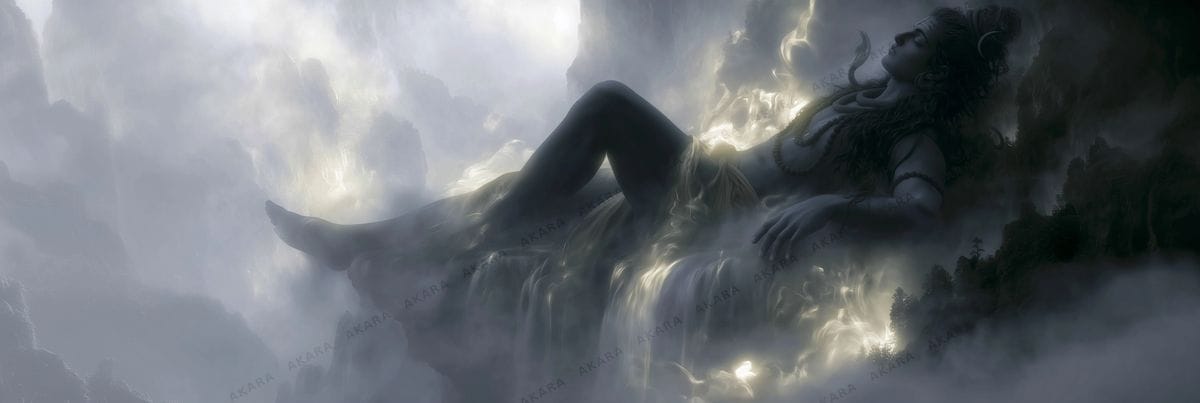
There are mantras one learns, and there are mantras one recognises — as though the syllables were already resting quietly in the chest, waiting to be spoken aloud. Om Namah Shivaya is, for countless seekers across millennia and across every corner of the world, precisely such a mantra. Chanted at Himalayan shrines and in suburban living rooms, whispered at dawn and carried silently through the noise of the day, it is perhaps the most widely recited mantra in the whole of Sanatana Dharma. Yet its depth rewards careful study: every syllable is a world, every repetition a step closer to the Self.
Origins and Scriptural Home
The mantra's heart — the five syllables Na · Ma · Śi · Vā · Ya — is formally known as the Panchakshara (पञ्चाक्षर, pañcākṣara: pañca = five, akṣara = syllable or imperishable letter). Its canonical home is the Shri Rudram, specifically the eighth anuvāka of the Krishna Yajurveda's Taittiriya Samhita (4.5.8). There, within the Namakam — a litany of salutations to Rudra in his countless forms — the phrase namaḥ śivāya ca śivatarāya ca appears: "salutation to Śiva, and to the one who is even more auspicious." This single line crystallised, over centuries of transmission, into the mantra that devotees carry today.
The Shiva Purana and the Linga Purana both celebrate the Panchakshara as the king of mantras (mantra-rāja), capable of liberating the soul from the cycle of birth and death. The sage Upamanyu, according to the Shiva Purana, received it directly from Lord Shiva himself, underscoring the tradition that this is not a human composition but an apauruṣeya revelation — a sound that belongs to the fabric of existence itself.
The Full Mantra and Its Transliteration
The complete form most commonly chanted is:
Oṃ Namaḥ Śivāya (ॐ नमः शिवाय)
Pronunciation guide:
- Oṃ — the primordial sound, the pranava; the 'ṃ' is a nasal resonance, not a hard 'm'.
- Namaḥ — the 'ḥ' is a soft aspiration (visarga); it sounds like a faint 'ha' echo.
- Śivāya — the 'Ś' is a palatal sibilant, softer than 's'; the final 'ya' is the dative case ending ('to Śiva').
The mantra thus means, in its plainest rendering: "I bow to Śiva" or "Salutation to the auspicious one." The word Śiva itself comes from the root śi, meaning auspiciousness, welfare, and grace — not merely a name, but a declaration of the nature of ultimate Reality.
When the syllable Oṃ is counted, the mantra becomes six-syllabled (ṣaḍakṣara). Strictly speaking, the Panchakshara refers to Na-Ma-Śi-Vā-Ya alone, and this is the form installed in japa (meditative repetition). The Oṃ prefix is added in public chanting and liturgy; in interior japa, the five pure syllables are the practice.
The Five Syllables and Their Cosmic Map
The genius of the Panchakshara is that it is not merely devotional poetry — it is a compressed map of existence. Classical commentaries, particularly from the Shaiva Siddhanta and Kashmir Shaivism traditions, assign each syllable to a layer of reality:
- Na — corresponds to the earth element (pṛthvī) and to the obscuring power (nirodha); it represents the bound soul (paśu) in its grossest state.
- Ma — corresponds to water (jala) and to the the bond (pāśa), specifically the primordial ignorance (āṇava mala) that veils the Self.
- Śi — corresponds to fire (agni) and to Śiva himself — pure consciousness, the witnessing light.
- Vā — corresponds to air (vāyu) and to Śakti, the dynamic power of grace that draws the soul upward.
- Ya — corresponds to space (ākāśa) and to the individual Self (jīva) in its essential nature — spacious, free, unbounded.
Chanting the mantra is therefore not a petition to an external being alone. It is a traversal of the entire cosmos — from earth to sky, from bondage to liberation, from paśu (bound creature) to Śiva (pure awareness). Each round of japa is a miniature journey from matter to consciousness.
The Living Practice: Japa, Bhakti, and Daily Life
The Shiva Purana recommends 108 repetitions as the base unit of japa, with 1,008 for deeper practice and 125,000 (ek lakh pañcāviṃśati sahasra) as a complete anushthana (dedicated vow). A rudraksha mala of 108 beads is the traditional counting aid, with the sumeru bead (the larger head bead) marking the beginning and end — one never crosses the sumeru but reverses direction, so the energy of the practice remains continuous and contained.
Practical guidance for beginning a japa practice:
- Time: The brahma muhurta (roughly 90 minutes before sunrise) is ideal; twilight (sandhyā) is the second-best window.
- Posture: Seated comfortably with the spine upright; a mat of wool or kusha grass is traditional.
- Mind: Allow the mantra to settle from the lips inward — from voiced chanting (vaikharī) to a whisper (upāṃśu) to purely mental repetition (mānasa). The tradition teaches that mānasa japa is a thousand times more potent than voiced recitation.
- Continuity: Even five minutes of sincere daily practice, sustained over months, builds an interior resonance that persists through the rest of the day.
Bhakti — devotion of the heart — is the essential ingredient. The mantra is not a formula but a relationship. "Namah", the gesture of bowing, is at its core an act of surrender: the recognition that the small self is held within something immeasurably larger. This is the spirit in which Sanatana Dharma commends the Panchakshara: not as a technique for self-improvement, but as an opening of the heart toward Mahadeva, the Great Lord.
Across the Traditions: A Mantra Without Walls
One of the quiet marvels of the Panchakshara is its universality within the Hindu world. Shaiva Siddhanta initiates in Tamil Nadu have chanted it for over two thousand years; the great poet-saints of the Nayanmars soaked their verses in it. Kashmir Shaivism contemplatives use it as a vehicle for pratyabhijñā — the recognition of one's own nature as Śiva. Vaishnava and Shakta households chant it without contradiction, understanding Śiva as the consciousness-aspect of the one divine. Adi Shankaracharya composed the Shiva Panchakshara Stotra, a six-verse hymn meditating on each syllable in turn — one of the most luminous short texts in all of Sanskrit literature.
In our own era, the mantra crossed oceans through teachers like Swami Muktananda and Swami Sivananda of Rishikesh, finding homes in meditation centres from São Paulo to Seoul. This is not dilution — it is the natural pravaṇatā (flow) of a living tradition.
A Reflection
On a morning touched by the Yoga Shubha — an auspicious confluence — there is something fitting about sitting with these five syllables. The Sun moves through Vrishabha, the sign of patient, fertile earth; Purva Ashadha's nakshatra carries the energy of invincibility and purification. The Panchakshara was not composed for temples alone. It was given for exactly this: an ordinary morning, an open heart, and the willingness to bow. Na · Ma · Śi · Vā · Ya — five syllables that have held the universe together, one breath at a time, for as long as seekers have sought.
Five syllables that have held the universe together, one breath at a time, for as long as seekers have sought.
गिरिशं गंगाधरं सोमशेखरम् giriśaṃ gaṅgādharaṃ somaśekharam
the mountain lord who holds ganga and wears the moon as his crown. bholenath makes nature his temple.
Questions & answers
What does Om Namah Shivaya mean in English?
The phrase translates most directly as 'I bow to Śiva' or 'Salutation to the auspicious one.' Śiva means 'that which is auspicious and gracious,' so the mantra is also understood as a salutation to pure, benevolent consciousness itself. The 'namaḥ' conveys both reverence and surrender.
What is the difference between the Panchakshara and the full Om Namah Shivaya mantra?
The Panchakshara (five-syllable mantra) refers strictly to Na-Ma-Śi-Vā-Ya. When the syllable Oṃ is added as a prefix, the mantra becomes technically six-syllabled (ṣaḍakṣara). Oṃ is used in public liturgy and chanting; in private japa, the five pure syllables alone are traditionally the practice.
Where does Om Namah Shivaya come from in scripture?
Its root is in the Shri Rudram, eighth anuvāka of the Taittiriya Samhita (Krishna Yajurveda, 4.5.8), in the phrase 'namaḥ śivāya ca śivatarāya ca.' The Shiva Purana and Linga Purana also extol it as the king of mantras (mantra-rāja).
How many times should Om Namah Shivaya be chanted?
Classical texts recommend 108 repetitions as the base unit of daily japa, using a 108-bead rudraksha mala. Deeper practice involves 1,008 repetitions, and a full anushthana (votive commitment) involves 125,000 repetitions performed over a period of days. Consistency matters more than quantity for beginners.
What do the five syllables Na-Ma-Shi-Va-Ya represent?
According to Shaiva Siddhanta and Kashmir Shaivism, each syllable maps to one of the five elements and a layer of existence: Na = earth (the bound soul), Ma = water (the bond of ignorance), Śi = fire (Śiva, pure consciousness), Vā = air (Śakti, divine grace), Ya = space (the individual Self in its free nature). Chanting traverses the whole of creation from matter to pure awareness.