Mahalakshmi: The Grace That Pervades All Creation
On this auspicious Friday, we sit with Shri Lakshmi — not merely as the goddess of wealth, but as the very principle of abundance, beauty, and grace that sustains the cosmos.
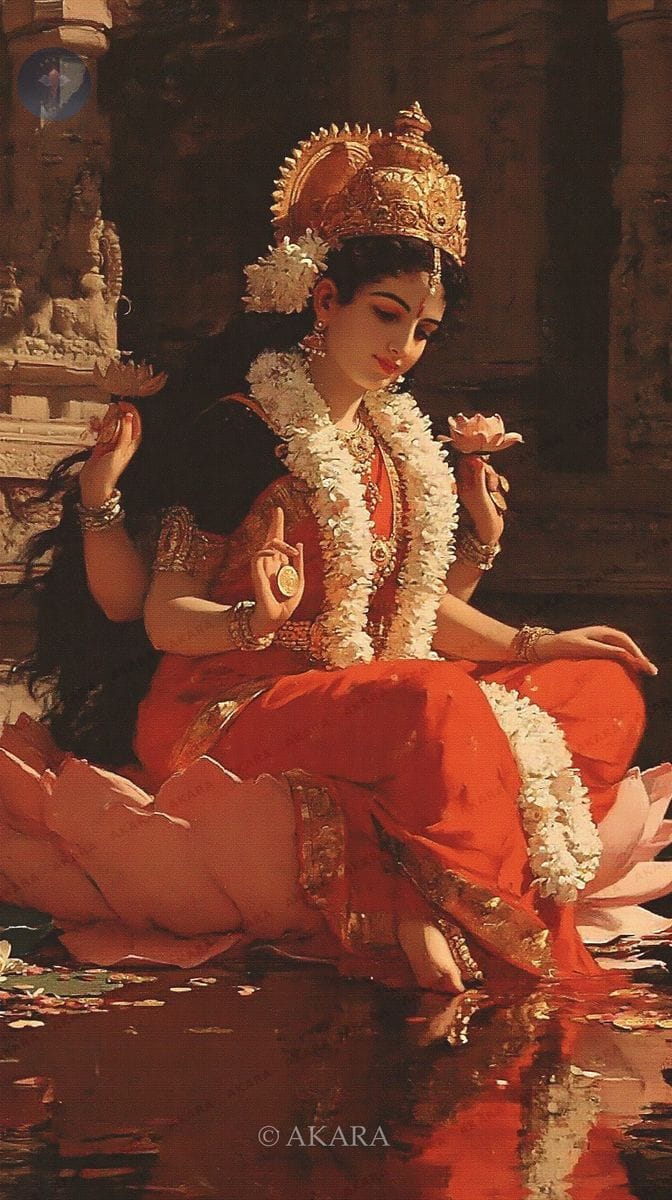
There is a moment, familiar to anyone who has stood before a Lakshmi murti at dusk, when the lamplight catches the gold of her form and something quietly shifts in the chest. It is not merely aesthetic pleasure. Tradition says that Shri herself — the radiance, the auspiciousness — is briefly, tangibly present, and the devotee instinctively knows it. This is the mystery at the heart of Lakshmi worship: she is not a distant benefactor dispensing coins from a heavenly ledger, but the living principle of abundance and grace woven into the fabric of existence itself, from the sweetness of ripe fruit to the warmth of a welcoming home to the quiet flourishing of a sincere life.
Who Is Lakshmi? The Goddess Beyond Wealth
In the language of Sanatana Dharma, Lakshmi is known by many names — Mahalakshmi, Shri, Kamala, Padmavati — each pointing to a different facet of an inexhaustible reality. The Vishnu Purana describes her as the eternal consort of Vishnu, present wherever he is, inseparable from him as sunlight is from the sun. She is Shakti in her most benevolent and sustaining form: not the fierce Shakti of transformation, but the gentle, abiding power that makes worlds livable and lives worth living.
The word Shri (श्री) itself is one of the oldest in the Vedic lexicon, appearing in the Rigveda and later celebrated in the Sri Sukta — a hymn so ancient and revered that it remains the canonical text of Lakshmi worship across virtually every Hindu tradition. Shri means radiance, auspiciousness, prosperity, and beauty simultaneously. The Goddess does not merely grant these qualities; she is them. To invoke Shri is to invoke the principle that makes existence luminous.
The Ashta Lakshmi — the eight forms of Lakshmi — elaborate this understanding beautifully. She presides over Adi Lakshmi (primordial grace), Dhana Lakshmi (material wealth), Dhanya Lakshmi (abundance of grain and nourishment), Gaja Lakshmi (power and sovereignty), Santana Lakshmi (the gift of progeny and continuity), Veera Lakshmi (courage and valor), Vidya Lakshmi (knowledge and wisdom), and Vijaya Lakshmi (victory and success). In other words, every domain of a flourishing human life falls within her embrace.
The Language of Her Form: Iconography and Its Meaning
Mahalakshmi is almost always depicted seated or standing upon a lotus, dressed in red and gold, flanked by white elephants that pour water over her — an image of royal consecration and cosmic abundance. Each element of this iconography carries precise symbolic weight.
The lotus (padma) roots itself in mud yet blooms in pristine beauty — the goddess's chosen seat signals that true prosperity arises from engagement with the world, not escape from it, while remaining untainted by it. The red garment speaks of vitality, auspiciousness, and the energy of life in full expression. The gold of her ornaments reflects not hoarding but the radiance that flows outward — Lakshmi is never depicted clutching her gifts; her palms are open.
Perhaps the most iconic gesture is the Abhaya mudra (the hand raised in reassurance,
Lakshmi is not seized; she is recognized — and she chooses. Abundance comes not to those who grasp, but to those who create conditions worthy of her presence.
या सा पद्मासना देवी पद्मवर्णा पद्मप्रिया yā sā padmāsanā devī padmavarṇā padmapriyā
She who sits on lotus, golden-hued, beloved of the sacred bloom.
Questions & answers
Why is Friday considered Lakshmi's day?
Friday (Shukravar) is governed by the planet Shukra (Venus), whose qualities of beauty, harmony, abundance, and grace closely mirror those of Goddess Lakshmi. Across most Hindu traditions, Friday is therefore the most auspicious day for Lakshmi puja and the chanting of her mantras.
What is the meaning of the Lakshmi mantra 'Om Shreem Mahalakshmiyei Namah'?
The mantra translates as: 'Om — I salute the great Lakshmi, to whom the seed-syllable Shreem belongs.' The bija (seed sound) Shreem is considered the sonic embodiment of Lakshmi herself, and chanting it with a pure heart is said to attune the practitioner to the divine principle of abundance and grace.
What are the eight forms of Ashta Lakshmi?
The Ashta Lakshmi are eight manifestations of Mahalakshmi, each governing a specific domain of flourishing: Adi Lakshmi (primordial grace), Dhana Lakshmi (material wealth), Dhanya Lakshmi (nourishment), Gaja Lakshmi (power), Santana Lakshmi (progeny and continuity), Veera Lakshmi (courage), Vidya Lakshmi (knowledge), and Vijaya Lakshmi (victory).
What is the Sri Sukta, and how is it used in worship?
The Sri Sukta is an ancient Vedic hymn from the Rigveda dedicated entirely to Goddess Lakshmi. It is considered the canonical text of Lakshmi worship and is recited during Friday puja, major festivals like Diwali, and daily home worship. It praises Shri's radiance, auspiciousness, and abundant grace.
What does the story of the Samudra Manthan teach about Lakshmi?
The churning of the cosmic ocean (Samudra Manthan) reveals that Lakshmi cannot be claimed by force — she arose freely and chose Vishnu, recognizing in him the qualities of dharma and sustaining love. The story teaches that true prosperity comes to those who cultivate worthy qualities, not to those who merely strive to possess it.