Bajrangbali: The Eternal Servant Who Conquered Every World
On this Tuesday of Krishna Navami, we enter the luminous world of Anjaneya — the one whose devotion became his very nature.
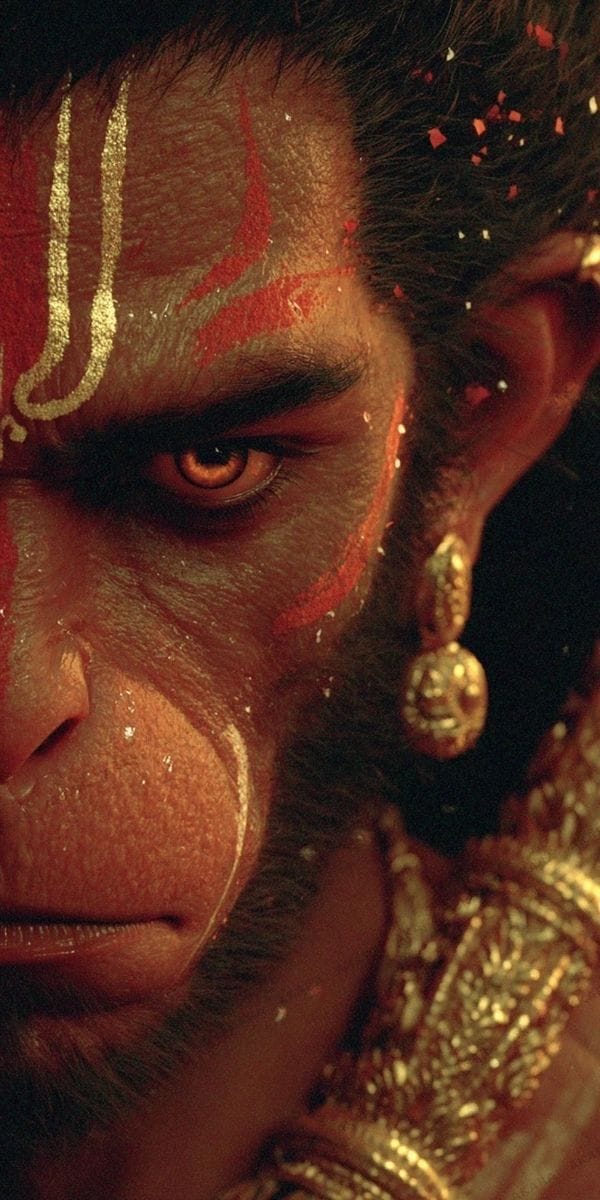
There is a moment in the Valmiki Ramayana when the sage Bharadvaja, astonished by Hanuman's eloquence, declares that no one who has not mastered the four Vedas and their subtle grammar could possibly speak as Hanuman does. Here stands the great paradox of this deity: a vanara, a forest-dweller, a being of immense and almost frightening power — yet the first and most complete exemplar of bhakti, of the love that dissolves the self entirely into the Divine. On Tuesdays across India and in temples in every corner of the world, millions fold their hands before the mace-bearing, vermilion-anointed form of Bajrangbali, and something very old and very alive stirs in the heart.
Who Is Hanuman? Roots in Scripture and Tradition
Hanuman — known also as Anjaneya (son of Anjana), Bajrangbali (one whose limbs are as hard as vajra, the thunderbolt), Pawanputra (son of the wind god Vayu), and Mahavira (the great hero) — appears in Vedic and Puranic tradition as a chiranjeevi, an immortal who remains present in this world across all ages. The Valmiki Ramayana, the Mahabharata, the Ananda Ramayana, and the Skanda Purana each contribute to his story, while Tulsidas's sixteenth-century Ramcharitmanas brought his legend into the hearts of every Hindi-speaking household through the incomparable Hanuman Chalisa.
His birth itself is attended by cosmic significance. His mother Anjana was an apsara who had taken birth as a vanara woman due to a sage's curse. His father is Vayu, the wind deity, through whom Hanuman inherits pranic force — the very life-breath of the universe. Some traditions also recognise Shiva's own essence as present within him, describing Hanuman as a partial manifestation of Rudra, which accounts for his fearlessness and his capacity to transcend all limitation.
Today's panchang places us on Krishna Navami in the nakshatra Purva Bhadrapada, whose presiding deity is Aja Ekapada — a fierce, fire-associated aspect of Rudra. This nakshatra carries within it a quality of sudden, transformative power held in check by deep inner stillness. There is no more fitting day to contemplate Hanuman, in whom storm and serenity live side by side.
The Iconography and Its Inner Meaning
Stand before any image of Lord Hanuman and you are receiving a visual teaching. His body is typically depicted with an orange-red hue — the colour of sindoor (vermilion), which he wears in remembrance of a beloved story: learning that Sita applied sindoor to her hair as a mark of her devotion and love for Rama's long life, Hanuman smeared his entire body with it, declaring that every pore of him was devoted to Rama's glory. Devotees today continue this tradition by anointing Hanuman's murti with sindoor mixed in oil.
He is shown with a muscular, powerful form — sometimes seated in reverence (as in the iconic Veer Hanuman posture), sometimes flying through the sky carrying the Dronagiri mountain, sometimes tearing open his own chest to reveal Rama and Sita enshrined within his heart. Each posture is a teaching:
- The gadā (mace) he carries is the power of dharma — strength placed in service of righteousness.
- The mountain carried aloft speaks of the capacity to undertake the impossible when love is the motive.
- The open chest is perhaps the most beloved image in all of Hindu iconography — bhakti not as sentiment but as a total restructuring of one's inner world around the Divine.
His tail, often shown raised high or coiled around him, carries its own story: the Lanka episode in which Ravana's soldiers set it ablaze, only for Hanuman to use the fire to burn Lanka itself. What was meant to humiliate became an instrument of justice — a reminder that the trials of devotees are never wasted.
Two Stories That Illuminate the Path
The Leap to Lanka. When Sita was abducted and the search seemed hopeless, it was Hanuman alone who dared the ocean. The bear chieftain Jambavan reminded him of his own forgotten powers — and this is a teaching in itself: the divine capacities within us lie dormant until a true teacher or a moment of grace awakens them. Hanuman leapt from the tip of India to Lanka in a single bound, located Sita in the Ashoka grove, and carried back the message that rekindled hope. The entire arc of the Ramayana turns on this one act of courage rooted in faith.
Carried in Every Cell. When Rama asked Hanuman what he was to him, Hanuman offered one of scripture's most profound answers: "When I think of myself as a body, I am your servant. When I think of myself as jiva (individual soul), I am your part. When I think of myself as Atman, I am You." This three-level response encapsulates the entire ladder of Hindu spiritual philosophy — karma, bhakti, and jnana — voiced by the deity who embodies all three simultaneously.
The Mantra: Om Hanumate Namah
The seed mantra Om Hanumate Namah — "I bow to Hanuman" — is among the most widely chanted in Sanatana Dharma. Simple in form, it is considered a complete invocation of his protection, strength, and grace. Tuesdays and Saturdays are regarded as especially powerful days for this mantra, and many devotees complete a dedicated japa of 108 repetitions on Tuesday mornings before eating.
The Hanuman Chalisa, composed by Tulsidas in Awadhi, functions as both a stotra (hymn of praise) and a kavach (protective shield). Its opening verse — Shri Guru Charan Saroj Raj, Nij manu mukuru sudhaari — frames the entire poem as an act of humility before the guru, a posture that Hanuman himself eternally models.
For deeper practice, the Hanuman Ashtottara Shatanamavali (108 names of Hanuman) and the Bajrang Baan are employed by devotees seeking particular protection from fear, illness, and spiritual obstacles.
Tuesday Worship: How Devotees Honour Bajrangbali Today
The day begins, in countless homes and temples, before sunrise. A clay or brass lamp is lit, sindoor is offered, and fresh marigold garlands are placed at his feet. Prasad of boondi laddoo, jaggery with chana (chickpeas), and bananas — all considered dear to him — is prepared and distributed. The chanting of the Hanuman Chalisa is the heartbeat of Tuesday devotion.
In temples, oil lamps are kept burning through the day. In Maharashtra, the tradition of Maruti temples — Hanuman by another name — means his presence is rarely more than a few streets away in any town. In South India, Anjaneya temples often observe abhishekam (ritual bathing) of the deity with panchamrita (a mixture of milk, honey, sugar, ghee, and curd), followed by a fragrant smearing of sandal paste.
For those unable to reach a temple, hindu spirituality recognises that sincere chanting, a clean space, and a lamp are sufficient. Hanuman does not ask for elaborate ritual — he asks for a heart that does not falter.
What Hanuman Asks of the Seeker
In a world that celebrates strength as dominance and celebrity as greatness, Hanuman offers a counter-vision: that true power is inseparable from humility, that the greatest force available to a human being is focused, loving service. He is the patron deity of wrestlers, soldiers, and athletes — yet his defining quality is not victory over others but mastery over the self.
"Where Rama is spoken of, there I am." — Traditional saying attributed to Hanuman
Akara's own understanding of Sanatana Dharma sees in Hanuman an inexhaustible archetype — the devoted servant who becomes, through that very devotion, more powerful than any ego-driven conqueror. To worship him is to be slowly reshaped in his image: fearless, faithful, joyful in service, and transparent as a clear window through which the light of Rama — of the Divine itself — shines unimpeded.
On this Tuesday, in the gentle hold of Purva Bhadrapada's transformative energy, let the chant rise: Om Hanumate Namah. Let it be less a petition and more a declaration — that we, too, choose the path of Anjaneya, the path of love made luminous by courage.
Where Rama is spoken of, there I am — the path of Anjaneya is love made luminous by courage.
मनोजवं मारुततुल्यवेगं जितेन्द्रियं बुद्धिमतां वरिष्ठम्। वातात्मजं वानरयूथमुख्यं श्रीरामदूतं शिरसा नमामि॥ manojavaṃ mārutatulyavegaṃ jitendriyaṃ buddhimatāṃ variṣṭham | vātātmajaṃ vānarayūthamukhyaṃ śrīrāmadūtaṃ śirasā namāmi ||
fast as thought, swift as wind, master of his senses and supreme among the wise — we bow to hanuman, son of the wind and rama's messenger.
Questions & answers
Why is Tuesday considered Hanuman's day?
Tuesday (Mangalvaar) is traditionally associated with Mars (Mangala), a planet of energy, courage, and strength — qualities that mirror Hanuman's nature. Worship on Tuesdays is believed to invoke his protection, remove fear, and grant vitality. Many temples observe special abhishekam and extended Chalisa recitations on this day.
What is the significance of offering sindoor to Hanuman?
The tradition comes from a story in the Ramayana: Hanuman, learning that Sita applied sindoor to pray for Rama's long life, smeared his entire body with it as an act of total dedication. Offering sindoor mixed in oil to Hanuman's murti today replicates this gesture and is considered especially potent for seeking his blessings and protection.
What does 'Bajrangbali' mean?
Bajrang is derived from 'vajra-anga' — meaning 'one whose limbs are as firm and brilliant as the vajra (thunderbolt)'. Bali means powerful or mighty. Together, Bajrangbali means 'the mighty one with limbs of diamond' — a name that honours both his physical invincibility and his indestructible devotion.
How should a beginner begin worshipping Hanuman at home?
Begin simply: light a lamp (ghee or sesame oil is ideal) before his image or murti on Tuesday morning, offer a marigold or red flower, and chant the Hanuman Chalisa once or the mantra Om Hanumate Namah 108 times. Offering a little jaggery and roasted chickpeas as prasad is traditional. Consistency and a sincere heart matter far more than elaborate arrangements.
Is Hanuman considered an avatar of Shiva?
Several Puranic traditions, including the Shiva Purana and certain Shakta texts, describe Hanuman as a manifestation or partial avatar of Rudra (a fierce form of Shiva). This is why he is sometimes worshipped with Shaiva rituals. However, in the Vaishnava tradition of the Ramayana, he is primarily understood as the supreme devotee of Vishnu's avatar Rama — the two understandings are considered complementary rather than contradictory.