Bajrangbali: The Eternal Servant Who Carries the Whole World
On a Saturday touched by Pradosh and the nakshatra of Krittika, we turn to the one whose very name is a mantra — the invincible, the ever-devoted Bajrangbali.
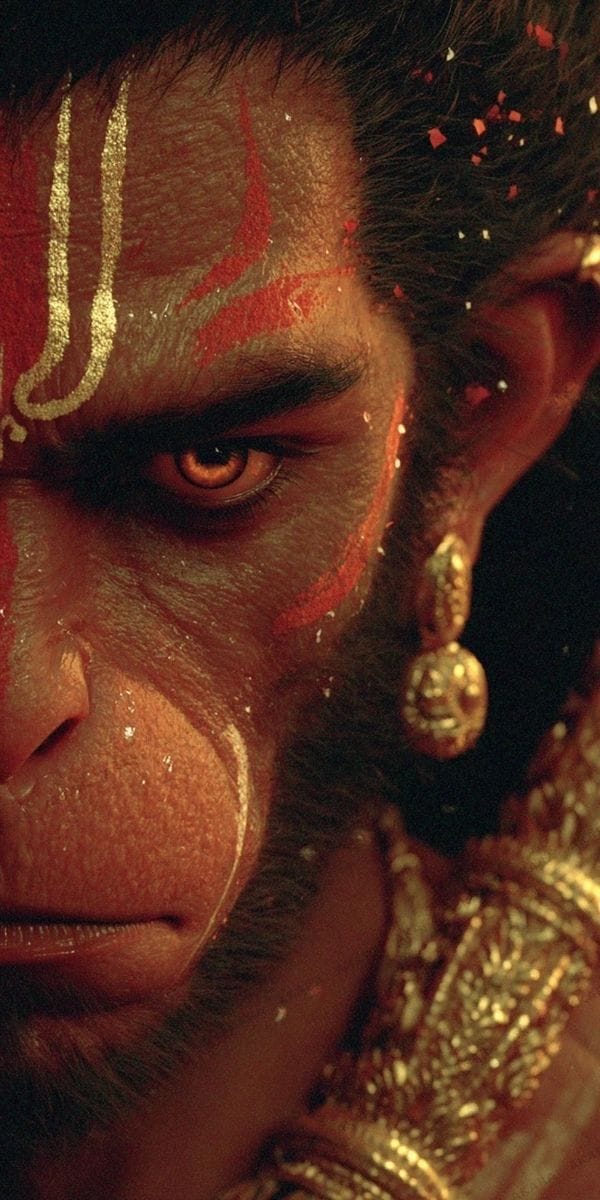
There is a figure in Sanatana Dharma who stands at the threshold of every temple dedicated to Rama — arms folded, eyes bright with devotion, body radiant with an inner fire that no ocean of obstacles can extinguish. He is Hanuman: son of the wind, student of the sun, servant of Rama, and for millions of seekers across centuries, the single most accessible face of divine grace. To invoke his name is already to feel something shift — a steadying, a brightening, as though the very air becomes more alive.
Who Is Hanuman? The Many Names of the Infinite One
Hanuman is known by 108 names, each illuminating a different facet of his glory. Anjaneya — son of Anjana — roots him in a mother's love and a hermit's grace. Bajrangbali — from vajra-anga, the one whose limbs are as hard as the thunderbolt diamond — proclaims his indestructible strength. Mahavira, the great hero. Pavanputra, son of Pavana, the wind deity, whose speed and subtlety he inherits. Sankat Mochan, the one who relieves distress. Each name is not merely a label but a doorway: chanting any one of them is said to open a particular quality of divine energy within the devotee.
Hanuman belongs, in the taxonomy of Sanatana Dharma, to a category all his own. He is a chiranjeevi — one of the immortal beings who remain present in this world through all ages — and simultaneously the supreme exemplar of bhakti, selfless devotion. The Valmiki Ramayana, one of the oldest and most sacred of Hindu scriptures, introduces him as a being of matchless intelligence, eloquence, and spiritual power. Yet he uses none of these qualities for personal glory. Every gift is placed entirely in the service of Rama.
Iconography and Its Meaning
The traditional image of Hanuman is a treasury of symbolic meaning. He is depicted as a vanara — often translated as monkey, though the Puranas describe the vanaras as a divine, semi-human race — with a powerful, muscular form that conveys both the animal kingdom's vitality and the yogi's discipline.
His right hand is raised in abhaya mudra, the gesture of fearlessness: do not be afraid, I am here. In many images the left hand carries a gada (mace) or a mountain — specifically the Dronagiri mountain peak he is said to have lifted bodily to save Lakshmana's life. His tail, often depicted curling magnificently above him, represents kundalini shakti in some tantric readings — primal energy that has been fully mastered and uplifted. He wears a yajnopavita (sacred thread), marking him as a brahmacharya (one established in celibacy and sacred learning), and a garland of red sindoora flowers.
The sindoora — vermilion — deserves special mention. The Ramayana tells us that when Hanuman saw Sita applying sindoora to her hair as a mark of her love for Rama, he asked its significance. On learning it prolonged Rama's life and preserved their union, Hanuman immediately covered his entire body in sindoora out of sheer love for his lord. To this day, devotees apply sindoora to Hanuman's murti and receive it back as prasada, a blessing saturated with that same fierce, tender devotion.
Two Stories That Reveal a Soul
The Sundara Kanda, the fifth book of the Valmiki Ramayana, is often called Hanuman's own kanda — a book of such beauty and power that many devotees recite it as a complete spiritual practice. Here Hanuman leaps across the ocean to Lanka, alone and in the dark, carrying only Rama's name and his own boundless faith. When he finds Sita imprisoned in the Ashoka grove, he does not rush. He observes, he waits, he speaks with infinite care and gentleness, ensuring she is not frightened. Every action is calibrated — fierce when it must be, tender when it must be. This balance of shakti (power) and karuna (compassion) is the deepest teaching of the Sundara Kanda.
The second story is subtler. When the war is won and Rama is restored to Ayodhya, Sita gifts Hanuman a beautiful pearl necklace as a reward. Hanuman accepts it, examines each pearl carefully, then begins breaking them open one by one. The assembled court is astonished. Why? "I am searching for Rama in each pearl," he replies quietly. "What I cannot find Rama in, I have no use for." When someone points out that his own body then must be useless too, Hanuman tears open his chest — and there, within, is Rama and Sita, shining in his heart. This is not mythology for children. It is a precise description of the state of prema bhakti — love-devotion so complete that the beloved permeates every cell of one's being.
The Mantra: Om Hanumate Namah
The seed mantra Om Hanumate Namah — "I bow to Hanuman" — is among the most practised mantras in Hindu spirituality. Hanumate is the dative case of Hanuman's name, carrying the feeling of offering oneself toward him entirely. Tradition recommends chanting it 108 times, especially on Saturdays, using a rudraksha or coral mala. The Hanuman Chalisa, composed by the saint-poet Tulsidas in the 16th century in Awadhi Hindi, remains perhaps the most universally beloved devotional hymn in the world — forty verses that serve simultaneously as biography, mantra, and prayer.
For those beginning a practice, even a single sincere recitation of the Chalisa at dusk on a Saturday — the traditional vaar devata of Hanuman — is considered immensely auspicious. Today, with the tithi of Krishna Trayodashi and Pradosh Vrat also present at dusk, the moment carries a double sanctity: both Hanuman and Shiva, who himself reveres Hanuman as a supreme devotee, are honoured in the same twilight hour.
Saturday Worship: How Devotees Approach Hanuman Today
A traditional Saturday Hanuman puja is simple and deeply personal. The devotee bathes, dresses cleanly, and approaches the murti or image with a lit lamp (deepa) and incense. Offerings of sindoora, jasmine or red flowers, besan ke ladoo (gram flour sweets), and a handful of tulsi leaves are placed with love. The Hanuman Chalisa is recited, followed by the mantra. Many devotees also read from the Sundara Kanda on this day.
In the spirit of the Akara tradition — where devotion flows not only through ritual but through art, music, and the beauty of sacred imagery — there is wisdom in spending a few quiet minutes before a beautiful image of Hanuman, allowing the mind to settle and the heart to open. The darshan itself — the act of beholding the divine image and being beheld by it — is considered a form of worship.
What Hanuman Asks of the Seeker
Hanuman asks very little and gives everything. He asks for sincerity over sophistication, presence over performance. He asks that you show up — with your fear, your confusion, your tiredness, your longing — and simply call his name. The promise embedded in the last verses of the Hanuman Chalisa is remarkable in its directness: Jo yeh padhe Hanuman Chalisa, hoy siddhi sakhi Gaureesa — "Whoever recites this Chalisa, attains perfection, as Gauri's lord (Shiva) is witness."
But perhaps the deepest invitation Hanuman extends is this: to discover, as he did, that strength and surrender are not opposites. The most powerful being in the Ramayana chose to place every ounce of that power in service of something greater than himself. In doing so, he became not diminished but infinite. This is the paradox at the heart of bhakti — and it is as alive and necessary today as it was when Valmiki first set it down in verse.
Sankat kate mite sab peera — jo sumirai Hanumat Balbeera. "All distress is cut away, all pain dissolved — for one who remembers mighty Hanuman."
May this Saturday be blessed.
The most powerful being in the Ramayana chose to place every ounce of that power in service of something greater than himself. In doing so, he became not diminished but infinite.
मनोजवं मारुततुल्यवेगं जितेन्द्रियं बुद्धिमतां वरिष्ठम्। वातात्मजं वानरयूथमुख्यं श्रीरामदूतं शिरसा नमामि॥ manojavaṃ mārutatulyavegaṃ jitendriyaṃ buddhimatāṃ variṣṭham | vātātmajaṃ vānarayūthamukhyaṃ śrīrāmadūtaṃ śirasā namāmi ||
fast as thought, swift as wind, master of his senses and supreme among the wise — we bow to hanuman, son of the wind and rama's messenger.
Questions & answers
Why is Saturday considered Hanuman's day?
In Sanatana Dharma, each day of the week is presided over by a particular deity or planetary energy — this is called the vaar devata. Saturday (Shanivar) is sacred to both Shani (Saturn) and Hanuman. Tradition holds that devotion to Hanuman on Saturdays helps mitigate the difficult transits of Shani and attracts protection and strength. Many temples see their highest attendance on Saturday mornings for this reason.
What is the significance of sindoora in Hanuman worship?
Sindoora (vermilion) is closely associated with Hanuman because of the story in the Ramayana where he covers his entire body with sindoora out of love for Rama, having learned it prolonged Rama's life. Devotees apply sindoora to Hanuman's murti as an act of devotion, and receiving it back as prasada is considered a special blessing carrying the energy of that intense, selfless love.
What is the Hanuman Chalisa and why is it recited so widely?
The Hanuman Chalisa is a forty-verse devotional hymn composed by the saint-poet Tulsidas in the 16th century in the Awadhi dialect of Hindi. It covers Hanuman's qualities, his feats in the Ramayana, and culminates in a blessing for the devotee. It is recited by millions daily because it functions simultaneously as biography, mantra, and prayer — and because Tulsidas himself promised that its sincere recitation grants protection, clarity, and ultimately liberation.
Is Hanuman considered a god or a devotee in Hindu tradition?
He is both — and this is precisely what makes him unique. Hanuman is a divine being of immense shakti (power), worshipped as a deity in his own right across India and wherever Hindu traditions flourish. At the same time, he is the supreme exemplar of bhakti, the devoted servant of Rama. In theological terms, he embodies the ideal that the highest spiritual attainment is not to become God, but to love God completely.
How does today's Pradosh Vrat connect with Hanuman's Saturday?
Pradosh Vrat falls on the thirteenth tithi (Trayodashi) at dusk and is primarily a Shaiva observance — honouring Shiva and Parvati in the twilight hour. When Pradosh falls on a Saturday, it is called Shani Pradosh and carries heightened significance. Since Shiva himself is said to revere Hanuman as a supreme devotee, and since Saturday is already Hanuman's vaar, the convergence of both observances on the same evening creates a rare auspicious moment for devotees of both traditions to worship together.