Ganesha: The Elephant-Headed Lord Who Clears Every Path
On this Wednesday, the day Sanatana Dharma dedicates to Ganapati, we turn toward the one who stands at every threshold — and learn why he is there.
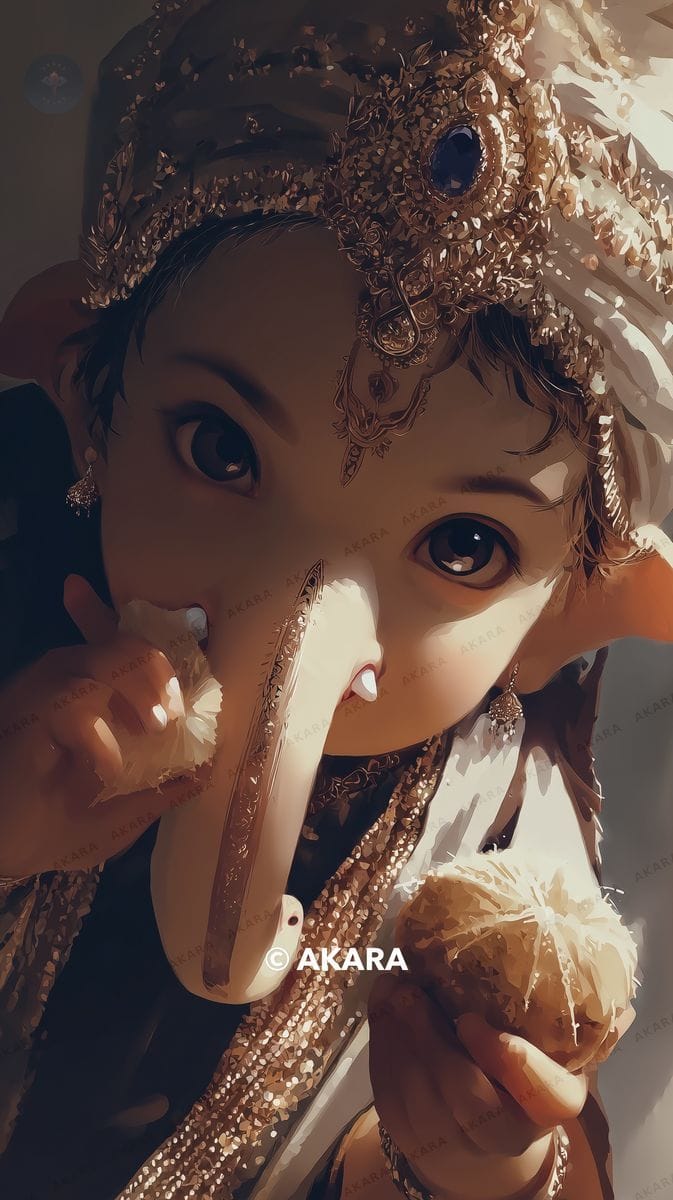
Before a journey begins, before a word is written, before a prayer is offered to any other deity, tradition asks the seeker to pause at the feet of Ganesha. He is Vighneshvara, the Lord of Obstacles — not merely their remover, but their very master, the one who decides which door opens and when. In temples from the Himalayas to Tamil Nadu, in homes from Mumbai to Melbourne, the first lamp of every auspicious undertaking is lit before his murti. This Wednesday, falling on Shukla Tritiya with the moon in Punarvasu nakshatra and Yoga Dhruva lending stability to the day, is an especially auspicious moment to sit with Ganapati and understand what, exactly, this remarkable deity is asking of us.
Who Is Ganesha? Origins in Scripture and Tradition
Ganesha — also worshipped as Ganapati, Ganesh, Vinayaka, Heramba, and by a hundred other names — is among the most beloved figures in Sanatana Dharma. His origins are sung across the Puranas, with the Shiva Purana, Skanda Purana, and Ganesha Purana each offering rich accounts. The most widely known narrative tells of Goddess Parvati, longing for a devoted attendant of her own, fashioning a child from the turmeric paste she was preparing for her bath, breathing life into him, and posting him as guardian at her door. When Shiva arrived and was refused entry by this unknown boy, a confrontation arose. In his divine wrath, Shiva severed the child's head — and then, recognising the grief of Parvati and the sanctity of the moment, replaced it with the head of the first creature found sleeping with its face to the north: an elephant.
This is not a story of violence. It is a story of transformation. The elephant head, arriving at the intersection of destruction and restoration, becomes the very emblem of wisdom, memory, and the capacity to carry immense burdens without being crushed by them. The name Ganapati itself — from the Sanskrit gana (group, assembly) and pati (lord) — tells us he is the leader of Shiva's celestial attendants, the one who governs order within multiplicity.
The Iconography: A Philosophy Encoded in Form
Every detail of Ganesha's form is a teaching. Hindu spiritual tradition understands the murti not as a mere statue but as a yantra made visible — a form designed to transmit understanding through sight itself.
- The elephant head signifies incomparable wisdom (mati), the capacity to see what is subtle, and the power to break through the forest of ignorance.
- The large ears tell us that the true seeker must learn to listen deeply — to scripture, to the guru, to the still voice within.
- The small eyes invite concentration; Ganesha sees precisely, not broadly.
- The one broken tusk — he is also called Ekadanta, the single-tusked — speaks of sacrifice. According to the Brahmanda Purana, Ganesha broke his own tusk to use as a stylus to transcribe the Mahabharata as dictated by the sage Vyasa, pausing not a single moment. Wisdom, this tells us, sometimes costs us something.
- The large belly (lambodara) contains the entire universe. All experiences — pleasant and painful — are digested here with equanimity.
- **The modaka** (sweet dumpling) held in one hand is the reward of spiritual effort: ananda, bliss.
- The mouse (Mushika) at his feet is his vahana, his vehicle. The mouse, who can slip through every crack, represents the restless mind. That such a small creature carries such a vast lord is itself the lesson: the seeker must not let the mind run unchecked; instead, it is made the vehicle of the divine.
- The four arms traditionally carry the ankusha (goad, to prod the seeker forward), the pasha (noose, to restrain the passions), the broken tusk, and the modaka — an elegant grammar of the spiritual path.
The Story of the Moon and the Lesson of Humility
One of the most charming stories associated with Ganesha involves the moon, Chandra. On Ganesh Chaturthi — his great annual festival — Chandra laughed at Ganesha when he fell from Mushika, belly and modakas tumbling across the ground. Incensed, Ganesha cursed the moon: anyone who gazes at Chandra that night shall be falsely accused. This is why, even today, devout Hindus avoid looking at the moon on Ganesh Chaturthi evening.
The story carries more than its surface charm. Chandra's laughter was the laughter of the ego that cannot resist mockery, that sees the divine in a moment of apparent undignity and judges it as comic. Ganesha's response — the curse — is a reminder that appearances deceive. The lord who rolls in the mud remains the lord.
Om Gam Ganapataye Namah: The Mantra and Its Power
The mantra most widely offered to Ganapati is:
Om Gam Ganapataye Namah
Broken into its parts: Om is the pranava, the primordial sound; Gam is the bija (seed syllable) of Ganesha, said to activate his presence directly; Ganapataye is the dative case of Ganapati —
Ganesha does not promise a frictionless life. He offers clarity about which obstacles are genuinely in the way — and which are placed there by our own fear.
वक्रतुण्ड महाकाय सूर्यकोटि समप्रभ। निर्विघ्नं कुरु मे देव सर्वकार्येषु सर्वदा॥ vakratuṇḍa mahākāya sūryakoṭi samaprabha nirvighnaṃ kuru me deva sarvakāryeṣu sarvadā
O elephant-faced one, with a massive form radiant as millions of suns, remove all obstacles in all my endeavors, always.
Questions & answers
Why is Wednesday considered Ganesha's day?
In the Hindu tradition of *vaar devata* — the presiding deity of each weekday — Wednesday (Budhvara) is associated with Ganesha. Devotees consider it especially auspicious to begin new projects, chant the Ganesha mantra, and perform puja on Wednesdays.
What is the meaning of Om Gam Ganapataye Namah?
This is the primary mantra of Ganesha. 'Om' is the universal primordial sound; 'Gam' is the bija or seed syllable of Ganesha; 'Ganapataye' means 'to Ganapati, the lord of all assemblies'; and 'Namah' is a reverential salutation. Together it means: 'I bow to Ganapati.' It is traditionally chanted 108 times, ideally on Wednesdays.
Why does Ganesha have an elephant head?
According to the Shiva Purana, Ganesha was created by Goddess Parvati and later had his original head replaced by Shiva with that of an elephant — the first creature found sleeping with its face to the north. The elephant head symbolises supreme wisdom, keen memory, and the power to overcome any obstruction.
What is the significance of the mouse (Mushika) as Ganesha's vehicle?
The mouse represents the restless, nibbling mind that creeps into every corner. That such a small creature serves as the vehicle of the vast-bellied lord is a teaching: the spiritual practitioner must tame and redirect the mind rather than suppress it, making it a vehicle for the divine rather than a source of distraction.
Can anyone worship Ganesha, or is it tradition-specific?
Ganesha is worshipped across virtually all streams of Hinduism and is considered a universal figure of auspicious beginnings. The Ganapati Atharvashirsha even identifies him with Brahman, the supreme reality. His worship requires no elaborate initiation — a sincere heart, a simple offering, and the mantra are considered fully sufficient.