The Meaning of Om (Aum): The Primordial Sound Explained
From the Mandukya Upanishad to the morning prayer, Om is not merely a word — it is the sound from which all existence unfolds.
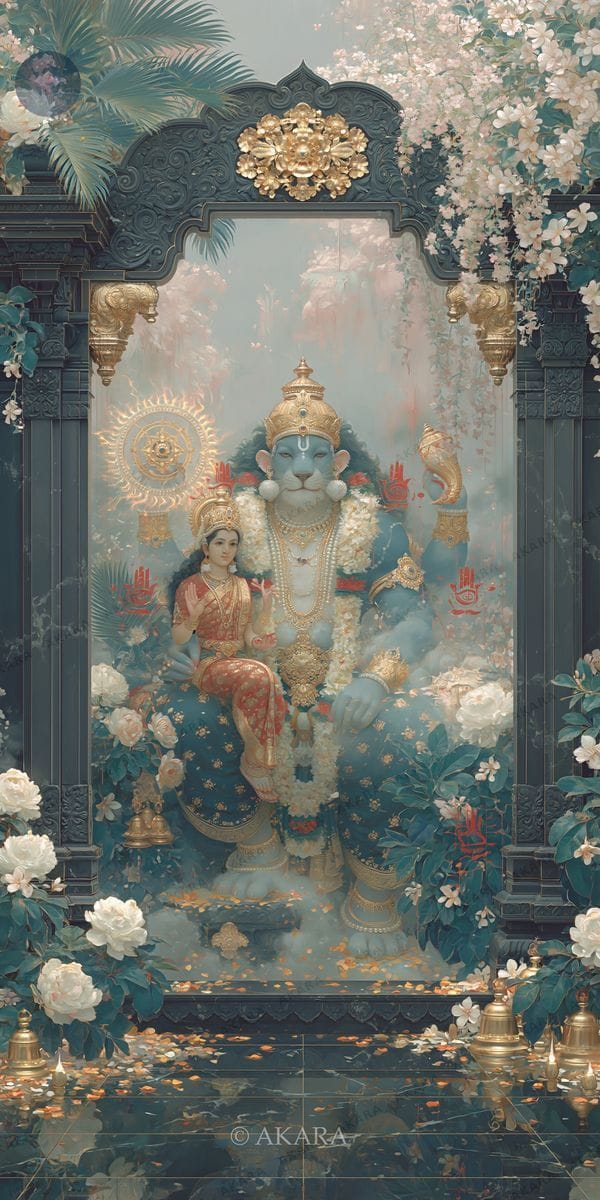
Before the first star ignited and before the first word was spoken, there was a vibration. The Vedic seers, in the stillness of deep meditation, heard it — a resonance that underlies all that is, all that was, and all that will be. They named it Om, or more precisely in its full form, Aum. Across thousands of years and every lineage of Sanatana Dharma, this single syllable has remained the most sacred of all utterances — the pranava, the primordial sound — and understanding it opens a door not merely to intellectual knowledge, but to direct experience of the divine.
What Does Om Actually Mean? The Root of the Word
The Sanskrit syllable Om (ॐ) is called the pranava — from the root pra-nu, meaning 'to resound' or 'to reverberate.' Some scholars derive it alternatively from ava, meaning 'to protect' or 'to sound.' Either etymology points to the same truth: Om is not a word that means something about reality; it is held to be reality itself in sonic form.
In the Vedic tradition, Om is placed at the beginning and end of every scripture, every prayer, and every ritual. The Taittiriya Upanishad declares: "Om iti Brahman — Om is Brahman." Brahman here is not a personal deity but the ultimate ground of being, the infinite, self-luminous consciousness from which all phenomena arise. When a devotee chants Om, she is, in the understanding of the sages, not addressing something outside herself — she is recognising the very nature of existence.
The Three-and-a-Half Syllables: A, U, M and the Silence
The written form Aum — which is the same as Om, differing only in transliteration convention — reveals a crucial structure. The Mandukya Upanishad, one of the shortest and most profound of the Upanishads, dedicates its entire twelve verses to unpacking Aum. It tells us that this syllable is composed of three matras (measures or syllables) plus a fourth:
- A (अ) — pronounced from the open throat, the most fundamental of all sounds. It corresponds to jagrat, the waking state, and to Brahma, the principle of creation. Notably, akara — the letter A — is considered the seed of the Sanskrit alphabet itself; the Bhagavad Gita (10.33) has Krishna say, "Aksharanam akaro'smi" — "Among letters I am the letter A."
- U (उ) — formed as the sound rolls forward across the tongue. It corresponds to svapna, the dreaming state, and to Vishnu, the principle of sustenance. The U also suggests elevation, the movement from gross to subtle.
- M (म) — the lips close. This is sushupti, the deep dreamless sleep, the state of pure potential, associated with Shiva or Rudra, the principle of dissolution and renewal.
- The Silence after M — the Mandukya calls this the turiya, the 'fourth,' which is neither waking, dreaming, nor sleeping. It is pure awareness, undivided consciousness. No syllable can fully capture it; the silence after the chant is itself the teaching.
This is why scholars and practitioners both insist that Om is not complete when the voice falls silent — the real chant continues inwardly.
The Om Symbol: Reading the Sacred Geometry
The visual form of Om (ॐ) is as rich as its sound. The symbol contains several curves, a crescent, and a dot (bindu):
- The large lower curve represents the waking state (A).
- The upper curve represents deep sleep (M).
- The middle curve (curling out from the centre) represents the dream state (U).
- The crescent (nada) represents maya, the veil of illusion — that which obscures our recognition of the absolute.
- The dot (bindu) represents the turiya, the transcendent fourth state, pure consciousness resting above the three ordinary states and the veil.
When you see the Om symbol on a temple wall, a Akara devotional wallpaper, or a mala bag, you are looking at an entire cosmology compressed into a single glyph.
Scriptural Authority: What the Texts Say
The authority of Om in Sanatana Dharma is comprehensive across shruti (revealed scripture) and smriti (remembered tradition):
"Tasya vachakah pranavah" — "The designator of Ishvara is the pranava Om." — Patanjali, Yoga Sutras 1.27
Patanjali goes further, instructing in sutra 1.28 that one should repeat Om (taj-japas) and meditate on its meaning — a practice that leads to inward-turning awareness and the removal of obstacles.
The Bhagavad Gita (17.23) places Om alongside Tat and Sat as the triple designation of Brahman. The Katha Upanishad describes Om as the supreme goal that all the Vedas declare, that all austerities aim at. In the Chandogya Upanishad, the udgitha — the chant at the heart of the Sama Veda — is identified with Om.
This convergence across texts separated by centuries is not coincidence. The seers were pointing, independently and collectively, to the same living reality.
Living Practice: How to Work With Om Today
Understanding Om intellectually is the beginning. The tradition holds that the syllable must be practiced to be known. Here are several ways that seekers in every walk of life engage with it:
Japa (repetitive chanting): Sitting quietly, spine upright, eyes softly closed — begin with three long, unhurried chants of Aum aloud, then continue internally. Feel the A opening the chest, the U lifting the awareness, the M settling into stillness. Rest in the silence.
Nada upasana (worship through sound): Advanced practitioners listen to Om rather than only chanting it. In deep states of meditation, the inner sound — the anahata nada, the unstruck sound — becomes perceptible. This is Om as cosmic background, available always.
At the start and close of practice: Every Vedic recitation, every yoga session in the classical sense, every puja begins and ends with Om. This is not ritual formality — it is a reminder that whatever follows is situated within the infinite.
As bhakti (devotion): For the devotee, chanting Om with love and surrender is itself a complete act of worship. The pranava contains every deity's name implicitly; it is the undivided name of the divine before any particular form arises.
In the spirit of Akara — which means the sacred letter A, the first and most fundamental sound — engaging with Om is an act of returning to the origin of all things.
A Reflection
On a morning when Nakshatra Vishakha illuminates the sky and Yoga Siddha graces the panchang, it is auspicious to remember that the universe itself is not ultimately silent. The ancient rishis did not speculate about Om — they heard it. Modern physics, in its own language, speaks of quantum fields vibrating at every point of space; cosmologists study the 'echo' of the Big Bang still resonating in the cosmic microwave background. The language differs entirely; the intuition converges. Whether you approach Om as theology, philosophy, or simply as a tool for gathering the scattered mind, its invitation is the same: pause, listen, and recognise what has always been here. That recognition — however brief, however partial — is the beginning of everything the tradition calls liberation.
Om is not a word that means something about reality — it is held to be reality itself in sonic form.
शुक्लाम्बरधरं विष्णुं शशिवर्णं चतुर्भुजम्। प्रसन्नवदनं ध्यायेत् सर्वविघ्नोपशान्तये॥ Shuklambara-dharam Vishnum shashi-varnam chatur-bhujam. Prasanna-vadanam dhyayet sarva-vighno-pasantaye.
Meditate on Vishnu, clad in white, of moon-like complexion, with four arms and a serene face — for the removal of all obstacles.
Questions & answers
What is the difference between Om and Aum?
There is no difference in meaning — both refer to the same sacred syllable. 'Aum' is a more phonetically precise transliteration that shows the three constituent sounds (A, U, M), while 'Om' is the common conventional spelling used in English. In Devanagari script, both are written as ॐ.
Which scripture first mentions Om?
Om appears in the Rigveda, the oldest of the Vedic texts. It is expounded most fully in the Mandukya Upanishad, which is devoted entirely to unpacking the four states of consciousness contained within its three syllables and the following silence. The Katha Upanishad, Chandogya Upanishad, and Bhagavad Gita also give it central importance.
How should a beginner chant Om?
Sit comfortably with the spine upright. Take a full breath in. On the exhale, shape the mouth open and sound 'Aaa,' let it close to 'Uuu,' then seal the lips for 'Mmm,' feeling the vibration in the skull. Rest in the natural silence before the next breath. Three to eleven repetitions at the start of any meditation or prayer is the traditional recommendation.
Why is Om placed at the beginning of all mantras and prayers?
Because Om is the pranava — the primordial sound from which all other sounds and meanings arise. Placing it at the start consecrates whatever follows, situating the prayer within the infinite ground of being. The Taittiriya Upanishad instructs students to precede and follow all Vedic recitation with Om to ensure its completeness and protection.
Is Om specific to Hinduism, or is it found elsewhere?
The pranava Om is rooted in the Vedic tradition of Sanatana Dharma. Related sounds — the Tibetan Buddhist 'Om mani padme hum,' the Jain 'Om' (a condensation of the five supreme beings), and even the speculative connection to the Christian 'Amen' and Hebrew 'Amen' — suggest that ancient cultures intuited a sacred primordial sound. However, the systematic philosophy of Om as Brahman, as elaborated in the Upanishads and Yoga Sutras, belongs distinctively to the Vedic-Hindu tradition.