Mahadeva: Understanding Shiva, the Auspicious Lord of All
On Shiva's own day, we enter the mystery of the one who destroys only to liberate — the great Mahadeva who holds the cosmos in stillness.
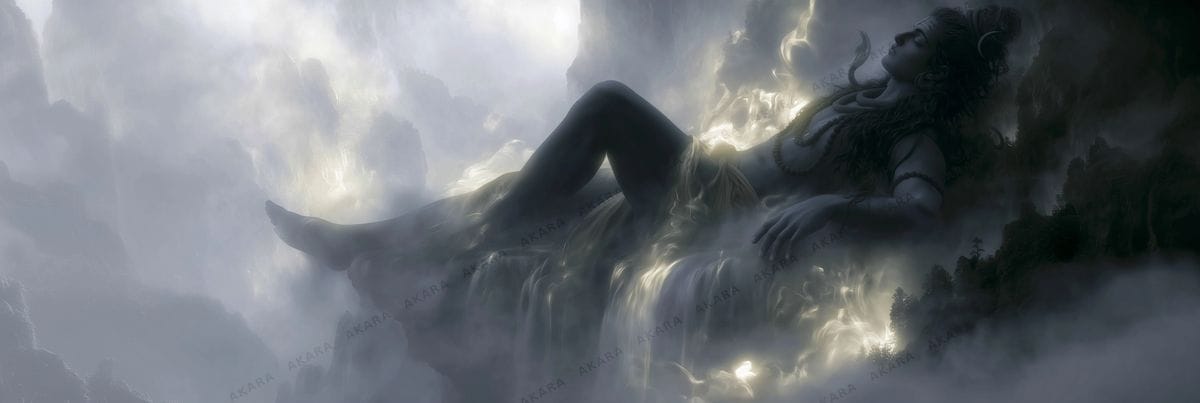
There is a moment just before dawn, when the world has not yet decided to be anything in particular, that belongs to Shiva. The temples are still dark, the priest's footsteps echo on cold stone, and the air carries the faint sweetness of bel leaves and camphor. In that liminal pause — neither night nor morning, neither form nor formlessness — Mahadeva is most himself. Monday, known in the Vedic tradition as Somavar, is consecrated to him: the day of Soma, the moon he wears as a crown, the day when countless devotees across the world offer water, milk, and the quiet prayer of their attention to the lingam and say, simply, Om Namah Shivaya.
Who Is Shiva? The Paradox at the Heart of Sanatana Dharma
Shiva defies easy categorisation, which is precisely the point. He is simultaneously Mahakala, the lord of time who swallows all things, and Shankara, the benevolent giver of peace. He is the ascetic who burns desire in his third eye, and the devoted husband whose love for Parvati is one of the great love stories in all of scripture. He is the dancer Nataraja, whose cosmic anandatandava — the dance of bliss — both creates and destroys universes, and he is also the yogi seated unmoving on Mount Kailasa in eternal samadhi.
The Shiva Purana describes him as svayambhu — self-arising, without origin or end. He is one of the Trimurti, the three great cosmic functions of Brahma (creation), Vishnu (sustenance), and Shiva (dissolution). Yet the Shaiva traditions — and indeed many of the broader currents of Hindu spirituality — do not see him merely as the "destroyer" in some catastrophic sense. His dissolution is moksha-kara: the one who makes liberation possible. He does not end things out of anger; he returns them to their source.
To be a devotee of Shiva, a Shaiva, is to sit with that paradox and let it teach you.
Reading the Iconography: A Theology Written in Form
Every element of Shiva's iconography is a teaching. The Shiva Purana and the Linga Purana offer extended explanations; here are a few to contemplate today.
- The third eye (trinetram): Located at the ajna chakra, the seat of higher perception. It opens not to destroy the world, but to burn away maya — illusion — and with it, the ego that mistakes the temporary for the eternal.
- The crescent moon (chandrakala): Worn in his matted hair, it represents time measured and contained. The moon also signifies Soma, the nectar of immortality, suggesting that even time, when held by Shiva, becomes the ground of bliss rather than anxiety.
- The Ganga flowing from his locks: The Devi Bhagavata narrates how the celestial river Ganga descended from the heavens with a force that would have shattered the earth. Shiva caught her in his hair, releasing her gently — a gesture of profound compassion. He absorbs what would overwhelm others.
- The trishula (trident): Three prongs for the three gunas — tamas, rajas, and sattva — held in one steady hand. He transcends all three even while governing them.
- Nandi, the sacred bull: Seated always at Shiva's threshold, Nandi is dharma made visible, and also the quality of absolute attentiveness. He faces Shiva always. The devotee is invited to be like Nandi: turned toward the divine with undivided gaze.
- The lingam: Perhaps the most misunderstood symbol in all of Hindu spirituality. The Shiva Purana is explicit: the lingam is the formless made approachable — stambha, the infinite pillar of light and consciousness, without beginning or end. The Jyotirlinga shrines across India mark sites where Shiva appeared as this pillar of pure light.
Two Stories That Open the Heart
Shiva and the Poison of the Churning (Halahala): When the gods and demons churned the cosmic ocean (Samudra Manthan) in search of amrita — the nectar of immortality — what rose first was not nectar but halahala, a poison so virulent it threatened to annihilate all creation. The gods fell back in despair. It was Shiva alone who stepped forward, took the poison into his hands, and drank it. Parvati, seated beside him, clasped his throat so the poison would not reach his heart. It lodged in his throat, turning it blue-black — hence his name Neelakantha, the blue-throated one.
This story has been read across centuries as an image of what true strength looks like: not domination, but the willingness to absorb the world's suffering so others may flourish. Neelakantha holds what cannot be held, so that the rest of existence may continue toward the light.
Markandeya and the Grace of Mahadeva: The sage Markandeya was destined to die at sixteen. When Yama, the lord of death, came to claim him, Markandeya clung to the Shivalingam in the temple, chanting Shiva's name with every breath. Shiva burst forth from the lingam and drove Yama back with his trishula, declaring Markandeya beyond the reach of death — mrityunjaya, conqueror of death. This is also the inner meaning of the Mahamrityunjaya Mantra (Om Tryambakam Yajamahe...): not a charm against physical dying, but an invocation of the consciousness that sees through the illusion of death entirely.
Om Namah Shivaya: The Pancha-Akshara Mantra
Of all the mantras associated with Shiva, none is more central to daily bhakti than the Panchakshara — the five-syllable mantra: Na-Ma-Shi-Va-Ya (preceded by the pranava Om). Each syllable corresponds to one of the five elements (pancha bhuta): Na to earth (prithvi), Ma to water (jala), Shi to fire (agni), Va to air (vayu), Ya to ether (akasha). To chant Om Namah Shivaya is, in a very literal sense, to bring one's whole elemental being into alignment with Shiva — to say: I offer all five elements of which I am made back to their source.
The mantra appears in the Shri Rudram, one of the oldest hymns of the Krishna Yajurveda, in the eighth anuvaka. Its sound has been continuous for thousands of years, chanted in temples from Varanasi to Tamil Nadu to Bali. On Monday mornings, as Somavar begins, it rises again — in homes, at ghats, in tiny roadside shrines — threading the present moment into something very ancient and very alive.
Worship on Monday: Simple, Sincere, Sufficient
Shiva's worship (puja) does not demand elaborate preparation. The tradition is emphatic on this: Shiva is Ashutosh — the easily pleased. Bel leaves (bilva patra), raw milk, water from a sacred river or simply clean water, a stick of dhoop, and an open heart are the classical offering.
The Shiva Purana prescribes the Abhisheka — the ritual bathing of the lingam — with milk, honey, ghee, yogurt, and water, each carrying a specific intention: milk for purity, honey for sweetness of speech, ghee for prosperity, yogurt for joy, water for clarity. But even a single bel leaf placed with sincerity, the texts say, carries the weight of a hundred elaborate rites when offered from a genuinely stilled mind.
Today's panchang is auspicious in its own way: Yoga Saubhagya — the yoga of good fortune — attends this Monday. Purva Bhadrapada nakshatra in its third pada carries a quality of transformation and inner fire that resonates with Shiva's nature. It is a good day to sit a little longer, to let the mantra settle past the restless mind.
What Shiva Asks of the Seeker
Every deity in the Sanatana Dharma tradition holds up a particular mirror to the devotee. Shiva's mirror is perhaps the most demanding — and the most generous. He asks you to look at what you are clinging to, what you are afraid to release. His dance destroys forms, yes — but only the forms that have become cages. The ego's constructions, the grief that has hardened into identity, the certainty that has become dogma: these are what Nataraja's foot touches as he dances.
And then — and this is the grace of Mahadeva that the tradition returns to again and again — he is also the one who remains. After all dissolution, Shiva is the witnessing awareness: the sakshi, the still point around which everything turns. The devotee who comes to him does not find annihilation. She finds, behind the fire, something perfectly quiet.
Shiva is not the god of endings. He is the god of what remains when everything unnecessary has been released.
This Monday, whether you have access to a temple or simply a quiet corner, light a diya, speak the Panchakshara, and offer the one thing Shiva actually asks for: your attention, undivided, for just this moment. That is enough. That has always been enough.
Shiva is not the god of endings. He is the god of what remains when everything unnecessary has been released.
गिरिशं गंगाधरं सोमशेखरम् giriśaṃ gaṅgādharaṃ somaśekharam
the mountain lord who holds ganga and wears the moon as his crown. bholenath makes nature his temple.
Questions & answers
Why is Monday considered Shiva's day?
Monday is called Somavar in Sanskrit — the day of Soma. Shiva wears the crescent moon (Soma) in his matted locks, linking him intimately with lunar energy. Tradition holds that worship offered to Shiva on Mondays is especially potent, and fasting on Mondays (Somavar Vrat) is among the most widely observed devotional practices in the Hindu calendar.
What is the meaning of Om Namah Shivaya?
Om Namah Shivaya is the Panchakshara — the five-syllable mantra of Shiva. It means, essentially, 'I bow to Shiva,' but more deeply each of the five syllables (Na-Ma-Shi-Va-Ya) corresponds to one of the five elements: earth, water, fire, air, and ether. To chant it is to return one's whole being — elemental and spiritual — to its source in Shiva's consciousness. The mantra appears in the ancient Shri Rudram of the Krishna Yajurveda.
What is the significance of the Shivalingam?
The Shivalingam is not an anthropomorphic image but a representation of the infinite — stambha, the pillar of light and consciousness without beginning or end. The Shiva Purana explains it as the formless Absolute made approachable for worship. The Jyotirlinga shrines across India mark twelve sites where Shiva is said to have appeared in this form of pure radiant light.
What are the simplest offerings one can make to Shiva?
The tradition calls Shiva Ashutosh — the easily pleased. The classical offering is bel leaves (bilva patra), clean water or milk, and a stick of incense, accompanied by sincere chanting of Om Namah Shivaya. The Shiva Purana specifically states that a single bel leaf offered with genuine devotion and a quieted mind outweighs elaborate rituals performed mechanically.
Who is Neelakantha and why is Shiva called by that name?
Neelakantha means 'the blue-throated one.' During the Samudra Manthan — the churning of the cosmic ocean — a deadly poison called halahala arose before the nectar of immortality. Shiva alone was willing to drink it to save all creation. The goddess Parvati held his throat to prevent the poison from reaching his heart, and it lodged there, turning his throat blue. The name Neelakantha celebrates this supreme act of selfless compassion.