Maha Mrityunjaya Mantra: Meaning, Origins & Practice
The great victory-over-death mantra of Lord Shiva: its sacred syllables, scriptural roots, and how to bring it into living practice.
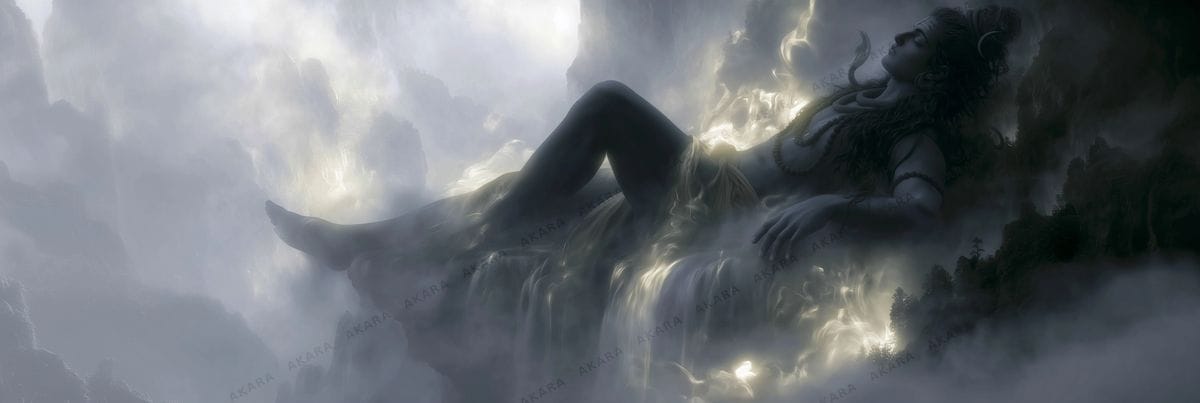
Of all the mantras that have traveled across millennia of Hindu spirituality, few carry the raw, luminous power of the Maha Mrityunjaya Mantra. Chanted at bedsides and dawns, at rites of passage and in moments of quiet dread, its three lines hold what the Vedic seers understood about mortality, divine grace, and the possibility of liberation — a possibility that, remarkably, the tradition insists is available to every sincere seeker.
Origins: A Mantra Born of the Rishis
The Maha Mrityunjaya Mantra appears in three of the most authoritative scriptural sources of Sanatana Dharma. Its earliest recorded form is in the Rigveda (VII.59.12), where it is attributed to the rishi Vasishtha. It appears again in the Krishna Yajurveda (within the Taittiriya Samhita, IV.5.8.j), and in the Shukla Yajurveda (Vajasaneyi Samhita, III.60). It is also enshrined within the Shiva Purana and forms the heart of the Shri Rudram, one of the most revered hymns in Vedic literature.
Legend in the Puranas credits the mantra's revelation to the rishi Markandeya — himself a living testimony to its power. Destined by fate to die at sixteen, Markandeya's unwavering devotion to Shiva led the Lord to vanquish Yama, the god of death, on his behalf. The mantra he chanted, tradition tells us, was this very one. It is thus sometimes called the Markandeya Mantra, though its broader title — Maha Mrityunjaya — means simply "the great victory over death."
The Text and Its Word-by-Word Meaning
The mantra, in IAST transliteration, reads:
**oṃ tryambakaṃ yajāmahe sugandhiṃ puṣṭivardhanam
urvārukamiva bandhanān mṛtyormukṣīya māmṛtāt**
Let us walk through it carefully, because precision matters:
- oṃ — The primordial sound, the vibration underlying all creation.
- tryambakaṃ — "The three-eyed one." Tri (three) + ambaka (eye). This is Lord Shiva, whose third eye perceives what the two eyes of ordinary perception cannot — the true nature of reality.
- yajāmahe — "We worship, we honour, we adore." From the root yaj, to offer sacrifice or reverence. The plural voice is notable: this is a collective act of bhakti, not merely a personal petition.
- sugandhiṃ — "The fragrant one, the sweet-smelling." Shiva is described as the source of all that is auspicious and nourishing, as a flower perfumes everything around it without effort.
- puṣṭivardhanam — "The nourisher of all, the one who increases fullness." Puṣṭi means nourishment, flourishing, abundance; vardhana means he who grows or multiplies it.
- urvārukam iva — "Like a cucumber" (or, in some readings, a ripe gourd). The urvāruka is the fruit that separates naturally from its vine when fully ripe — without force, without violence, in its own time.
- bandhanāt — "From bondage, from the binding." This refers to the cords that tether us — to karma, to the body, to the cycle of birth and death (saṃsāra).
- mṛtyor mukṣīya — "Liberate me from death." Mṛtyu is death; mukṣīya is the optative of mokṣa — may I be freed.
- mā amṛtāt — "Not from immortality." The seeker does not ask to escape amṛta — the deathless, the nectar of liberation. The prayer is: free me from death, but do not separate me from that which is deathless.
Read as a whole, the mantra is a luminous prayer: We worship the three-eyed Shiva, the fragrant nourisher of all. As the ripe cucumber is freed naturally from its vine, may I be liberated from the bondage of death — but never from immortality.
The Three Levels of Meaning
Sanatana Dharma consistently teaches that sacred texts operate on multiple registers simultaneously — adhyātmika (spiritual/inner), ādhidaivika (cosmic/divine), and ādhibhautika (physical/manifest).
At the physical level, the mantra is a healing prayer — a call for the body to be sustained by divine grace, to recover from illness, to be freed from untimely death.
At the cosmic level, it is an invocation of Shiva as Mahakala, the master of time and its dissolution. Shiva, who holds the third eye that once reduced Kama to ash and that perceives beyond the illusion of impermanence, is the only fitting witness for a prayer about mortality.
At the spiritual level — and this is the deepest register — the mantra is about mukti, liberation itself. The "death" from which we seek freedom is not merely biological; it is the repeated death of the soul that does not know its own immortal nature. Amṛtāt — from immortality, may I not be severed. The entire arc of Vedanta can be heard in those final syllables.
Chanting Practice: Guidance from Tradition
Several practical considerations help a seeker bring this mantra into living devotion:
Number and rhythm. Traditional prescriptions recommend chanting in multiples of 108 — one full mala of 108 beads being the standard unit. For serious practice (japa), 11, 21, or 108 repetitions are common. The Shiva Purana speaks of 1,25,000 repetitions for a full anushthana (consecrated recitation retreat).
Time and posture. The Brahma muhurta — approximately ninety minutes before sunrise — is considered the most potent time. Face north or east; sit on a kusha grass mat or wool mat if possible. A rudraksha mala is the classical choice for counting, as rudraksha is especially associated with Shiva.
Intention. Whether you chant for your own healing, for a loved one's recovery, or purely as an act of bhakti and surrender, hold the intention clearly and gently at the beginning, then release it into the vibration of the sound. Grasping too tightly at outcome can itself become a bondage.
Pronunciation. The aspirated consonants — tryambakaṃ, puṣṭi — matter. The anusvara (the nasal ṃ) should be heard. If you are new to Sanskrit, listen to recordings from reputable Vedic pandits before settling into your own practice.
Why This Mantra Still Matters
In an era of extraordinary medical science, existential anxiety, and collective uncertainty, the Maha Mrityunjaya Mantra offers something that technology cannot manufacture: the felt sense that death is not the last word. The mantra does not deny mortality — it looks it squarely in its face, names it (mṛtyu), and then, with the gentleness of a ripe fruit leaving its vine, steps beyond it.
At Akara, we hold that this is one of the great gifts of Sanatana Dharma to humanity — not magical thinking, but a mature spiritual technology refined over thousands of years, pointing the seeker toward the amṛta that was never absent, only unrecognised.
Chant it with sincerity. Let the sound do what sound has always done: reveal the silent presence that underlies it.
Free me from death, but do not separate me from that which is deathless.
गिरिशं गंगाधरं सोमशेखरम् giriśaṃ gaṅgādharaṃ somaśekharam
the mountain lord who holds ganga and wears the moon as his crown. bholenath makes nature his temple.
Questions & answers
What does the Maha Mrityunjaya Mantra literally mean?
The mantra translates as: 'We worship the three-eyed Lord Shiva, the fragrant nourisher of all. As a ripe cucumber is freed naturally from its vine, may I be liberated from the bondage of death — but never from immortality.' Each word carries precise Sanskrit meaning, from tryambakam (three-eyed one) to amṛtāt (immortality).
Where does the Maha Mrityunjaya Mantra come from?
It appears first in the Rigveda (VII.59.12), attributed to rishi Vasishtha. It also occurs in the Taittiriya Samhita of the Krishna Yajurveda, in the Shukla Yajurveda, and is associated with the legendary rishi Markandeya in the Shiva Purana and Shri Rudram.
How many times should I chant the Maha Mrityunjaya Mantra?
Tradition recommends chanting in multiples of 108 using a rudraksha mala. Everyday practice often consists of one mala (108 repetitions). A full anushthana (consecrated recitation) as described in the Shiva Purana involves 1,25,000 repetitions. Even a sincere daily practice of 11 or 21 repetitions is considered beneficial.
Is the Maha Mrityunjaya Mantra only for healing physical illness?
No. While it is widely used as a healing mantra, its deepest purpose in the tradition is spiritual liberation (moksha). The 'death' referenced is ultimately the existential bondage of not knowing one's immortal nature. It is a prayer for freedom from the cycle of birth and death (samsara), not only for bodily recovery.
Can anyone chant the Maha Mrityunjaya Mantra?
Yes. The mantra is considered universally accessible — there is no requirement for initiation for this particular mantra, though receiving guidance from a qualified teacher enhances one's practice. Chanting with sincerity, correct pronunciation, and genuine intention is the primary requirement across all traditions.