Bajrangbali: The Eternal Servant Who Holds the World Together
On this Krishna Dwadashi Saturday, we bow before Hanuman — the one whose devotion is itself a form of liberation.
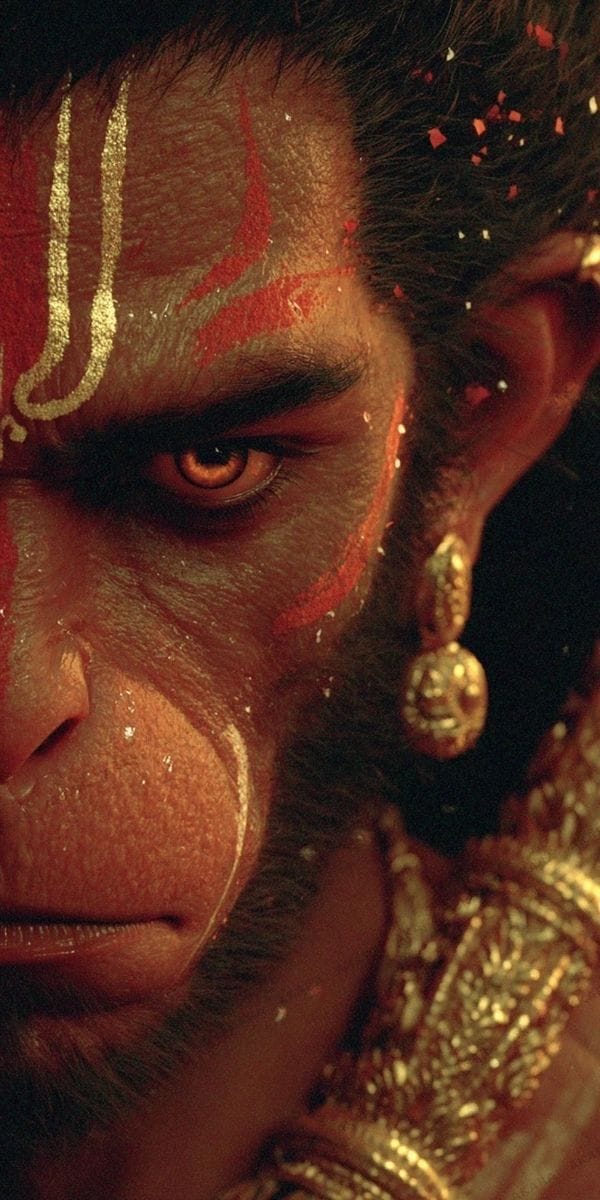
There is a moment in the Sundara Kanda of Valmiki's Ramayana that stops the breath. Hanuman, having leapt across the ocean, found Sita in the ashoka grove of Lanka, and now stands before Rama to deliver the news. He does not boast. He does not linger on his own heroism — the mountain-lifting, the ocean-crossing, the burning of a demon city. He simply says: I have seen her. In that restraint, in that complete dissolution of self into service, the entire philosophy of bhakti is contained. Hanuman is not merely a deity of strength; he is the supreme exemplar of what it means to love without remainder.
Who Is Hanuman?
Hanuman — known also as Bajrangbali, Anjaneya, Mahavira, and Maruti — is the divine son of Vayu, the wind god, and Anjana, a celestial apsara who had taken birth as a vanara (a forest-dwelling being of semi-divine nature). His very conception is an act of grace: the wind carried the sacred payasam (sacred food offering) to Anjana as she prayed for a child, and from that union of prayer, wind, and divine will, Hanuman was born.
In Sanatana Dharma, he is counted among the chiranjivis — the immortals who remain present in the world age after age. The tradition holds that wherever the Ramayana is recited, Hanuman is present, listening with folded hands. This is not metaphor alone; devout communities across India keep a space at recitation gatherings for the unseen guest who never fails to attend.
His epithets reveal layers of meaning. Bajrang (from vajra-anga, meaning diamond-limbed) speaks to his indestructible body. Anjaneya honors his mother. Pavanputra — son of the wind — reminds us that he is everywhere, formless and yet utterly present. Sankat Mochan, the remover of afflictions, is perhaps the name most whispered by ordinary devotees in moments of crisis.
The Iconography and Its Inner Meaning
A murti of Hanuman rarely stands still. He is most often shown in one of three forms: vira (heroic), dasya (servant), or dhyana (meditative). In the vira form, he holds a gada (mace) and a mountain — the Dronagiri hill he carried when the life of Lakshmana hung by a thread. In the dasya form, he kneels or stands with hands folded, a look of complete surrender on his face. In some remarkable icons, he parts open his chest to reveal Rama and Sita seated within his heart — the most radical possible statement of where God lives.
The color of his murti is significant. Sindoor red — the pigment smeared on his form in countless temples — carries a story. Hanuman, watching Sita apply sindoor to her hair as an offering of love for Rama's long life, covered his entire body with it: if a little ensures Rama's well-being, let all of it do the same. The gesture is simultaneously childlike and profound. It is the logic of total love.
His tail, always present and often elaborate, represents the vasana — the subtle tendencies of the ego — but in Hanuman's case, that tail becomes an instrument of service and of glory, eventually used to set Lanka ablaze with divine purpose.
Two Stories That Define Him
The Leaping of the Ocean (Sundara Kanda): When the vanaras assembled at the southern shore, paralyzed before the impossible ocean, it was Jambavan's words that awakened Hanuman to his own forgotten greatness. As a child, Hanuman had reached toward the sun thinking it a fruit; the gods had placed a temporary veil over his power so he would live humbly. Jambavan lifts that veil with words of recognition, and Hanuman grows — literally, in the telling — to fill the sky. The Sundara Kanda teaches that our deepest capacities are often covered by forgetting. A true teacher, a true friend, reminds us who we are.
The Heart Opened: After the war, when Rama distributed gifts to his companions, Hanuman received a pearl necklace from Sita. He bit into each pearl, looking inside. The courtiers laughed — was he checking their value? No, Hanuman said: I look for Rama within. Finding none in the pearls, he discarded them. Asked if he too lacked Rama — since he had tossed away the gift — Hanuman tore open his chest. Inside, luminous and still, sat Rama and Sita. The laughter stopped. In this single story, the Bhakti tradition makes its boldest claim: the devotee, through love, becomes the living temple.
The Mantra and Its Vibration
The primary mantra for Hanuman worship is:
Om Hanumate Namah —
The devotee, through love, becomes the living temple — and Hanuman is its eternal proof.
मनोजवं मारुततुल्यवेगं जितेन्द्रियं बुद्धिमतां वरिष्ठम्। वातात्मजं वानरयूथमुख्यं श्रीरामदूतं शिरसा नमामि॥ manojavaṃ mārutatulyavegaṃ jitendriyaṃ buddhimatāṃ variṣṭham | vātātmajaṃ vānarayūthamukhyaṃ śrīrāmadūtaṃ śirasā namāmi ||
fast as thought, swift as wind, master of his senses and supreme among the wise — we bow to hanuman, son of the wind and rama's messenger.
Questions & answers
Why is Saturday associated with Hanuman?
Saturday (Shanivaar) is Hanuman's primary day because tradition holds that Hanuman subdued Shani (Saturn), and sincere devotees of Hanuman are said to be protected from Saturn's malefic effects. Worshipping Hanuman on Saturday is believed to ease karmic burdens and bring courage.
What is the significance of sindoor (vermilion) in Hanuman worship?
Sindoor is offered to Hanuman because of a beloved story: seeing Sita apply sindoor as an expression of love for Rama's well-being, Hanuman covered his entire body with it, reasoning that if a little helps Rama, all of it will help even more. The gesture represents total, unconditional devotion.
What is the Hanuman Chalisa and who composed it?
The Hanuman Chalisa is a 40-verse devotional hymn composed by the poet-saint Goswami Tulsidas in the 16th century in the Awadhi language. It narrates Hanuman's qualities and deeds and is considered one of the most powerful and widely recited prayers in the Hindu tradition.
What does 'Bajrangbali' mean?
Bajrangbali comes from 'vajra-anga-bali' — vajra meaning diamond or thunderbolt, anga meaning limbs, and bali meaning mighty. Together it means 'the mighty one with diamond-hard limbs,' pointing to Hanuman's indestructible, divinely protected body.
How should a beginner start a Hanuman mantra practice?
The mantra 'Om Hanumate Namah' is ideal for beginners — it is simple, protective, and universally recommended. Chant it in multiples of 108 on a Saturday or Tuesday, preferably facing south, with a lamp or incense lit before a Hanuman image. Sincerity of feeling (bhava) matters far more than ritual complexity.