The Bhagavad Gita in Brief: Krishna's Eternal Teaching to Arjuna
Across eighteen chapters on a battlefield, Krishna distills the whole of Sanatana Dharma into a conversation that still speaks to every human life.
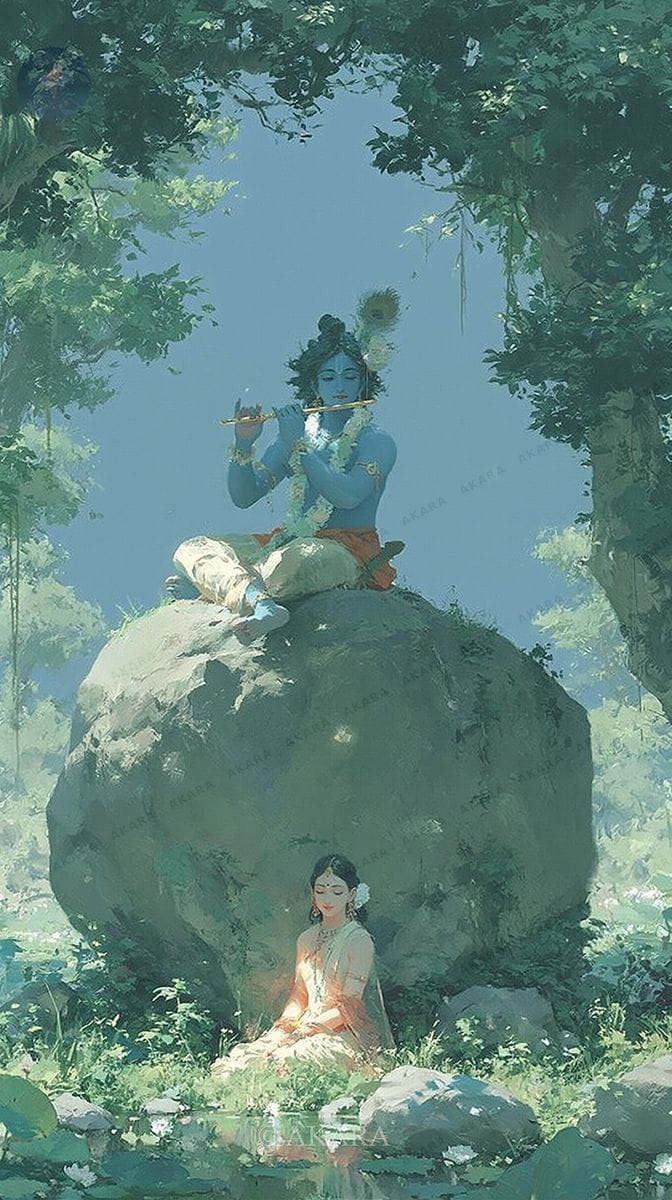
More than five thousand years ago, on the field of Kurukshetra, a warrior laid down his bow. Arjuna — skilled, beloved, and suddenly paralysed by grief — could not bring himself to fight. What followed was not a battle cry but a dialogue: one hundred and twenty minutes of teaching, preserved in seven hundred Sanskrit verses, that would become the Bhagavad Gita, the 'Song of the Blessed Lord.' It is the most widely read scripture of Sanatana Dharma, translated into over seventy-five languages, studied by soldiers, scientists, saints, and seekers alike. Yet for all its fame, many who reach for it are unsure where to begin. This is an attempt to offer a clear map.
The Setting: Why a Battlefield?
The Bhagavad Gita forms chapters 23 to 40 of the Bhishma Parva within the Mahabharata, yet it stands complete as its own scripture. The battlefield of Kurukshetra (Sanskrit: Kurukṣetra, 'field of the Kurus') is not incidental. It is the sharpest possible image of the human condition — a moment of total crisis in which duty, love, fear, and identity collide. Arjuna asks his charioteer, Lord Krishna, to position their chariot between the two armies. Seeing uncles, teachers, and cousins arrayed for war, he is overwhelmed by viṣāda (grief, despondency), and the Gita begins.
The opening chapter, sometimes called Arjuna Viṣāda Yoga — the yoga of Arjuna's grief — is not a preamble to skip. It is deliberately placed so that every reader recognises themselves. We have all stood on our own Kurukshetra, frozen between what we know we must do and what we feel we cannot bear.
The Structure: Eighteen Chapters, Three Great Streams
The Bhagavad Gita's eighteen chapters have traditionally been grouped into three broad teachings, each corresponding to a path toward liberation (mokṣa):
Chapters 1–6: Karma Yoga — the Path of Right Action Krishna addresses Arjuna's paralysis first through reason. He establishes the immortality of the ātman (the Self): 'Na jāyate mriyate vā kadācit' — 'It is never born, nor does it die at any time' (2.20). The body perishes; the Self does not. From this ground, Krishna introduces karma yoga — action performed without attachment to its fruits. The famous verse 2.47 reads: 'Karmaṇy-evādhikāras te mā phaleṣu kadācana' — 'You have a right to perform your prescribed duties, but you are not entitled to the fruits of your actions.' This is not fatalism. It is the highest form of freedom: to act with full commitment and complete inner release.
Chapters 7–12: Bhakti and Jnana Yoga — Devotion and Knowledge Here the Gita deepens. Krishna reveals his divine nature — 'Ahaṁ sarvasya prabhavo', 'I am the source of all creation' (10.8) — and unfolds the spectacular Viśvarūpa Darśana in Chapter 11, where Arjuna is granted vision of the Cosmic Form. These chapters celebrate bhakti (devotion) as the most direct path. Chapter 12, the Bhakti Yoga chapter, is among the shortest and most beloved: Krishna describes the devotee who is 'free from malice toward all beings, friendly and compassionate, without possessiveness or ego' as supremely dear to him (12.13–14). Knowledge (jñāna) and devotion are not opposites here — they illuminate each other.
Chapters 13–18: The Synthesis — Nature, Self, and Liberation The final third of the Gita moves into metaphysics: the distinction between kṣetra (the field, meaning the body and world) and kṣetrajña (the knower of the field, the Self); the three guṇas — sattva (clarity), rajas (passion), and tamas (inertia) — and how they shape all of nature and human character. Chapter 17 analyses faith, food, sacrifice, and austerity through the lens of the three gunas. The Gita closes in Chapter 18 with Krishna's most direct instruction: 'Sarva-dharmān parityajya mām ekaṁ śaraṇaṁ vraja' — 'Abandoning all varieties of dharma, take refuge in Me alone. I shall deliver you from all sinful reaction; do not fear' (18.66). Arjuna's grief has dissolved. His bow is lifted.
The Core Teachings: What the Gita Actually Says
Stripped to its essentials, the Gita's instruction rests on several pillars that practitioners of every background can work with:
- The eternal Self: You are not the body or the mind. The ātman is unborn, unchanging, and beyond destruction. Recognising this is the beginning of all wisdom.
- Nishkama Karma: Act from duty and dedication, not from desire for reward or fear of failure. This is the teaching that inspired figures from Lokmanya Tilak to Mahatma Gandhi.
- Svadharma: Each person has their own svadharma — their particular nature and duty. 'Better is one's own dharma, though imperfectly performed, than the dharma of another well performed' (3.35). The Gita does not offer a single template for all lives.
- **The three paths (margas)**: Karma yoga, jñāna yoga, and bhakti yoga are not competing religions but different doorways into the same reality. Krishna affirms that all sincere seekers, by whatever path, ultimately reach him (4.11).
- **Surrender (śaraṇāgati)**: At its summit, the Gita points toward complete, loving surrender to the Divine — not as weakness but as the ultimate act of trust.
Why the Gita Speaks Now
In an age of burnout and fragmentation, the Gita's teaching on action without attachment feels almost urgent. We are a civilisation drowning in outcomes — metrics, results, validation — and Krishna's counter-instruction is radical: do the work because it is yours to do, offer it, and release it. This is not passivity. Arjuna is not told to withdraw from the field; he is told to engage it fully, but from a different place inside himself.
The Gita also holds space for grief. Krishna does not dismiss Arjuna's anguish in Chapter 1 as weakness — he listens to it in full before teaching. This is an important detail for seekers who approach spirituality through suffering. The Gita begins precisely there.
"The soul is never born nor dies at any time. It has not come into being, does not come into being, and will not come into being. It is unborn, eternal, ever-existing, and primeval." — Bhagavad Gita 2.20
For those drawn to Hindu spirituality through devotional art, music, or the quiet discipline of a morning prayer — as so many in the Akara community are — the Gita is not a text to be conquered but a conversation to be returned to. Its seven hundred verses are designed to be read slowly, a few at a time, chanted, contemplated, or simply kept near. Even a single verse, absorbed honestly, can rearrange something deep.
A Reflection
On this day of Nakshatra Ardra — the star of searching, of transformation through storm — the Gita's invitation feels especially fitting. Ardra is Rudra's star, associated with the dissolution of what no longer serves. Arjuna, too, stood in his own storm before clarity came. The Gita does not promise that the storm passes quickly. It promises something better: that beneath every storm, the Self remains untouched, luminous, and free. That is the Song's deepest note — and it has not stopped sounding.
The Gita does not promise that the storm passes quickly. It promises something better: that beneath every storm, the Self remains untouched, luminous, and free.
राधाकृष्णौ जगत्पाणी गोविन्दौ गोपिकाप्रिया rādhākṛṣṇau jagatpāṇī govindau gopikāpriyā
Radha-Krishna, holders of the world, beloved of the cowherd maidens—their love transcends all boundaries.
Questions & answers
How many chapters and verses does the Bhagavad Gita have?
The Bhagavad Gita contains 18 chapters and 700 Sanskrit verses (shlokas). It forms part of the Mahabharata's Bhishma Parva but is revered as a complete, standalone scripture of Sanatana Dharma.
What is the central message of the Bhagavad Gita?
At its heart, the Gita teaches that the true Self (ātman) is eternal and beyond death; that one should act from duty without attachment to results (karma yoga); and that sincere devotion to the Divine — by whatever path — leads to liberation (moksha).
What is 'karma yoga' as taught in the Gita?
Karma yoga is the path of selfless, dedicated action. Krishna's key verse (2.47) teaches: perform your duty fully, but do not cling to the fruits. Action offered without ego or desire becomes a form of worship and a means of inner freedom.
What is the difference between karma yoga, jnana yoga, and bhakti yoga in the Gita?
Karma yoga is the path of right action; jnana yoga is the path of wisdom and discriminative knowledge; bhakti yoga is the path of loving devotion to God. The Gita presents all three as valid and ultimately convergent paths toward moksha, suited to different temperaments.
Which verse of the Bhagavad Gita is considered the most important?
Many traditions consider verse 18.66 — 'Sarva-dharmān parityajya mām ekaṁ śaraṇaṁ vraja' (Abandon all varieties of dharma and take refuge in Me alone) — as the Gita's summit or charama shloka. Verse 2.47 on nishkama karma is equally celebrated and widely cited.