Ashadha Amavasya 2026: When Shiva Reigns in the Formless Dark
On the moonless night of Ashadha — when sky and soul grow equally still — Lord Shiva, keeper of dissolution and grace, becomes most reachable.
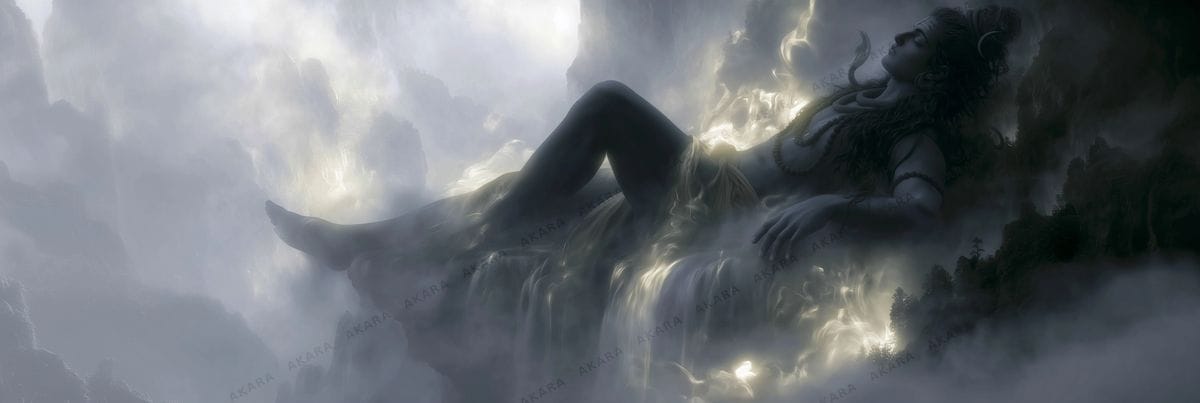
Tonight, the sky holds no moon. The tithi of Amavasya — that sacred, still absence at the heart of the Hindu lunar calendar — arrives on Tuesday, 14 July 2026, in the month of Ashadha, just as the monsoon deepens and the world turns inward with the rains. The Amavasya tithi began at 6:49 PM IST on 13 July and extends through 3:12 PM IST on 14 July — a span of just over twenty hours in which the Sun and Moon dwell together in Mithuna (Gemini), the sky emptied of reflected light. In the tradition of Sanatana Dharma, this is not a night of absence but of fullness of a different order: the fullness of Shiva, Mahadeva, whose nature is the formless, and whose grace pours most freely when the distracting shimmer of the world dims.
What Amavasya Means: A Name Rooted in the Cosmos
The word Amāvāsyā (अमावास्या) is built from two Sanskrit roots: amā, meaning "together," and vāsya, "to dwell" — pointing to the astronomical moment when Sun and Moon occupy the same ecliptic longitude, the Moon hidden within the solar embrace, invisible from Earth. It can equally be read as na + ma + asya — "no moon here." Both readings are true. The fifteenth and final tithi of Krishna Paksha (the dark fortnight), Amavasya is the concluding breath of the lunar month before the new cycle begins.
This year's Ashadha Amavasya carries an additional designation: Bhaumavati Amavasya, because it falls on a Tuesday (Mangalvāra). The Panchang for today records Nakshatra Punarvasu (pada 1), Yoga Vyaghata, and the Sun positioned in Mithuna — a configuration that astrologers associate with active inner churning and the need for grounding practice.
The Shiva Purana (2.5.2) preserves a remarkable line in which the gods eulogize Shiva: among all tithis, they declare, "you are Amāvāsyā." That the Puranas should place Amavasya above all other lunar days — and identify it with Shiva himself — is not decorative praise. It is a cosmological statement: the formless, the void, the dark pause between cycles, is Shiva's very nature.
The Shiva–Moon Bond: Chandrashekhara and Mahakala
Shiva's connection to the Moon is among the most philosophically rich in all of Hindu spirituality. He is Chandrashekhara — the one who bears the Moon as a crown — and Someshvara, Lord of Soma (the Moon and the sacred drink both), reminding us that the lunar mind, with all its tides and fluctuations, rests ultimately in divine governance. As Mahakala, the great lord of time, Shiva transcends every cycle the Moon measures even as he wears it. In the words of the Vedic Studies tradition, Shiva "is related particularly with the waning Moon, just before it becomes new" — he is the deity of the crescent, of the Ardhachandra, the Moon caught between its descent into darkness and its rebirth into radiance. Amavasya, then, is the moment of maximum Shaiva resonance: the Moon has completed its waning and returned to the primordial unity with the Sun. It is Samhara — cosmic dissolution — rendered in light and darkness.
In Shaiva temple calendars, this logic is institutionalized. The Pancha Parva Utsavam — five monthly festival observances in Shiva temples — always includes Amavasya alongside Purnima, Ravi Sankramana, Krishna Paksha Ashtami, and Krishna Paksha Chaturdashi. Amavasya is not an asterisk on the temple calendar; it is one of its five pillars.
Pitru Puja: The Debt We Carry to Those Who Came Before
If Shiva governs the cosmic dimension of Amavasya, the pitru (पितृ) — the ancestors — govern its intimate, familial dimension. Tradition holds that on every Amavasya, the souls of departed ancestors draw close to the earthly realm, more accessible than on ordinary days. The Garuda Purana is explicit: ancestors visit their descendants on this night, and if offerings are made with love and sincerity, their spirits find peace and extend blessings across generations.
The rites prescribed are precise and beautiful: Pitru Tarpan — the offering of water cupped in the hands, mixed with black sesame seeds (til), sometimes with barley and honey — poured southward three times for each ancestor remembered by name. Pind Daan, the offering of cooked rice balls with sesame and ghee, goes deeper still, said to nourish the subtle body of the departed. These are not superstitions. They are acts of remembrance, of relational honesty — an acknowledgement that we did not arrive in this life alone, that the bodies, languages, dharmas, and loves we inhabit were given to us by a river of souls stretching back beyond memory.
This Ashadha Amavasya carries the additional weight of arriving at the threshold of Chaturmas — the four sacred months beginning with Guru Purnima (just days away) when spiritual practice intensifies across traditions. To honor one's ancestors now is to enter this concentrated season with a clean and grateful heart.
In the Tamil tradition, this lunar conjunction (Sun in the same sign as Moon, signifying in their cosmology the union of Shiva and Shakti) makes the day especially powerful for Tharpanam. Across Tamil Nadu, devotees gather at Agni Theertham in Rameswaram, at the Triveni Sangamam in Kanyakumari, and at river ghats across the state to perform ancestral rites at the water's edge.
How to Observe: A Practical Guide for the Devout
The beauty of Amavasya observance is that it scales from the simple to the elaborate without losing its essence. Here is what Sanatana tradition recommends:
- Before sunrise — Brahma Muhurta (approx. 4:14–5:02 AM IST): Rise, bathe, and sit in silence. This hour belongs to Shiva in his meditative stillness. Even five minutes of breath-awareness here carries unusual depth.
- At sunrise — Snan and Sankalpa: Take a ritual bath — in a river if accessible, otherwise at home with the intention of purification. Make a sankalpa (inner vow) to observe the day with honesty and care.
- Morning — Pitru Tarpan: Face south. Offer water with sesame seeds three times each for your father's, mother's, and maternal grandfather's lineage, naming them aloud. If uncertain of names, offer to "all ancestors who have given me this life."
- Midday — Daan (charity): Donate food, cloth, or essentials to those in need. Offerings of black sesame, rice, and milk are classically prescribed. The merit of giving on Amavasya is considered multiplied.
- Evening — Shiva Puja: Light a deepa (lamp) before the Shiva linga or murti. Offer bilva leaves — the tree sacred above all others to Mahadeva — along with water, milk, or raw honey. Many communities perform Rudrabhishekam (ceremonial bathing of the linga with Vedic Rudra chanting) on this night.
- Night — Mantra and meditation: As the sky deepens and the moonless dark holds, chant Om Namah Shivaya on a rudraksha mala. This Panchakshara mantra — five sacred syllables, one for each element — is Shiva's own name-mantra. It aligns the practitioner with the dissolution energy of the night and returns the mind to its source.
Om Namah Shivaya — I bow to Shiva. I bow to that which I am, stripped of all that I am not.
The Maha Mrityunjaya Mantra (Om Tryambakam Yajamahe...), drawn from the Rigveda and the Yajurveda, is equally powerful on this night: it is Shiva as Mrityunjaya, conqueror of death, liberator of ancestral karmic bonds.
Fasting, if observed, is traditionally broken only after the evening puja — with sattvic food free of salt and heavy spices. Silence (mauna) through at least part of the day is honored by many devotees, recognizing that the moonless night calls us inward.
Why It Matters Now: The Akara Sanatan Lens
In a world of relentless brightness — screens, notifications, the constant demand to perform and produce — Amavasya offers something increasingly rare: a cosmologically sanctioned invitation to stop. To sit in the dark. To feel the absence of the Moon not as deprivation but as Shunya — the fertile void, the emptiness that is also fullness, the silence from which the next creation will arise.
Shiva is the deity of this threshold. He sits at the cremation ground not because he is morbid, but because he alone is comfortable in the presence of endings. He knows that what dissolves was never truly lost. He is the lord who drank the Halahala poison — the venom that arose during the churning of the cosmic ocean — to protect all creation from destruction. Amavasya, when the sky's own light is swallowed into darkness, is the night when that protection is most naturally invoked.
For the seekers who form the worldwide Akara community — whatever their region, language, or sect — this night is an opportunity to deepen bhakti not through excitement but through quietude. Light a lamp. Remember those who walked before you. Chant Shiva's name. Let the dark be what it is: not the end, but the sacred pause before the new Moon's first silver thread — Shiva's own crescent — reappears in the sky.
Har Har Mahadev.
The formless, the void, the dark pause between cycles — this is Shiva's very nature. Amavasya is the night he becomes most reachable.
गिरिशं गंगाधरं सोमशेखरम् giriśaṃ gaṅgādharaṃ somaśekharam
the mountain lord who holds ganga and wears the moon as his crown. bholenath makes nature his temple.
Questions & answers
When exactly does Ashadha Amavasya 2026 fall, and what are its tithi timings?
Ashadha Amavasya 2026 is observed on Tuesday, 14 July 2026. The Amavasya tithi begins at 6:49 PM IST on 13 July and ends at 3:12 PM IST on 14 July — a duration of approximately 20 hours and 23 minutes. The Brahma Muhurta ideal for puja and meditation is approximately 4:14–5:02 AM IST, and the Snan (bath) Maha Punya Kaal is from sunrise (approx. 5:33 AM) to 9:00 AM. All timings are for New Delhi/IST and may vary slightly by location.
Why is Shiva particularly worshipped on Amavasya?
Shiva's connection to the Moon is deep and multifaceted. As Chandrashekhara he wears the crescent Moon; as Someshvara he is lord of the lunar mind; as Mahakala he is master of all time cycles the Moon measures. The Shiva Purana itself identifies Amavasya as Shiva's own tithi among all tithis. The moonless night — representing dissolution (Samhara), the formless, and the void — mirrors Shiva's essential nature as the great dissolver who makes way for new creation. Traditional Shaiva temple calendars include Amavasya as one of the five monthly sacred observances (Pancha Parva Utsavam).
What is Pitru Tarpan and how is it performed on Amavasya?
Pitru Tarpan is the ritual offering of water, black sesame seeds (til), and sometimes barley or milk to the souls of departed ancestors. The devotee faces south (the direction associated with the ancestors and Lord Yama), cups water in their palms, and pours it three times for each ancestor while speaking their name and lineage. If names are unknown, one may offer "to all ancestors who have given me this life." The Garuda Purana prescribes this practice specifically on Amavasya, when ancestral souls are believed to be nearest to the earthly realm. This is a gesture of gratitude and love, not fear.
What is the best mantra to chant on Amavasya night?
Two mantras are most classically prescribed for Amavasya, especially in the Shaiva tradition. The first is the Panchakshara mantra, Om Namah Shivaya — five syllables corresponding to the five elements, Shiva's own name-mantra, ideal for japa on a rudraksha mala (108 repetitions per round). The second is the Maha Mrityunjaya Mantra (Om Tryambakam Yajamahe...) from the Rigveda, which invokes Shiva as conqueror of death and liberator of karmic bonds — particularly resonant when ancestors are remembered. Evening, after the lamp is lit, is the most potent time for this practice.
What is Bhaumavati Amavasya, and does it change the observance?
Bhaumavati Amavasya is the name given to any Amavasya that falls on a Tuesday (Mangalvāra — the day of Mangala/Mars). This year's Ashadha Amavasya, on 14 July 2026, is a Bhaumavati Amavasya. In some traditions, this combination is considered especially auspicious for Hanuman worship alongside the usual Shiva and ancestral rites. The core observances — Pitru Tarpan, fasting, charity, Shiva puja, and mantra recitation — remain the same, but the Mars energy of the day is said to add strength and courage to one's spiritual sankalpa.