Ganesha: The Elephant-Headed Lord Who Opens Every Door
On this Wednesday blessed by Pushya nakshatra, we turn to the first among the gods — Ganapati, the one who holds both the goad and the modaka, both discipline and delight.
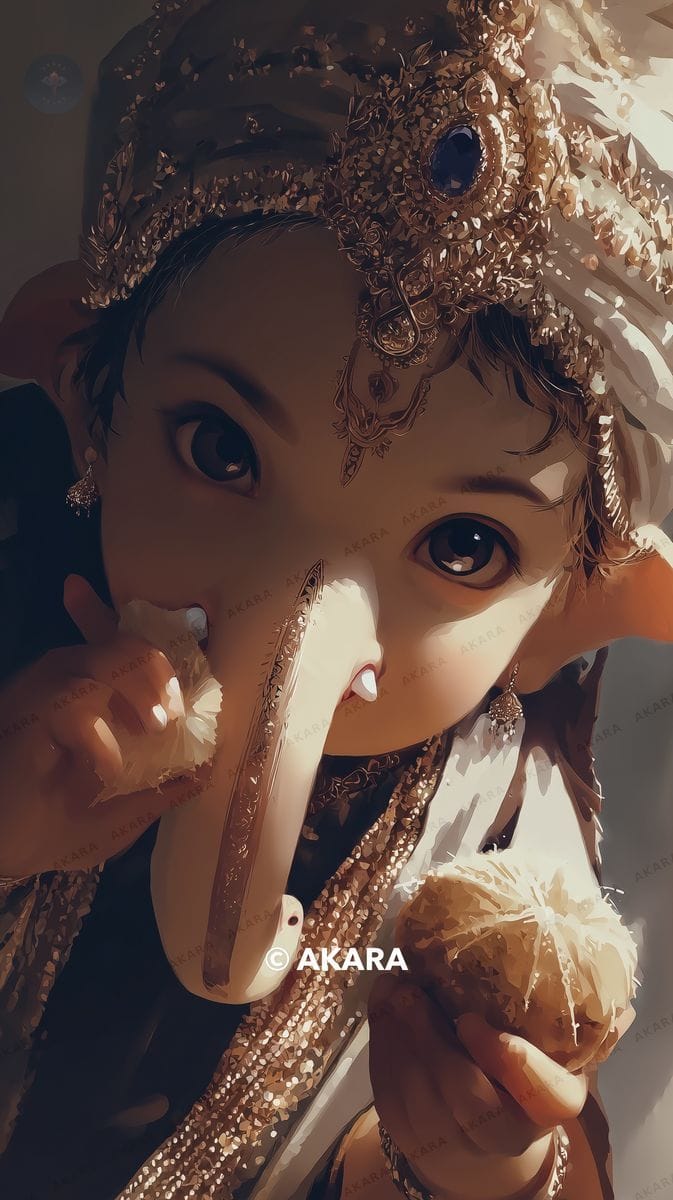
Before a prayer is uttered, before a journey begins, before a single syllable of scripture is read — there is Ganesha. In the vast, luminous landscape of Sanatana Dharma, no deity is invoked more universally, more instinctively, than the elephant-headed son of Shiva and Parvati. He sits at every threshold: of temples and homes, of new ventures and ancient rites, of the human mind itself as it turns toward the divine. To understand Ganesha is to understand something essential about the Hindu spiritual imagination — that wisdom and grace must come first, that no path is truly clear until the inner obstacles have been met and dissolved.
The Name and Its Resonance
Ganesha carries many names — the Ganesha Purana alone lists 108 of them — but two stand above the rest. Ganapati (गणपति) means 'lord of the ganas,' the vast host of celestial attendants, the forces of creation and dissolution that move through all realms. Vighnaharta (विघ्नहर्ता) means 'remover of obstacles.' Together they describe his essential function: he is the sovereign of forces, and he clears the path. Yet there is a subtlety here that devotees return to again and again. Ganesha does not simply sweep difficulties away like dust from a courtyard floor. He is also Vighnakarta — the one who places obstacles. The seeker who approaches him earnestly is asking not for an effortless life, but for the wisdom to navigate whatever arises. Ganesha is, in this sense, the deity of discernment itself.
Reading the Iconography
Every curve and colour of Ganesha's form is a teaching. Sit before any murti — whether carved in sandstone, cast in brass, or painted in the brilliant hues of a Pune workshop — and the entire philosophy of his being is written there.
The elephant head speaks of immense intelligence. The elephant in the Indian tradition is the wisest of animals, possessed of a memory that never falters and a strength that moves mountains. To meditate on that vast cranium is to aspire to a mind large enough to hold the whole cosmos without confusion.
The single tusk — the broken one, the other intact — carries one of the most beloved stories in Hindu scripture. When the sage Vyasa wished to dictate the Mahabharata, no hand in all the three worlds was quick or sure enough to keep pace. Ganesha broke his own tusk to use as a stylus. He completed the task; the tusk was lost. In that act, the Lord of Beginnings became the patron of sacrifice in the service of knowledge. He gave something irreplaceable so that wisdom could be preserved for generations yet unborn.
The large ears and small eyes counsel us to listen more than we look, to receive before we project. The large belly — the lambodara (लम्बोदर) — contains all the universes, all experience, held with equanimity. The modaka (मोदक), the sweet dumpling held in his hand, is the reward of spiritual practice, the bliss (moda = joy) that arises when the inner work is done. The mouse at his feet, his vahana, is the restless mind — small, quick, able to gnaw through anything. Ganesha rides it, directs it. The master of wisdom masters the mind.
The four arms hold the ankusha (goad — the push of grace), the pasha (noose — the pull away from distraction), the broken tusk, and the modaka. Push and pull, sacrifice and sweetness: the whole of sadhana in four gestures.
Stories from Scripture
The Shiva Purana and the Mudgala Purana between them offer the richest mythological treasury around Ganesha. The most famous story — Ganesha's head — tells us that the young Ganesha was set to guard the entrance of Parvati's chambers. When Shiva himself approached and Ganesha barred the way, a confrontation arose. In the cosmic drama that followed, Ganesha's head was severed. Parvati's grief shook the heavens. Shiva, moved by love and repentance, commanded that the head of the first living being found sleeping with its face to the north be brought. An elephant was found; Ganesha was restored, and Shiva declared his son would henceforth be worshipped first in all rites.
This myth, read with care, is not merely a family drama among gods. It is a story about the primacy of the guru-principle, about consciousness (Shiva) recognising what it had destroyed and restoring it in a higher form. Ganesha before his restoration is a child of the manifest world; after, he is the bridge between the human and the transcendent.
A second story, from the Mudgala Purana, concerns the sage Krauncha, who accidentally stepped on the foot of the rishi Vamadeva and was cursed to become a mouse. Humbled and repentant, Krauncha surrendered to Ganesha — who accepted the mouse as his vehicle. The untameable energy of the ego, when surrendered, becomes the vehicle of the divine.
The Mantra and Its Practice
The seed-mantra (bija mantra) of Ganesha is Gam (गं). The most widely recited invocation is:
Om Gam Ganapataye Namah (ॐ गं गणपतये नमः)
Translated: 'Salutation to Ganapati, the lord of all ganas.' The syllable Gam is said to carry the full vibrational signature of Ganesha's presence — it activates the muladhara chakra at the base of the spine, the seat of grounded energy and new beginnings.
On Wednesday — Budhavar in Sanskrit, Ganesha's vaar devata day — many devotees rise early, bathe, and offer durva grass (a particular favourite of Ganesha), red hibiscus, and modakas at home altars or at a neighbourhood Ganesh temple. The number 21 recurs in his worship: 21 blades of durva, 21 modakas, 21 names recited. Incense of sandalwood or loban is lit. A simple lamp of ghee burns. The Ganesh Atharvashirsha — a brief Upanishadic text dedicated entirely to Ganesha — is chanted, affirming that Ganesha is not merely a deity but a name for ultimate consciousness itself: Tvam eva pratyaksham tattvam asi — 'You are indeed the directly perceived truth.'
Today, with Pushya nakshatra gracing the sky — Pushya, the most auspicious of nakshatras, associated with nourishment and spiritual growth — the timing for any new beginning or for deepening one's mantra practice is considered especially potent.
What Ganesha Asks of the Seeker
The bhakti (devotion) that Ganesha inspires is not sentimental. His iconography makes this clear: he carries a goad. He will prod you. The path he clears is not the easy path — it is the right path, which often runs directly through our own resistances, our own fixed ideas, our comfortable avoidances.
The broken tusk is perhaps his most personal teaching. He sacrificed something that could not be replaced, without hesitation, in the service of a task larger than himself. He asks the same quality of us: not perfection, not comfort, but the willingness to give what is needed, when it is needed, for the sake of something true.
In the Akara understanding of Sanatana Dharma, Ganesha is the divine intelligence that stands at the crossroads of the human and the cosmic, asking us: 'What are you beginning? Are you beginning it well — with awareness, with integrity, with an open and humble mind?' The elephant head nods slowly. The modaka waits. The mouse is still.
Begin there.
He does not simply sweep difficulties away like dust from a courtyard floor. He is the deity of discernment itself.
वक्रतुण्ड महाकाय सूर्यकोटि समप्रभ। निर्विघ्नं कुरु मे देव सर्वकार्येषु सर्वदा॥ vakratuṇḍa mahākāya sūryakoṭi samaprabha nirvighnaṃ kuru me deva sarvakāryeṣu sarvadā
O elephant-faced one, with a massive form radiant as millions of suns, remove all obstacles in all my endeavors, always.
Questions & answers
Why is Wednesday considered Ganesha's day?
In the Hindu calendar, each day of the week (vaar) is presided over by a deity. Wednesday — Budhavar — is associated with Ganesha as its vaar devata. Devotees often observe a fast, recite the Ganesh Atharvashirsha, and offer durva grass and modakas on this day for blessings at the start of new endeavours.
What does the mantra 'Om Gam Ganapataye Namah' mean?
'Om' is the primordial sound; 'Gam' is the bija (seed) syllable of Ganesha; 'Ganapataye' is the dative form of Ganapati, meaning 'to the lord of ganas'; 'Namah' means 'salutation' or 'I bow.' Together the mantra offers reverent salutation to Ganapati and is believed to invoke his presence, clear obstacles, and awaken focused intelligence.
Why does Ganesha have only one full tusk?
According to the Mudgala Purana and other sources, Ganesha broke his own tusk to use as a stylus when the sage Vyasa dictated the Mahabharata. No other instrument could keep pace with Vyasa's words, so Ganesha sacrificed his tusk. This story makes him the patron of writers, scholars, and all who give something of themselves in the service of knowledge.
What is durva grass and why is it offered to Ganesha?
Durva (Cynodon dactylon) is a resilient grass considered sacred to Ganesha. It is offered in bunches of 21 blades. Tradition holds that durva has the quality of regeneration — it regrows even after being cut — and symbolises the ever-renewing grace of Ganesha. Mythologically, offering durva is said to have once cooled the burning discomfort of Ganesha after he consumed a demon, and the offering has been beloved to him ever since.
What is the Ganesh Atharvashirsha?
The Ganesh Atharvashirsha (also called Ganapati Atharvashirsha) is a short Upanishadic text dedicated to Ganesha. It declares Ganesha to be the supreme reality — Brahman itself — identifying him with Om, with all four states of consciousness, and with the entire universe. It is widely chanted on Wednesdays, during Ganesh Chaturthi, and at the start of any important undertaking.