Tulsi: The Sacred Basil That Stands at Every Threshold
From Vedic verse to the courtyard altar, the holy basil is far more than a plant — she is a goddess, a guardian, and a gateway to the divine.
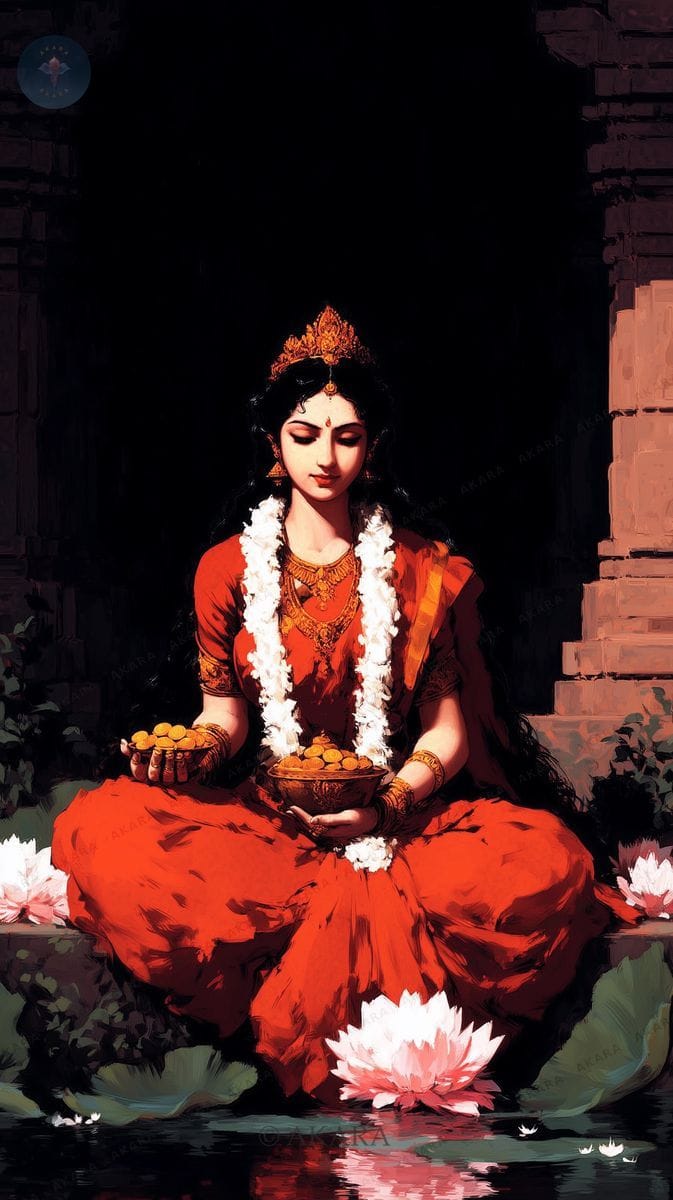
Step into almost any traditional Hindu home and you will find her before you find the deity enshrined within — Tulsi, the holy basil, standing in a painted clay pedestal called a brindavan or tulsi-vrindavana, her small green leaves stirring in the morning air. Lamps are lit before her at dawn and dusk. Prayers are whispered to her. Children are taught to bow before they leave for school. No herb in the world bears quite the same weight of mythology, medicine, and daily devotion that this modest plant carries in the heart of Sanatana Dharma.
Who Is Tulsi? Name, Nature, and Identity
The Sanskrit name Tulasī (तुलसी) derives from the root tul, meaning 'incomparable' — she who has no equal. Botanically she is Ocimum tenuiflorum (synonym Ocimum sanctum), called Holy Basil in English, and she appears in two principal forms in Indian tradition: Rama Tulsi (bright green leaves, milder fragrance) and Krishna Tulsi (deep purple-tinged leaves, sharper aroma), named after the avatars of Vishnu they are most closely associated with.
Yet to reduce Tulsi to a plant is to misread the tradition entirely. In the Puranas — particularly the Devi Bhagavata Purana and the Padma Purana — Tulsi is a goddess in her own right. She is Vrinda (वृन्दा), a supremely devoted woman whose pativratā (devotion to her husband) was of such intensity that it made her an immortal presence. Her story, her transformation, and her eventual union with Vishnu-Narayana form one of the most poignant narratives in Vaishnava theology — a meditation on the nature of divine love, surrender, and moksha (liberation).
The Mythology: Vrinda, Vishnu, and the Promise of Eternity
The most widely told Puranic account describes Vrinda as the wife of the asura (demon) king Jalandhar, whose power rested entirely on his wife's unbroken chastity. Her satitva (virtue) rendered him invincible. When the devas sought Vishnu's help, Vishnu, through divine illusion (maya), broke that protection. Vrinda, understanding she had been deceived, cursed Vishnu — and then, in sorrow and devotion both, gave up her body.
From her remains grew the Tulsi plant. Vishnu, moved by her sacrifice, blessed her: she would be worshipped in every home as inseparable from him. No puja (ritual worship) to Vishnu would be complete without a Tulsi leaf placed upon the offering. Tulsī-dala vihīnaṃ viṣṇu-pūjāṃ na kurvīta — 'One should not perform Vishnu puja without a Tulsi leaf' — is a dictum observed across Vaishnava households to this day.
This is not merely mythology. It is a theological statement: that bhakti (devotion) so total it transforms the devotee into something eternal is the very ground of the divine relationship between Vishnu and his creation.
Tulsi Vivah: The Annual Sacred Marriage
Every year on the Shukla Dvadashi of Kartika month (the twelfth day of the bright fortnight, typically in October–November), Hindu families celebrate Tulsi Vivah — the ceremonial marriage of the Tulsi plant to Lord Vishnu, usually represented by a shaligrama stone or an image of Krishna. This festival marks the formal end of the Chaturmas period (the four-month sacred interval during which auspicious ceremonies are traditionally suspended) and opens the wedding season.
Tulsi Vivah is conducted with the full ritual structure of a human wedding — mandapa (wedding canopy), mangalsutra, saptapadi (seven circumambulations). Families who perform it are said to receive the merit of conducting a daughter's wedding. The ritual is a vivid enactment of the Puranic promise: Vrinda and Vishnu united across time and transformation.
"She who is the beloved of Hari, the destroyer of sin, the purifier of the three worlds — salutations to Tulasi, O most sacred one." — Traditional Tulsi Vandana
Daily Life at the Tulsi Vrindavana
In practical terms, the Tulsi plant is the heartbeat of the Hindu home's spiritual routine. The tulsi-vrindavana — the raised masonry or clay planter that houses the plant — is placed in the northeast or east-facing courtyard or balcony, in alignment with principles of Vastu Shastra (the Vedic science of space and energy). This positioning honours the plant's relationship to light and to the sacred directions.
Daily observances include:
- Morning and evening circumambulation (pradakshina): walking clockwise around the tulsi plant three times, a practice said to remove accumulated karma (action-impression) and invite Lakshmi's grace into the home.
- Deepa-prajvalana (lighting a ghee or oil lamp) at the base of the plant at dusk, especially during the auspicious month of Kartika.
- Offering water (jala-arpanam) each morning, often accompanied by a simple mantra: Om Tulasyai Namah.
- Plucking leaves mindfully: tradition holds that Tulsi leaves should be gathered before noon, not on Sundays or Ekadashi (eleventh lunar day), and never after dark. The act of plucking is accompanied by a prayer of permission (kshama-prarthana), acknowledging the plant's living sanctity.
These are not superstitions but samskaras — refined habits of consciousness that orient daily life toward the sacred.
Ayurvedic and Scientific Resonance
Tulsi's sacred status is inseparable from her extraordinary medicinal power. In Ayurveda, she is classified as a rasayana — a rejuvenating herb of the highest order. Her leaves are tikta (bitter) and katu (pungent) in taste, laghu (light) and ruksha (dry) in quality, and ushna (heating) in effect. The Charaka Samhita and Sushruta Samhita both list Tulsi for its capacity to balance kapha and vata doshas, and to support respiratory health, immunity, and mental clarity.
Modern pharmacology has increasingly confirmed what Ayurveda has known for millennia. Studies identify eugenol, rosmarinic acid, and ursolic acid in Tulsi as having antimicrobial, adaptogenic, anti-inflammatory, and immunomodulatory properties. Tulsi tea consumed daily has been associated in clinical trials with reduced stress markers and enhanced cognitive function. In the language of Sanatana Dharma, this is no coincidence: the goddess does not merely bless the home — she purifies its air, its water, and its inhabitants.
Tulsi in Bhakti Poetry and Living Tradition
The poet-saints of India have never ceased to sing of Tulsi. Goswami Tulsidas — whose very name is an acknowledgement of her grace — composed the immortal Ramcharitmanas in Avadhi. Sant Kabir weaves the Tulsi into his couplets as a symbol of pure devotion over empty ritual. Mirabai's songs speak of offering Tulsi garlands to her Krishna. In each of these voices, the plant is not a metaphor — she is a living presence, a witness to love.
This is the Akara lens: that the sacred in Sanatana Dharma is never merely symbolic. The Tulsi at your threshold is, simultaneously, a botanical wonder, a Puranic goddess, an Ayurvedic pharmacy, and a daily invitation — to pause, to bow, to remember that the divine is not only in the temple but in the small, fragrant, incomparable plant you walk past every morning.
A Living Reflection
On this Shukla Tritiya, with the Sun moving through Karka (Cancer) and the atmosphere of the monsoon deepening, it is fitting to sit beside a Tulsi plant and simply be present. She does not ask for elaborate ceremony. A little water, a little lamp, a whispered acknowledgement — and in return she offers purification, protection, and a reminder that in Sanatana Dharma, every home is a temple and every threshold, a tirtha.
She who has no equal stands at your threshold — a botanical wonder, a Puranic goddess, and a daily invitation to remember the divine.
शान्ताकारं भुजगशयनं पद्मनाभं सुरेशम् śāntākāraṃ bhujagaśayanaṃ padmanābhaṃ sureśam
The peaceful one resting on the serpent, lotus-naveled lord of the gods. Vishnu in his element — holding the universe together while looking effortlessly serene.
Questions & answers
Why is the Tulsi plant kept in Hindu homes?
Tulsi is considered a manifestation of the goddess Vrinda and is inseparable from the worship of Vishnu. She is believed to purify the home spiritually and physically, ward off negative energies, and bestow the grace of Lakshmi. Her presence transforms the home into a sacred space, or tirtha.
What is Tulsi Vivah and when is it celebrated?
Tulsi Vivah is the ceremonial marriage of the Tulsi plant to Lord Vishnu (represented by a shaligrama stone or image of Krishna). It is celebrated on Shukla Dvadashi of the Kartika month (October–November), marking the end of Chaturmas and the opening of the auspicious wedding season.
Which direction should the Tulsi plant face in a home?
According to Vastu Shastra, the Tulsi vrindavana (the raised planter) should ideally be placed in the northeast or east-facing area of the courtyard or balcony, where it receives morning sunlight and aligns with sacred directional principles.
Are there any days when Tulsi leaves should not be plucked?
Traditional practice holds that Tulsi leaves should not be plucked on Sundays, Ekadashi (the eleventh lunar day), after sunset, or during Dwadashi. Leaves should be gathered in the morning with a respectful prayer of permission, acknowledging the plant's living sanctity.
What are the Ayurvedic benefits of Tulsi?
In Ayurveda, Tulsi is a rasayana — a rejuvenating herb. It balances kapha and vata doshas, supports respiratory health, boosts immunity, and reduces stress. Modern studies confirm its adaptogenic, anti-inflammatory, and antimicrobial properties, attributed to compounds like eugenol and rosmarinic acid.