Narayan: The Preserver Who Holds the World in Balance
On this auspicious Thursday, under the grace of Nakshatra Vishakha, we turn to the One who sustains all creation — Vishnu, the eternal Preserver.
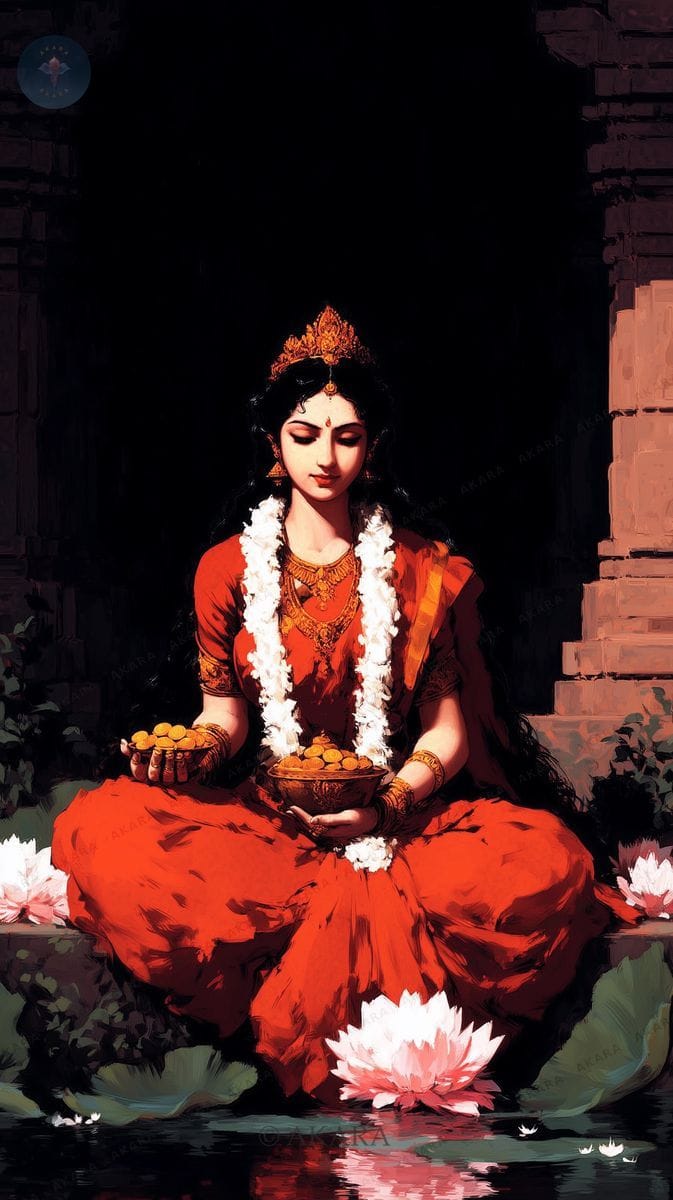
Before the world was formed and after it dissolves, there is a stillness — a vast, luminous ocean on which a figure rests in serene repose, coiled serpent beneath him, lotus blooming from his navel, the cosmos itself an exhalation of his breath. This is Vishnu, Narayana, Hari — the Preserver of dharma, the axis around which the wheel of existence turns without breaking. On every Thursday (Brihaspativaar, which tradition also honours as the day of Vishnu's blessings), devotees across the world light lamps, offer tulsi leaves, and whisper the ancient syllables: Om Namo Narayanaya. Today, with the panchang aligned to Shukla Navami under the nakshatra Vishakha — a star whose very name means 'the forked one,' symbolising purposeful direction — it is an especially fitting moment to sit with this magnificent, compassionate deity and ask: who is Vishnu, and what does he ask of us?
The Nature of Vishnu: Pervading All That Is
The Sanskrit root of the name Vishnu is vish — to pervade, to enter, to spread throughout. He is not merely a guardian sitting at some cosmic gatehouse; he is the intelligence woven into the fabric of existence itself. The Vishnu Sahasranama, one of the most beloved texts of Sanatana Dharma, opens with the declaration that Vishnu is vishvam — the universe itself — before naming him across a thousand facets of reality.
In the great triad of Hindu spirituality — the Trimurti — Brahma creates, Vishnu preserves, and Shiva dissolves. Yet the Vaishnava tradition holds that Vishnu's role of preservation is not passive maintenance. It is active, loving, engaged. He intervenes. When the balance of dharma (cosmic and moral order) is threatened, he descends. The Bhagavad Gita records his own declaration through the voice of Krishna, who is his eighth avatar: Yada yada hi dharmasya glanir bhavati Bharata... sambhavami yuge yuge — "Whenever dharma declines... I manifest, age after age" (BG 4.7–8). This is the theological heartbeat of Vishnu-bhakti: the universe is not abandoned. It is held.
Iconography: A Theology Painted in Form
To stand before an image of Vishnu is to read a scripture written in colour and symbol. He is typically depicted with a blue or dark complexion — the blue of infinite sky, of deep water, of that which has no boundary. In his four hands he holds:
- Shankha (conch shell): The primordial sound of creation, Om reverberating through matter
- Chakra (Sudarshana discus): The mind that discerns right from wrong, the wheel of time and justice that cannot be halted
- Gada (mace): The power of knowledge that dispels ignorance
- Padma (lotus): Purity, liberation, and the beauty that arises from the mud of worldly existence
He wears the Vaijayanti garland of five flowers representing the five elements, and the brilliant gem Kaustubha rests at his chest. His consort Lakshmi — embodiment of grace and abundance — is ever at his side or at his feet. His vehicle (vahana) is Garuda, the great eagle: swiftness, fearlessness, the capacity to carry the divine across the vast distances of the cosmos. And beneath him in his reclining form (Anantashayana) coils the infinite serpent Shesha, whose many hoods form a canopy — the primal energy of time and infinity cradling the lord of preservation in perfect rest.
Nothing in this iconography is decorative. Every element is a contemplation.
Stories from Scripture: When Vishnu Descended
The doctrine of the Dashavatara — the ten principal avatars of Vishnu — is among the most profound narrative theologies ever conceived. Each descent addresses a specific crisis of dharma in cosmic history.
The story of Prahlada and Narasimha is especially beloved. The demon king Hiranyakashipu had secured a boon making him seemingly invincible — he could not be killed by man or beast, by day or night, indoors or outdoors, on earth or in sky, by any weapon. He declared himself God and forbade all worship of Vishnu. Yet his own young son Prahlada remained an unwavering devotee, chanting the name of Hari even as his father subjected him to every torment. When Hiranyakashipu, furious, demanded to know if Vishnu was present in a nearby pillar and struck it with his mace, Vishnu erupted from that pillar as Narasimha — half-man, half-lion — at twilight, on a threshold, holding the demon on his lap, and tore apart the one who had mocked dharma and persecuted the devoted. The message is thunderous and tender simultaneously: the Lord is present in every pillar, every threshold, every ordinary object of the world — and the love of a devotee is never, ever abandoned.
The Gajendra Moksha from the Bhagavata Purana offers another facet. An elephant (Gajendra), seized by a crocodile and exhausted after a thousand years of struggle, finally lets go of all pride and self-reliance. He raises a single lotus flower with his trunk toward the sky and calls out to Vishnu with complete surrender. Vishnu, at that very instant, descends. The story teaches that it is not strength or ritual perfection that summons the Lord — it is genuine surrender, sharanagati, offered from the very bottom of oneself.
The Mantra: Om Namo Narayanaya
The Ashtakshara mantra — Om Namo Narayanaya, eight sacred syllables — is one of the most ancient and widely recited mantras in Hindu spirituality. Found in the Taittiriya Upanishad and expanded in the Narayana Suktam, it is simultaneously a salutation, a meditation, and a declaration of identity: I bow to Narayana; I recognise myself as belonging to the all-pervading One.
Om Namo Narayanaya — I bow to that Narayana who pervades all, who is the ground of all being.
Devotees recite it 108 times on Thursdays, often with a tulsi mala (rosary of holy basil beads). Tulsi herself is considered a form of Lakshmi, deeply sacred to Vishnu — her fragrance and presence purify the home and the mind. Thursday worship typically includes offering tulsi leaves and water to a Vishnu image or Shaligrama stone, lighting a ghee lamp, and reading a passage from the Vishnu Sahasranama or Bhagavata Purana. Even the smallest act performed with bhava (inner feeling) is complete in itself.
What Vishnu Asks of the Seeker
Of all the major deities of Sanatana Dharma, Vishnu is perhaps the one most associated with anugraha — grace. His most characteristic gesture in iconography is abhaya mudra, the hand raised in the gesture of fearlessness: do not be afraid. He does not demand asceticism or feats of will. He asks for bhakti — devotion, yes, but a devotion that gradually transforms the devotee into one who, like Vishnu himself, preserves: who protects the vulnerable, who upholds truth in daily life, who sustains relationships with steadiness and care.
In today's world, the invitation of Vishnu is startlingly relevant. He asks us to be the ones who hold — who do not abandon a difficult commitment, who remain present in the face of chaos, who trust that dharma, though it may bend, does not break. He asks us to see the divine not only in sacred spaces but in every pillar of ordinary life.
On this Thursday, under the purposeful star of Vishakha, let the name of Hari settle into the breath. Let the mantra rise like a lotus from the water. The Preserver is present — in the world, and in you.
He asks us to be the ones who hold — who do not abandon a difficult commitment, who remain present in the face of chaos, who trust that dharma, though it may bend, does not break.
शान्ताकारं भुजगशयनं पद्मनाभं सुरेशम् śāntākāraṃ bhujagaśayanaṃ padmanābhaṃ sureśam
The peaceful one resting on the serpent, lotus-naveled lord of the gods. Vishnu in his element — holding the universe together while looking effortlessly serene.
Questions & answers
Why is Thursday considered Vishnu's day in Hindu tradition?
Thursday (Brihaspativaar or Guruvaar) is associated with Jupiter (Brihaspati), the guru of the devas, who is deeply connected to Vishnu's grace and cosmic order. Tradition holds that worship of Vishnu on Thursday brings his special blessings, and many Vaishnava devotees observe a fast or enhanced puja on this day.
What is the significance of the mantra Om Namo Narayanaya?
The Ashtakshara mantra — meaning 'I bow to the all-pervading Narayana' — is one of the most ancient Vaishnava mantras, found in the Taittiriya Upanishad. Its eight syllables are said to correspond to the eight directions of space, signifying that Vishnu pervades all of existence. Reciting it 108 times, especially on Thursdays with a tulsi mala, is a common devotional practice.
What does Vishnu's blue complexion symbolise?
Vishnu's blue or dark complexion represents infinity — the boundless sky, the depths of the ocean, that which has no beginning or end. It signifies that his nature transcends the visible and the finite, pointing the devotee toward the absolute reality that underlies all appearance.
What is the story of Gajendra Moksha and why is it important?
Gajendra Moksha, from the Bhagavata Purana, tells of an elephant who, after years of struggle against a crocodile, finally surrenders completely to Vishnu and is immediately saved. The story is a teaching on sharanagati — total surrender — as the highest form of devotion. It shows that Vishnu's grace is not earned through strength or ritual alone, but through genuine, humble surrender.
How can a modern devotee observe Vishnu worship at home on Thursdays?
A simple home puja can include offering tulsi leaves and water to a Vishnu image or Shaligrama stone, lighting a ghee lamp, reciting Om Namo Narayanaya 108 times with a tulsi mala, and reading a passage from the Vishnu Sahasranama or Bhagavata Purana. Even a few minutes of sincere, attentive practice carries great meaning in the Vaishnava tradition.