Mahadeva: Meeting Shiva on a Pradosh Monday
On this rare Pradosh Monday, the Akara Times opens the door to the great mystery that is Mahadeva — destroyer, yogi, and the most intimate of gods.
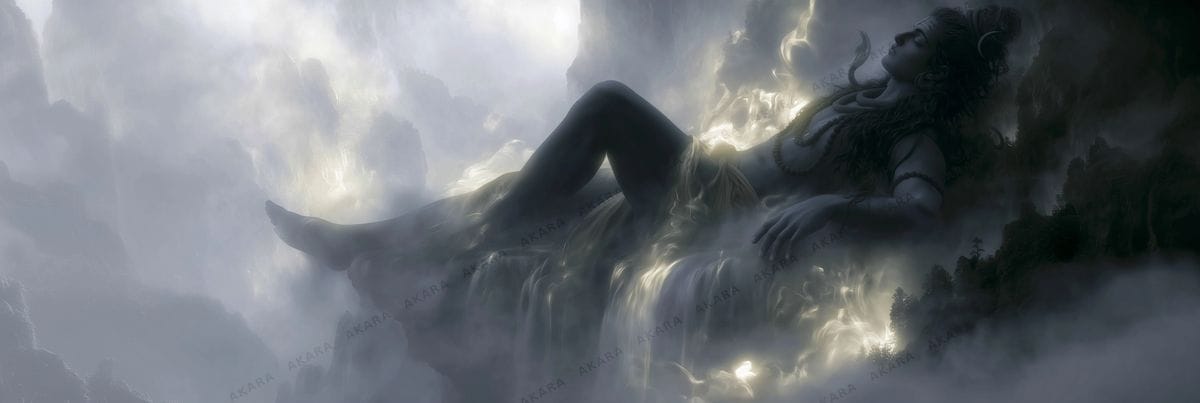
There is a moment at dusk — that liminal pause between the busyness of day and the quiet of night — when the air itself seems to hold its breath. Tradition says this is when Shiva dances. And on a Pradosh Monday like today, when the thirteenth tithi of the bright fortnight (Shukla Trayodashi) falls on Somavar, his own day, that moment becomes something rarer: a convergence of sacred time that devotees across the world have recognised for millennia as a direct opening into the presence of Mahadeva, the Great God.
Who Is Shiva?
To ask who Shiva is, is to ask one of the oldest questions in Sanatana Dharma — and to receive not one answer, but many, each as true as a facet of a jewel. In the Shaiva Agamas he is the Supreme Reality, Paramashiva, from whom all creation arises and into whom it dissolves. In the Puranas he is the brooding ascetic on Mount Kailasha, the tender husband of Parvati, the father who lifts a grieving parent's son back to life. In the philosophical vision of Kashmir Shaivism, he is pure consciousness, Chit, identical with the very awareness by which you are now reading these words.
His name itself is a teaching. Shiva (शिव) means "the auspicious one" — which is, when you think about it, a startling name for the god of dissolution. Yet Sanatana Dharma has always understood that destruction is not the opposite of auspiciousness; it is its precondition. What Shiva dissolves is not life, but the accumulated rust of ego, illusion, and all that keeps a soul from its own luminous nature. This is why the Shiva Purana calls him Kalyankari — the doer of what is good.
The Iconography and Its Meaning
Every detail of Shiva's form is a compressed scripture. Stand before any image of Mahadeva and you are looking at a map of the cosmos and a manual for inner life, simultaneously.
- The third eye (trinetra): Two eyes perceive the world of duality; the third sees through it. When it opens, it burns what is false — most famously, it reduced Kamadeva, the god of desire, to ash. Not because desire is condemned, but because clinging to it is.
- The crescent moon (Chandrakala): Shiva wears the waxing moon in his matted locks, marking him as the master of time and its cycles. On Trayodashi — the thirteenth tithi — the moon is nearing fullness, and Shiva's own symbol brightens in the sky above us.
- The Ganga flowing from his hair: When the celestial river was sent to earth, its force would have shattered the world. Shiva received her in his jata (matted hair) and released her gently — a teaching in compassion and the absorbing of overwhelming force without being destroyed by it.
- The serpent Vasuki and the necklace of rudraksha: The snake, feared by most, rests easily on Shiva. He has gone beyond fear. The rudraksha beads — said to be formed from Shiva's tears of compassion — are the preferred mala of every serious Shiva devotee.
- Nandi the bull: His gatekeeper and the very embodiment of dharma and faithful devotion. To reach Shiva, tradition says, you must first whisper your prayer into Nandi's ear — an elegant metaphor for how bhakti precedes presence.
- The Trishula (trident): Representing his sovereignty over the three states of consciousness — waking, dreaming, and deep sleep — and the three qualities (gunas) of nature.
Two Stories the Heart Remembers
Neelakantha — the Blue-Throated One: When the gods and demons churned the cosmic ocean in search of amrita (immortality), something catastrophic arose first: Halahala, a poison so potent it threatened all of creation. No one would touch it. Shiva stepped forward, took the poison in his palm, and drank it. Parvati, ever watchful, caught his throat before it could descend into his body, and the poison was held there, turning his throat a deep blue. He became Neelakantha — a name chanted to this day. The story is not mythology at a remove. It is an archetypal truth about what the greatest among us do: they consume what would destroy others, and they bear that weight so creation may continue.
Markandeya and the Grace Beyond Death: The young devotee Markandeya was destined to die at sixteen. On his final day, he clung to the Shivalinga in prayer. When Yama, the god of death, cast his noose, it encircled the linga as well. Shiva emerged in wrath, kicked Yama aside, and granted Markandeya eternal life. The Maha Mrityunjaya Mantra is said to have been born from this moment — and is chanted to this day by those facing illness, fear, or the simple human anxiety of impermanence.
Om Namah Shivaya: The Panchakshara Mantra
Om Namah Shivaya — five syllables (Na, Ma, Shi, Va, Ya), one of the most sacred sound-formulas in all of Sanatana Dharma. The Shiva Purana calls it the Panchakshara, meaning the five-lettered mantra, and maps each syllable to one of the five elements: Na (earth), Ma (water), Shi (fire), Va (air), Ya (space). To chant it is to honour the entire cosmos within oneself.
The meaning is simple and bottomless: I bow to Shiva. Or more intimately: I bow to the auspicious reality within and around me. The Kashmir Shaiva tradition reads it as a declaration of identity — not just reverence, but recognition. Chanting on a Rudraksha mala, 108 times, at the hour of Pradosh, is among the most powerful forms of Shiva worship a householder can practise.
Pradosh Vrat: Worship at the Cusp
Pradosh (pradosha — twilight, the auspicious junction) falls on the Trayodashi tithi of both fortnights each month. When it coincides with Monday — Soma Pradosh, as today's is — the potency is understood to multiply. The Skanda Purana details the Pradosh Vrat: a devotee fasts until dusk, bathes, and then, in the window between sunset and nightfall, offers bilva (bel) leaves, milk, water, flowers, and incense to Shiva. The bilva leaf, with its trifoliate form, is said to be Shiva's favourite, each lobe representing his three aspects as creator, sustainer, and dissolver.
Today, with the Sun in Karka (Cancer) and the Nakshatra Mula in its fourth pada, there is a quality of depth and turning inward in the sky's own disposition — an invitation to go to the root (mula means root) of one's own awareness. The Yoga of today, Vaidhriti, carries a reflective, even cautious energy: it is a day to pause and return to essentials, which is precisely what Pradosh Vrat asks of us.
What Shiva Asks of the Seeker
Of all the great deities, Shiva is perhaps the most paradoxical: the most terrifying and the most tender, the greatest renunciate and the most devoted husband, the destroyer who is also the supreme yogi absorbed in stillness. What does such a god ask of those who seek him?
He asks for nothing more — and nothing less — than honesty. Not perfection. Shiva's devotees include the outcast, the eccentric, the broken, and the bold. The Shiva Purana is full of unlikely saints. What Mahadeva recognises is sincerity. A single bilva leaf offered with a full heart, the scriptures say, reaches him. The Om Namah Shivaya whispered by a child in the dark reaches him.
But beneath the ritual, there is a deeper invitation. The Nataraja — Shiva as cosmic dancer — holds one foot raised in liberation and the other pressing down on the demon of ignorance (Apasmara). The message: stillness and motion, dissolution and grace, are not opposites. The spiritual life is not about escaping the world. It is about dancing through it with such clarity that nothing — not even death — can shake your centre.
"He who is Shiva is truly in all beings; and all beings are in Shiva." — Shiva Purana
This Pradosh Monday, as the light softens and the evening star appears, light a lamp. Offer a leaf. Chant the five syllables. And for a moment, be still enough to hear the drum that never stops — the damaru of Mahadeva, beating at the heart of all things.
What Mahadeva recognises is sincerity. A single bilva leaf offered with a full heart, the scriptures say, reaches him.
गिरिशं गंगाधरं सोमशेखरम् giriśaṃ gaṅgādharaṃ somaśekharam
the mountain lord who holds ganga and wears the moon as his crown. bholenath makes nature his temple.
Questions & answers
Why is Monday considered Shiva's day?
Monday is called Somavar in Sanskrit, named for Soma, the moon — which Shiva wears in his hair as Chandrashekhara. The moon is intimately associated with Shiva's cooling, meditative, and compassionate qualities, making Monday the traditional day of Shiva worship and fasting.
What is Pradosh Vrat and how is it observed?
Pradosh Vrat falls on the thirteenth tithi (Trayodashi) of both the bright and dark fortnights each month. Devotees fast until dusk, then worship Shiva and Parvati during the twilight window (approximately 90 minutes after sunset) with bilva leaves, milk, water, flowers, and the chanting of Om Namah Shivaya. When Trayodashi falls on a Monday, it is called Soma Pradosh and is considered especially auspicious.
What does Om Namah Shivaya mean?
Om Namah Shivaya is the Panchakshara mantra — the five-syllabled mantra of Shiva. Literally it means 'I bow to Shiva' or 'salutations to the auspicious one.' Each of the five syllables (Na, Ma, Shi, Va, Ya) is mapped to one of the five elements: earth, water, fire, air, and space, making the mantra a salutation to the entire cosmos.
Why is the bilva (bel) leaf sacred to Shiva?
The bilva leaf, from the bel tree (Aegle marmelos), has a distinctive trifoliate shape said to represent Shiva's three eyes, his trident (trishula), and his three aspects as creator, sustainer, and dissolver. Scripture holds that offering a bilva leaf to Shiva with devotion is equivalent to offering all flowers in the world.
What is the significance of Shiva being called Neelakantha?
Neelakantha means 'blue-throated one.' The name comes from the story of the churning of the cosmic ocean (Samudra Manthan), during which a devastating poison called Halahala arose. Shiva drank the poison to save creation; Parvati held his throat to prevent it from entering his body, turning his throat permanently blue. The name celebrates Shiva as the supreme protector who absorbs what no one else can bear.