Mahalakshmi: The Grace That Dwells in the Worthy Heart
On this auspicious Friday, we turn toward the radiant Shri — Mahalakshmi, whose lotus feet bestow abundance, beauty, and the grace that transforms an ordinary life into a sacred one.
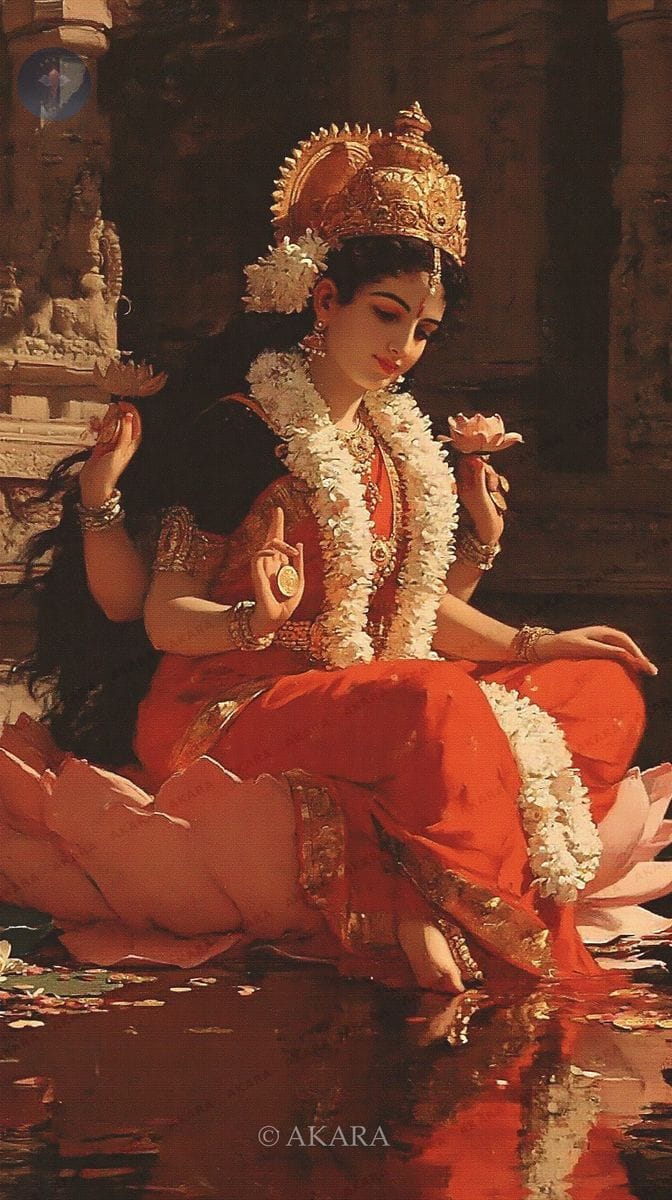
There is a quality of light that arrives quietly — not in a blaze, but the way dawn softens the sky before you notice the sun has risen. The ancient seers of Sanatana Dharma knew this quality and gave it a name: Shri. They also gave it a face, a fragrance, a sound, and a day of the week. She is Lakshmi — the goddess who does not merely grant wealth, but who *is* the grace woven into all that flourishes, all that is beautiful, and all that endures.
Who Is Lakshmi? The Many Faces of Shri
The name Lakshmi (Sanskrit: लक्ष्मी) derives from the root lakṣ — to perceive, to mark, to aim toward a goal. She is that which is auspicious and worthy of attainment. Her other great name, Shri (श्री), is both a title of reverence and an invocation of beauty itself. The Vishnu Purana describes her as the eternal consort of Lord Vishnu, inseparable from him as sunlight is from the sun — where Vishnu upholds dharma, Lakshmi provides the abundance and grace that makes dharma liveable and luminous.
She is not one goddess but eight — the Ashtalakshmi (अष्टलक्ष्मी), eight aspects governing different dimensions of prosperity: Adi Lakshmi (primordial grace), Dhana Lakshmi (material wealth), Dhanya Lakshmi (abundance of grain), Gaja Lakshmi (royal power and elephants), Santana Lakshmi (the wealth of progeny), Veera Lakshmi (courage), Vijaya Lakshmi (victory), and Vidya Lakshmi (the wealth of knowledge). This eightfold nature reminds us that prosperity in the Vedic understanding is never merely financial — it is holistic, encompassing health, courage, wisdom, and family.
The Language of Her Iconography
Every element of Lakshmi's form is a teaching. She stands or sits upon a fully bloomed pink lotus (padma), which grows rooted in mud yet rises immaculate — the perennial symbol of purity arising from the world's complexity. She wears gold and red: gold for wealth and light, red for energy, auspiciousness, and the vitality of shakti.
Her four arms carry deep meaning. Two hands hold lotuses, embodying beauty and spiritual liberation. One hand is raised in abhaya mudra (अभय मुद्र — the gesture of fearlessness and protection). The fourth hand pours gold coins earthward in varada mudra (वरद मुद्र — the gesture of bestowing boons), a perpetual act of giving. She is never hoarding; she is always in the posture of generosity.
Flanking her stand two great elephants (gaja), their trunks raised, pouring consecrated water over her in a divine abhisheka. The elephant in Indian tradition represents viveka — discernment — as well as royal dignity and memory. Lakshmi bathed by elephants is grace anointed by wisdom: the message being that true abundance chooses the discerning and the worthy.
Two Stories That Illuminate Her Nature
**The Churning of the Ocean (Samudra Manthan):** Among the most beloved narratives of the Bhagavata Purana and Vishnu Purana, this great myth tells how the devas (gods) and asuras (demons) churned the cosmic ocean of milk using Mount Mandara as a churning rod and the serpent Vasuki as the rope. From the depths arose fourteen great treasures (chaturdasha ratna). Lakshmi herself rose last from those waters — serene, radiant, garlanded with lotus flowers — and chose Lord Vishnu as her eternal consort. The story encodes a truth: grace is not given cheaply. It emerges from sustained effort, from the churning of one's own inner ocean, and from the willingness to receive both the nectar and the poison that arise in the process.
Lakshmi and the Sage Durvasa: When the irascible sage Durvasa gifted Indra, king of the gods, a divine garland and Indra carelessly placed it on his elephant (who then crushed it underfoot), Lakshmi — who had been residing in Svarga, the celestial realm — departed. The heavens immediately lost their luminosity; crops failed, rituals fell hollow, and the gods found themselves defeated by the asuras. Prosperity, this story reveals, does not automatically remain. She is Chanchala (the restless one) — she moves. Only when sincere worship was reinstated and respect for the sacred was restored did Shri return. The lesson for the present day is unmistakable: abundance requires both invitation and maintenance, through gratitude, dharmic living, and consistent devotion.
The Mantra: Om Shreem Mahalakshmiyei Namah
The seed syllable Shreem (श्रीं) is the bija mantra of Lakshmi — a single syllable containing the vibratory essence of her grace. When woven into the full mantra Om Shreem Mahalakshmiyei Namah (ॐ श्रीं महालक्ष्म्यै नमः —
या सा पद्मासना देवी पद्मवर्णा पद्मप्रिया yā sā padmāsanā devī padmavarṇā padmapriyā
She who sits on lotus, golden-hued, beloved of the sacred bloom.