Bajrangbali: The Eternal Devotee Who Carries the World
On this auspicious Tuesday, we turn to Anjaneya — the one whose very existence is an argument for the limitless power of surrender.
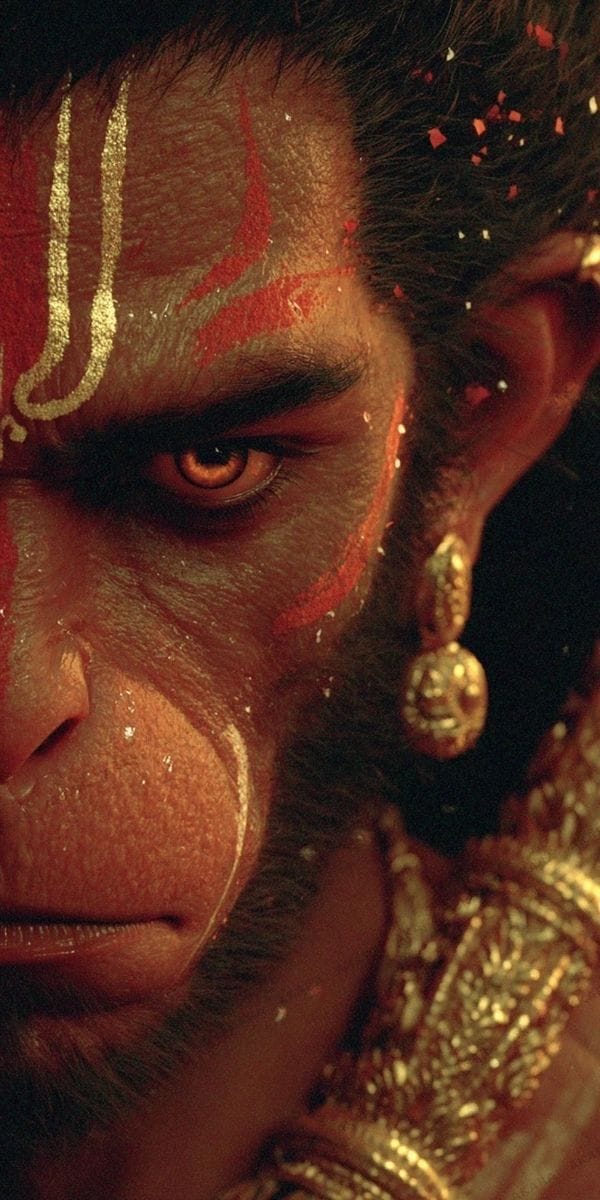
There is a moment in the Valmiki Ramayana when Hanuman, standing before a doubtful Rama who wonders how a mere vanara could have crossed the ocean, tears open his own chest to reveal what lives inside: Rama and Sita, enshrined in his heart. The gesture says everything that theology labours for centuries to express. Hanuman is not merely a deity of strength, though strength he has in unfathomable measure. He is, above all, a mirror — showing every seeker what becomes possible when ego dissolves completely into love.
Who Is Hanuman?
Hanuman — known across the traditions as Anjaneya (son of Anjana), Bajrangbali (one whose limbs are as hard as vajra, the thunderbolt), Maruti (son of the wind-god Vayu), and Pavanaputra (child of the wind) — is one of the most universally beloved figures in Sanatana Dharma. He appears principally in the Ramayana, both Valmiki's Sanskrit original and Tulsidas's sixteenth-century Awadhi retelling, the Ramcharitmanas. Yet his presence reaches into the Mahabharata, the Puranas, and countless regional traditions, each layer adding depth without contradiction.
In the cosmology of devotion, Hanuman occupies a singular station: he is a chiranjeevi — an immortal — who has taken a vow to remain present in the world as long as the name of Rama is sung. This is not legend; for hundreds of millions of devotees, it is living reality. When the Hanuman Chalisa is recited at dawn, when oil lamps are lit before his image on a Tuesday evening, when wrestlers anoint themselves with sindoor before entering the akhara — Hanuman is understood to be genuinely present, listening, empowering.
The Iconography and Its Inner Meaning
The standard murti (sacred image) of Hanuman encodes a complete philosophy.
- The monkey form: The vanara body signals the untamed, restless mind — the very mind that, through devotion and discipline, becomes the most powerful vehicle of grace. Hanuman does not transcend his animal nature; he consecrates it.
- The mace (gada): Held in one hand, it represents the power to destroy obstacles and adharma. Strength in the service of righteousness (dharma-bala) is never aggression — it is protection.
- The saffron complexion and sindoor coating: The story goes that Sita applied sindoor to her forehead for Rama's long life. When Hanuman asked why, and heard the answer, he covered his entire body in sindoor out of love for his Lord. To this day, sindoor is the foremost offering to Hanuman.
- The open chest: In some forms — most powerfully in the Hridaya Rama iconography — Hanuman parts his chest to reveal Ram and Sita within. The message is direct: the heart that has been completely surrendered becomes a temple.
- The mountain in hand: Referencing the episode of the Sanjeevani herb, this image speaks of the devotee who moves mountains — not through his own will, but because the Lord's mission courses through him.
There is also the Panchamukhi (five-faced) form of Hanuman, invoked for protection, in which he faces five directions simultaneously, each face representing a different aspect of divine power drawn from Shiva, Vishnu, and the Shakti traditions.
Two Stories That Illuminate Everything
The Crossing of the Ocean: When the vanaras reach the shore and face the vast sea between India and Lanka, despair sets in. Only Hanuman can make the leap — yet he sits quietly, head bowed. It is the sage Jambavan who reminds him of his own nature, his own limitless power, which Hanuman had forgotten due to a childhood curse. The moment he remembers, he expands to cosmic size and leaps. This story is told wherever seekers feel small before the challenges of life. The teaching is precise: our capacity is always greater than our forgetting of it. The guru — in whatever form — is the Jambavan who reminds us.
The Burning of Lanka: Having found Sita in the Ashoka grove and delivered Rama's ring, Hanuman allows himself to be captured. His tail is set ablaze by Ravana's soldiers. Rather than flee, he uses the moment: he bounds across Lanka's rooftops, burning the city. Then, remembering Sita, he extinguishes his tail in the sea. Even in apparent punishment, the devotee of Rama turns every circumstance toward the Lord's purpose. No situation, however dire, is outside the field of grace.
The Mantra: Om Hanumate Namah
The root mantra of Hanuman is Om Hanumate Namah — I bow to Hanumat, the one with mighty jaws (or, esoterically, the one who has annihilated the ego-jaw that devours peace). This mantra, repeated 108 times on a rudraksha mala, is traditionally begun on a Tuesday and sustained for 40 days for full effect — though any sincere repetition carries merit.
The Hanuman Chalisa, composed by Tulsidas in forty chaupai (quatrains), functions as an extended mantra-hymn. Recited once at dawn and once at dusk on Tuesdays, it is said in tradition to cleanse the environment of negative energies, fortify the mind, and draw Hanuman's blessings into the home. The verse "Bhuta pisacha nikata nahi aave, Mahavira jab naam sunave" — "No ghost or demon comes near when the name of the Great Hero is heard" — captures the protective dimension of Hanuman worship that spans from temple to household.
How Devotees Worship on Tuesday
Tuesday (Mangalvar) is Hanuman's day, the day when his energy is traditionally most accessible. A simple, sincere Tuesday practice:
1. Early bath and clean clothes — preferably in saffron or red tones. 2. Lamp offering: A deepa (lamp) lit with mustard or sesame oil before the murti or image. 3. Sindoor and jasmine flowers: Offered with the words "Jai Bajrangbali." 4. Recitation: Hanuman Chalisa, or at minimum the root mantra 108 times. 5. Prasad: Boondi (small fried sweet balls) or bananas, distributed after worship.
Many devotees also observe a partial fast on Tuesdays, abstaining from salt or non-vegetarian food, as an act of tapas (discipline) that sharpens the mind and focuses devotion.
Today's panchang carries the nakshatra Revati, ruled by Pushan — the nourishing, path-finding form of Surya. Revati and Hanuman share a resonance: both are associated with safe passage, protection on journeys, and the completion of what was begun. A Tuesday that falls under Revati is considered auspicious for beginning a new mantra discipline or deepening an existing one.
What Hanuman Asks of the Seeker
Hanuman does not ask for elaborate ritual. He asks for nishkama bhakti — devotion without demand, without transaction. His entire life is a demonstration: he performed the greatest feats in history and never once said "I did this." After burning Lanka, he returned to Rama and said simply, "Your work is done, Lord."
In the Akara understanding of Sanatana Dharma, this is the highest teaching of Hindu spirituality: that the self, fully offered, becomes infinitely capable. The ego that clutches its achievements remains small. The heart that empties itself of ownership is filled with the divine.
Bajrangbali stands at the threshold — of every temple, every Tuesday, every honest prayer — not as a gatekeeper but as a companion. He has crossed every ocean. He will cross yours too.
"Jai Hanuman gyan gun sagar, Jai Kapis tihun lok ujagar." Glory to Hanuman, ocean of wisdom and virtue; glory to the Lord of vanaras, who illumines the three worlds.
— Tulsidas, Hanuman Chalisa, verse 1
The heart that has been completely surrendered becomes a temple.
मनोजवं मारुततुल्यवेगं जितेन्द्रियं बुद्धिमतां वरिष्ठम्। वातात्मजं वानरयूथमुख्यं श्रीरामदूतं शिरसा नमामि॥ manojavaṃ mārutatulyavegaṃ jitendriyaṃ buddhimatāṃ variṣṭham | vātātmajaṃ vānarayūthamukhyaṃ śrīrāmadūtaṃ śirasā namāmi ||
fast as thought, swift as wind, master of his senses and supreme among the wise — we bow to hanuman, son of the wind and rama's messenger.
Questions & answers
Why is Tuesday considered Hanuman's day?
Tuesday (Mangalvar) is associated with the planet Mars (Mangala), whose qualities of energy, courage, and martial strength resonate with Hanuman's nature. Tradition holds that Hanuman is especially accessible to devotees on this day, and regular Tuesday worship is said to confer protection, strength, and the removal of fear.
What is the significance of applying sindoor to Hanuman's idol?
According to the Ramcharitmanas, Sita applied sindoor to her forehead for the longevity of Lord Rama. When Hanuman understood this, he smeared sindoor all over his body as an act of total devotion to Rama. Offering sindoor to Hanuman's murti thus reenacts this gesture of selfless love and is considered the most beloved offering to him.
What does 'Bajrangbali' mean?
Bajrang is a form of 'Vajranga,' meaning 'one whose limbs are as hard and indestructible as vajra (the divine thunderbolt).' Bali means 'mighty' or 'strong.' Together, Bajrangbali means 'the mighty one with a body hard as the thunderbolt' — a title celebrating Hanuman's invincible physical and spiritual strength.
How should a beginner start a Hanuman mantra practice?
The simplest entry point is the mantra Om Hanumate Namah, repeated 108 times on a rudraksha mala, ideally begun on a Tuesday. For those who wish to go deeper, the Hanuman Chalisa — recited at dawn and dusk on Tuesdays — is the most widely practised and accessible devotional text. Consistency and sincerity matter far more than elaborate preparation.
Who is Hanuman in relation to Shiva?
Several Shaiva and Vaishnava traditions hold that Hanuman is an amsha (partial manifestation) of Shiva himself, born into the world to serve Rama. The Panchamukhi form of Hanuman includes the face of Varaha (a form of Vishnu) alongside Narasimha, Garuda, and Hayagriva, pointing to Hanuman as a convergence point of multiple divine streams within Sanatana Dharma.