Bajrangbali: The Eternal Servant Who Holds the Mountain
On this Saturday of Krishna Dashami and the steady nakshatra Rohini, we turn to the lord of strength and bhakti — the inimitable Anjaneya.
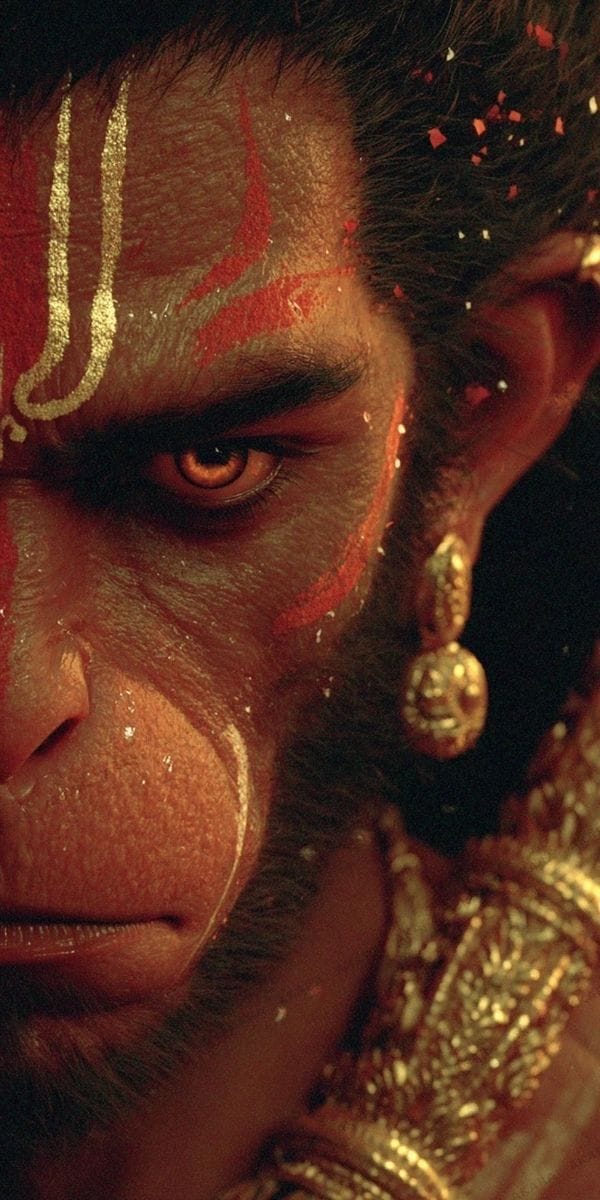
There is a figure in the vast landscape of Sanatana Dharma who defies easy categorisation. He is a vanara — a forest being — yet he speaks Sanskrit with the grace of a grammarian. He is a warrior of terrifying power, yet his eyes are always wet with devotion. He is a servant, yet no deity in the Hindu pantheon is worshipped more widely or more fervently across the subcontinent. His name is Hanuman — and on this Saturday, under the steady light of Rohini nakshatra and the yoga Dhruva (meaning 'fixed, immovable'), there is no more auspicious moment to sit with him.
Who Is Hanuman?
Hanuman is the eleventh Rudra, an avatara of Shiva's life-force, born of the wind-god Vayu and the celestial apsara Anjana — which is why he is also called Anjaneya ('son of Anjana') and Pavana-putra ('son of the wind'). In the Valmiki Ramayana, the oldest and most authoritative text in which he appears, Hanuman is introduced not with fanfare but with speech: he meets Rama and Lakshmana in the forests of Kishkindha and speaks so eloquently that Rama whispers to his brother, 'This one has mastered the Vedas. His grammar is flawless. His voice is without tremor. Even an enemy, hearing such speech, would lay down his sword.'
This is the first portrait scripture paints of him: not the muscled god leaping across oceans, but the scholar-devotee whose every word is consecrated. Strength, for Hanuman, always flows from knowledge and devotion — never the other way around.
The Iconography and Its Inner Meaning
Step into almost any temple on a Saturday morning and you will find Hanuman's murti smeared with sindoor (vermilion) and draped in a saffron or red dhoti. Every element of his form is a teaching.
- The red-orange hue (sindoor) comes from a famous episode in the Uttara Kanda: Sita applies sindoor to her parting as a sign of her devotion to Rama's long life. Hanuman, hearing this, smears sindoor over his entire body so that Rama may live forever. Devotees follow this act of radical love when they anoint his image.
- The gada (mace) he carries in one hand is the sceptre of righteous power — bala that is wielded only in the service of dharma.
- The mountain he lifts — the Dronagiri or Sanjeevani hill — is not merely a story of physical strength. It is the image of a devotee who, when he cannot find the single herb to save a life, lifts the entire hill and brings everything he has to his lord's feet. In spiritual terms: when in doubt, offer all.
- The open chest, as depicted in many murti forms, reveals Rama and Sita within his heart. His interiority is his deity. The outer form contains the inner truth.
- The tail, always raised and curled, is a mark of his vanara nature — joyful, alert, never fully domesticated by convention.
His popular name Bajrang (also Bajrangbali) is a folk rendering of Vajra-anga — 'one whose limbs are hard as vajra (diamond or thunderbolt)'. This name is used lovingly across North India and speaks to his indestructibility.
Two Stories That Reveal His Soul
The Leap to Lanka. When the army of vanaras stands at the southern shore, staring at one hundred yojanas of ocean between them and Sita, doubt descends on Hanuman himself. It is the sage Jambavan who reminds him of his own forgotten power — how, as a child, Hanuman leapt toward the sun thinking it a ripe fruit. The moment he remembers, he grows. This is one of Valmiki's quiet revolutions: the greatest strength is often hidden inside us, waiting for someone who loves us to name it. Hanuman then crosses the ocean, finds Sita, burns Lanka, and returns — all in the service of a word Rama gave him: 'find her.'
The Sundara Kanda. The fifth book of the Ramayana is named Sundara — beautiful — and many scholars believe it is named not for Lanka but for Hanuman himself, the most beautiful of devotees. When he sits before Sita in the Ashoka grove and she doubts whether this small monkey-messenger could truly be from her Rama, Hanuman recites Rama's entire lineage, qualities, and story with such precision and tenderness that Sita weeps with recognition. The scholar-devotee at work again: his mind holds Rama so completely that he becomes Rama's most accurate mirror.
The Mantra: Om Hanumate Namah
The root Hanuman mantra — Om Hanumate Namah (ॐ हनुमते नमः) — translates simply as 'I bow to Hanuman'. Hanumate is the dative form of Hanuman, meaning 'to the one who has Hanu' — a reference to his jaw (hanu) broken by Indra's thunderbolt in childhood and healed by Vayu's grace. The name, then, carries the whole biography: the wound, the healing, the gift.
Devotees repeat this mantra 108 times on Saturday mornings, often at dawn or dusk, facing east or south. In Hanuman worship, it is common to light a sesame-oil lamp (tila-taila deepa), offer red or orange flowers — particularly marigold — and recite the Hanuman Chalisa, the forty-verse hymn composed by Tulsidas in the sixteenth century that remains perhaps the most memorised religious text in the world after the Gayatri Mantra.
Today's panchang brings an additional layer of steadiness: Yoga Dhruva — the cosmic configuration named for the Pole Star — makes this an excellent day for practices one wishes to root deeply. Sankalpa (vow or intention) taken under Dhruva yoga is said to hold firm. Begin a recitation practice today, and the tradition suggests it will not easily leave you.
What Hanuman Asks of the Seeker
In the language of Hindu spirituality, Hanuman is the mahabhakta — the great devotee — rather than the object of devotion alone. This is a subtle and important distinction. He does not ask to be placed above Rama; he points always beyond himself toward Rama. When Vibhishana bows to Hanuman, Hanuman redirects the bow toward Rama standing beside him.
This quality — the ego made transparent, the self made a window rather than a wall — is what Hanuman actually asks of the seeker who approaches him. Seva (selfless service), nishkama bhakti (devotion without agenda), and shuddha bala (pure strength used only for what is right). He is patron of wrestlers, of martial artists, of students of grammar and music, of those who carry heavy things — and in all these forms, his message is the same: your capacity comes from something beyond you; use it for something beyond yourself.
In the Akara understanding of Sanatana Dharma, Hanuman is the eternal reminder that the highest spiritual state is not detached isolation but radiant, energetic service. He meditates — but he also leaps. He sits in devotion — but he also carries mountains. The inner and the outer are not at war in him; they are one flame.
A Reflection for This Saturday
Rohini nakshatra, where the Moon rests today, is the nakshatra of growth, nourishment, and beauty — it is said to be the Moon's favourite dwelling, the station where creative energy flows most easily. On a Saturday, under Dhruva yoga, in the company of Bajrangbali: this is a rare constellation of stillness and power.
Light a lamp. Speak the mantra. And consider the question Hanuman quietly poses across all his stories: What mountain are you refusing to lift because you have forgotten how strong you are?
'Wherever the story of Rama is sung, wherever his virtues are recited — there Hanuman is present, with tears in his eyes and Rama in his heart.' — Valmiki Ramayana, Yuddha Kanda
When in doubt, offer all — lift the entire mountain and bring everything you have to your lord's feet.
मनोजवं मारुततुल्यवेगं जितेन्द्रियं बुद्धिमतां वरिष्ठम्। वातात्मजं वानरयूथमुख्यं श्रीरामदूतं शिरसा नमामि॥ manojavaṃ mārutatulyavegaṃ jitendriyaṃ buddhimatāṃ variṣṭham | vātātmajaṃ vānarayūthamukhyaṃ śrīrāmadūtaṃ śirasā namāmi ||
fast as thought, swift as wind, master of his senses and supreme among the wise — we bow to hanuman, son of the wind and rama's messenger.
Questions & answers
Why is Saturday associated with Hanuman worship?
Saturday is considered Hanuman's vaar devata (day-deity) in the Hindu panchang. It is also associated with Shani (Saturn), and Hanuman is believed to protect devotees from Shani's malefic influence. Worshipping Hanuman on Saturday is one of the most widespread devotional practices in Sanatana Dharma.
What does the name Bajrangbali mean?
Bajrang is a folk form of Vajra-anga, meaning 'one whose limbs are hard as vajra (diamond or thunderbolt)'. Bali means 'the powerful one'. Together, Bajrangbali means the indestructibly powerful Hanuman — a name used with great affection across North India.
How should one recite the Hanuman mantra Om Hanumate Namah?
Ideally, sit facing east or south, light a sesame-oil lamp, and repeat Om Hanumate Namah 108 times on a Saturday morning or evening. You may also follow it with the Hanuman Chalisa. The Dhruva yoga present today is considered especially auspicious for beginning a new mantra practice.
What is the significance of Hanuman smearing sindoor on his body?
According to the Uttara Kanda of the Ramayana, Hanuman saw Sita applying sindoor in her hair parting as a symbol of her prayer for Rama's long life. Understanding that more sindoor means greater longing and protection, Hanuman covered his entire body with it. Devotees anointing Hanuman's murti with sindoor re-enact this supreme gesture of devotion.
What is the Sundara Kanda and why is it special?
The Sundara Kanda is the fifth book of Valmiki's Ramayana and is devoted almost entirely to Hanuman's mission to Lanka to find Sita. It is named Sundara — beautiful — and is considered the most spiritually potent section of the epic for daily or weekly recitation. Many devotees recite it every Saturday as an act of Hanuman worship.