Shravana Amavasya 2026: The Night the Sky Goes Dark for Shiva
On the moonless night of Shravana, the darkness does not diminish the divine — it reveals it.
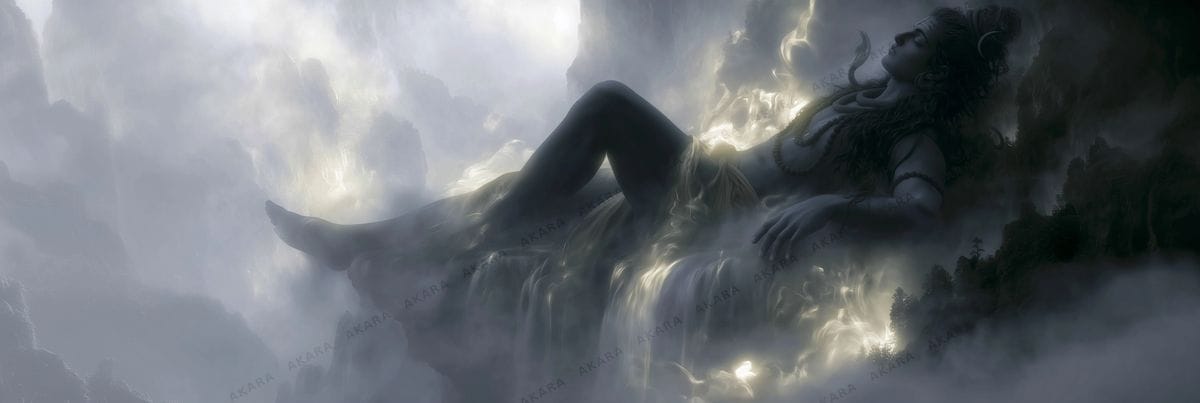
There is a moment every lunar month when the sky surrenders every trace of the moon and stands utterly still in its own depth. Tonight is that moment — magnified. Amavasya, the new-moon tithi, falls today, Wednesday 12 August 2026, within the holiest month of the Hindu calendar: Shravana, the month that belongs, above all, to Mahadeva. The panchang records the tithi as beginning at 01:52 AM IST and extending through 11:06 PM IST — a span of more than twenty-one hours, saturating almost the entire day with new-moon energy. The nakshatra is Pushya (pada 4), the yoga is Vyatipata, and the Sun rests in Karka. This is not simply an absence of moonlight. In the grammar of Sanatana Dharma, it is an invitation: to look inward, to remember the departed, and to dissolve, like Shiva himself, into the formless.
What Is Amavasya — And Why Does the Word Matter?
The Sanskrit word Amavasya (अमावस्या) carries its meaning inside itself. It derives from Ama — 'together' — and Vasya — 'dwelling': the moon dwells together with the sun, entirely hidden, absorbed into solar light. It is the fifteenth and final tithi of Krishna Paksha, the dark fortnight, marking the precise moment of astronomical new moon when the lunar disc vanishes from our sky. In the Vedic understanding, this conjunction is not a deficit but a consummation — the moon, Chandra, resting in the embrace of the sun, Surya. Twelve such tithis occur every year, each named for the month in which it falls. Tonight's is Shravana Amavasya, also known across regions as Hariyali Amavasya — hariyali meaning 'greenery' — because the monsoon has turned every field and hillside a luminous jade.
The absence of moonlight on Amavasya symbolises Shunyata (शून्यता) — the primordial emptiness from which all creation springs. Far from being inauspicious, this shunyata is the canvas on which the divine paints. And in the Shaiva tradition, no deity is more at home in that emptiness than Shiva — the Mahashunya himself, the great void in which all phenomena arise and dissolve.
Shrava Amavasya and the Lord of Shravan
The month of Shravana is, by ancient designation, Shiva's own month. Its presiding deity is Mahadeva, the Great God, and every Monday within it — Shravan Somvar — draws millions to Shivalingas across the subcontinent for abhisheka and prayer. When Amavasya falls within Shravana, the two streams of devotion — the Shaiva current of the month and the ancestral current of the new-moon tithi — merge into a single, unusually deep river.
The Puranas teach that the pitru — departed ancestors — draw closest to the earthly realm on Amavasya. But Shiva, in his aspect as Mahakala (the great lord of time and dissolution), is also the guardian of that liminal space between the living and the dead, between form and formlessness. To worship Shiva on Shravana Amavasya is, therefore, to honour both the cosmic dissolution he embodies and the specific souls who have already crossed into that dissolution. Tradition holds that this double honouring — of Mahadeva and of the pitru — in a single act of devotion yields blessings of unusual depth.
Today's panchang adds further texture. Nakshatra Pushya, which spans Cancer (Karka) — the same sign where the Sun currently rests — is celebrated in the Shiv Puran as a nakshatra intimately connected with Shiva himself. Pushya is one of the most auspicious of the twenty-seven lunar mansions, often called the king of nakshatras. It represents nourishment, spiritual growth, and the power of sadhana — disciplined spiritual practice. When Amavasya falls under Pushya, the invitation to mantra, meditation, and ancestral rites is considered especially potent.
The yoga of the day is Vyatipata — one of the twenty-seven sun-moon angular combinations — which the tradition regards as a demanding, serious-toned energy that rewards restraint and inwardness. Classical texts name Vyatipata among the yogas generally avoided for new worldly ventures, but consider it particularly suited to worship, vrata (fasting), tarpan, and prayer. The day's energy is not festive and outward; it is still, searching, and ripe for the kind of bhakti that needs no audience.
The Scriptural and Mythic Roots
The Garuda Purana speaks clearly of the Amavasya's ancestral dimension, stating that ancestors visit the earthly plane on this tithi. Offerings made — tarpan, the pouring of water mixed with black sesame seeds — are understood to nourish those souls and ease their onward journey. The Puranas teach further that performing shraddha (ritual of remembrance) on Amavasya can lead to the liberation, moksha, of departed souls.
But Shiva, the great lord of yoga and dissolution, adds a dimension the pitru rites alone cannot provide. He is Mrityunjaya — the conqueror of death — and his Maha Mrityunjaya Mantra is traditionally recited on days close to the boundaries of life and death, days like Amavasya, to seek release from fear, illness, and the cycle of rebirth. He is also Nataraja, the lord of the cosmic dance of creation and dissolution — and on the moonless night, when the dance reaches its pause between out-breath and in-breath, Shiva is most fully himself.
Shravana Amavasya is also known regionally under many names, each revealing a local emphasis: Hariyali Amavasya in the north celebrates the monsoon's green abundance. In Maharashtra it is Gatari Amavasya — a threshold day before the month's Shaiva fasting begins. In Tamil Nadu and parts of Kerala it becomes Aadi Amavasai (Aadi being the Tamil equivalent of Aadi/Shravana), devoted entirely to ancestral rites at riverbanks and seashores. In Andhra Pradesh it is Chukkala Amavasya; in Odisha, Chitlagi Amavasya. The names differ; the soul of the observance — ancestors, Shiva, the dark sky, the turning inward — remains constant.
How to Observe: Vrat, Puja, and Mantra
The Shravana Amavasya vrat is neither elaborate nor inaccessible. It asks primarily for sankalpa — intention — and sincerity. Here is how the day may be honoured, from dawn through nightfall:
- Dawn bath and sankalpa. Rise before sunrise. A bath in a river, lake, or at home with clean water drawn with a prayerful mind. Face south — the direction of Pitru Loka — and make your offering of water (arghya) mixed with black sesame seeds (til), naming each departed ancestor you remember. This is pitru tarpan, the core ancestral rite of the day.
- Shiva abhisheka. Visit a Shivalinga — at temple or home — and perform abhisheka, the sacred anointing, with water, milk, honey, curd, and, if available, Gangajal. Offer bilva leaves (bel patra), which are among Shiva's dearest offerings, along with incense and a lamp. Keep the mind quiet and the breath steady.
- Mantra and japa. The five-syllable Panchakshara mantra — Om Namah Shivaya (ॐ नमः शिवाय) — is the day's central practice. Each syllable corresponds to one of the five elements: Na to earth, Ma to water, Shi to fire, Va to air, Ya to space. Chanting this mantra is an act of interior abhisheka, anointing the five elements within oneself with divine consciousness. The Maha Mrityunjaya Mantra — Om Tryambakam Yajamahe... — may also be recited, especially for healing, protection of the household, and peace for departed souls.
- Fast and sattvic food. Many devotees observe a nirjala vrat (no food or water) or a phalahar (fruit-only) fast. The discipline is not punitive; it is a way of thinning the noise between the devotee and the divine. Avoid onion, garlic, meat, and processed food even if you do not keep a full fast.
- Feeding and giving. Offering food to cows, crows, and dogs on Amavasya is an act of ancestral care — in Sanatana Dharma, crows are regarded as messengers between the living and the departed. Donate to the needy. The tradition holds that acts of dana (giving) performed on Amavasya carry multiplied spiritual merit.
- Deep daan and evening prayer. As darkness falls completely and the sky is utterly moonless, light a lamp — at the home shrine, near a Tulsi plant, or at a river's edge. Sit in stillness. This is the moment the whole day has been building toward: the darkness of Amavasya is not emptiness to be feared but the lap of Shiva, the formless ground from which every light eventually rises.
Why It Matters Now
In an era of relentless illumination — every surface a screen, every night lit from within — the intentional observance of Amavasya is quietly radical. To sit with darkness, to remember the dead, to chant a mantra whose vibration predates the written word: this is what Sanatana Dharma has always called abhyasa — sustained, loving practice. It does not require a temple, a priest, or extraordinary conditions. It requires only that the seeker show up, honestly, to the day that the cosmos has arranged.
Shiva — Mahadeva, Shambhu, the auspicious destroyer — is not worshipped on Shravana Amavasya despite the darkness. He is worshipped because of it. His greatest teaching is that dissolution is not the end of the sacred story. It is the condition for the next verse.
The moon does not disappear on Amavasya. It simply turns entirely toward the sun.
So, today, may we also turn — entirely, without remainder — toward the light within.
The moon does not disappear on Amavasya. It simply turns entirely toward the sun.
गिरिशं गंगाधरं सोमशेखरम् giriśaṃ gaṅgādharaṃ somaśekharam
the mountain lord who holds ganga and wears the moon as his crown. bholenath makes nature his temple.
Questions & answers
When exactly is Shravana Amavasya 2026, and how long does the tithi last?
Shravana Amavasya 2026 falls on Wednesday, 12 August 2026. According to the panchang (IST), the Amavasya tithi begins at 01:52 AM and ends at 11:06 PM — spanning over 21 hours and covering virtually the entire calendar day. Timings may vary slightly by location; always verify with your local panchang.
Why is Shravana Amavasya especially important for Shiva worship?
The month of Shravana is dedicated to Lord Shiva. When the new-moon tithi (Amavasya) falls within Shravana, Shiva's domain of dissolution and the ancestral rites of the new moon converge. The tradition holds that worship of Mahadeva on this day yields blessings of unusual spiritual depth — for the devotee, and for the souls of departed ancestors.
What is Pitru Tarpan, and how is it performed on Amavasya?
Pitru Tarpan is a Vedic ancestral rite of offering water to departed souls. On Amavasya, devotees wake before sunrise, bathe, and then face south — the direction of Pitru Loka. Cupping water mixed with black sesame seeds (til) and kusha grass in both palms, they pour it slowly while chanting the names and gotras of deceased ancestors. Even a simple, sincere offering done at home carries deep merit.
What is the significance of the mantra Om Namah Shivaya on this day?
Om Namah Shivaya is the Panchakshara — the five-syllable mantra of Shiva. Each syllable (Na, Ma, Shi, Va, Ya) corresponds to one of the five elements: earth, water, fire, air, and space. Chanting it on Shravana Amavasya is understood as an inner abhisheka — anointing one's own consciousness with Shiva's light — and it is considered particularly effective when paired with sincere fasting and ancestral offerings.
What are the regional names and customs for today's Amavasya across India?
Today's Amavasya is known as Hariyali Amavasya in northern India (Rajasthan, UP, Himachal Pradesh), where planting saplings and celebrating the monsoon's greenery are customary. In Maharashtra it is called Gatari Amavasya — a day of feasting before Shravan's fasting begins. In Tamil Nadu and Kerala it is Aadi Amavasai, devoted to ancestral rites at rivers and seashores. In Andhra Pradesh it is Chukkala Amavasya; in Odisha, Chitlagi Amavasya. The names differ; the core acts of tarpan, Shiva puja, fasting, and giving remain universal.