Lord Vishnu: The Eternal Preserver Who Holds the World
On this auspicious Thursday, we enter the luminous world of Narayana — the one who abides in all beings, sustaining creation with grace.
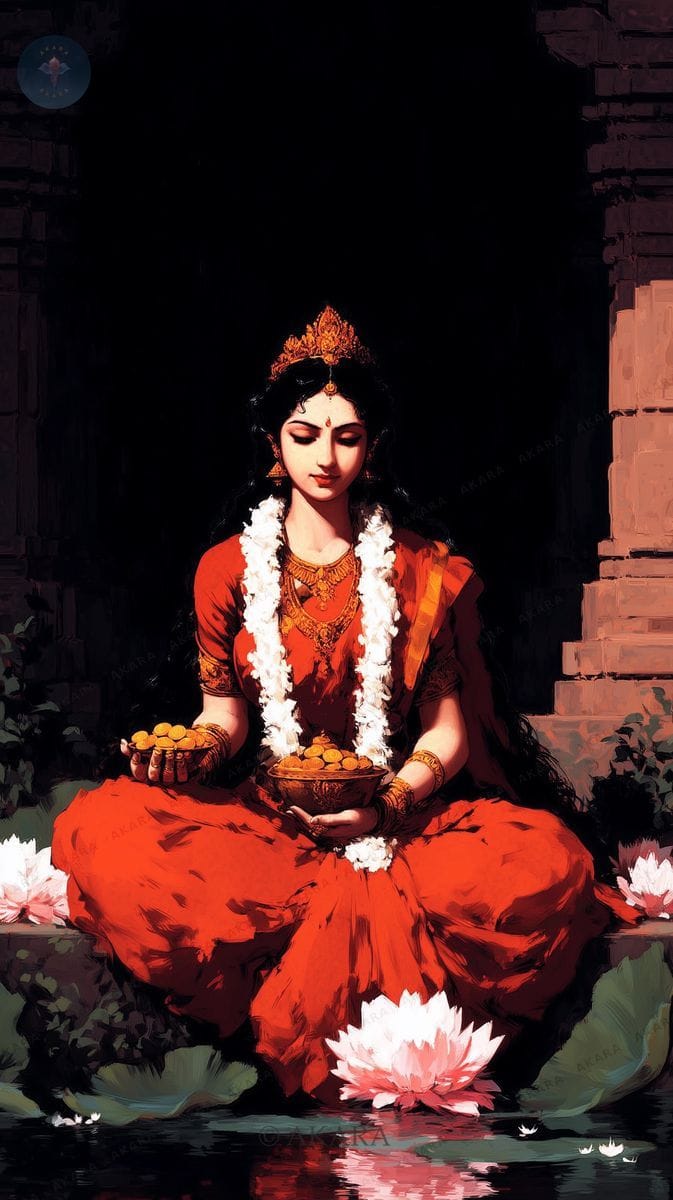
There is a stillness at the centre of a spinning world. For countless generations, devotees of Sanatana Dharma have found that stillness in the blue-bodied, lotus-eyed figure of Lord Vishnu — Hari, Narayana, the Great Preserver — reclining serenely upon the infinite ocean, even as galaxies spiral outward from his breath. To approach Vishnu is not merely to approach a deity; it is to approach the very principle that keeps existence from unravelling — the force that the Vedas call dharma, and that the heart simply calls love.
Who Is Vishnu? The Name, the Principle, the Presence
The name Vishnu (विष्णु) derives from the Sanskrit root viś — to pervade, to enter, to permeate entirely. The Vishnu Purana, one of the eighteen great Puranas, states plainly: "Vyāpanāt Viṣṇur ucyate" — he is called Vishnu because he pervades everything. This is not metaphor. In the Vaishnava darshana, Vishnu is understood as the antaryāmin, the inner controller who dwells within every atom of the universe while simultaneously transcending it. The Bhagavad Gita echoes this: "Having pervaded this entire universe with a single fragment of myself, I remain" (10.42).
Within the Trimurti — the cosmic triad of Brahma (creator), Vishnu (preserver), and Shiva (dissolver) — Vishnu holds the middle station, and that middleness is itself significant. Preservation is the quietest miracle. Creation announces itself; dissolution is unmistakable. But preservation is the ten thousand things continuing to exist from one moment to the next, love persisting through sorrow, dharma surviving in an age that tests it.
He is known by one thousand names — the Vishnu Sahasranama — each a facet of the same infinite jewel. He is Hari (the one who removes sins and sorrow), Narayana (he whose abode is the primordial waters, the ground of all souls), Madhava (the consort of Lakshmi, grace itself), Janardana (the one who is petitioned by all beings).
The Iconography and Its Meaning
Stand before any classical image of Lord Vishnu and you encounter a grammar of symbols, each speaking a theological sentence.
His skin is blue — the colour of the infinite sky and the fathomless ocean, suggesting a being whose nature exceeds any boundary the eye can draw. He is four-armed (chaturbhuja), holding four sacred objects: the shankha (conch), whose spiral form encodes the primordial Om-sound and whose call summons devotees from spiritual sleep; the chakra or Sudarshana (the blazing discus), representing the luminous mind that cuts through ignorance; the gada (mace), authority over time and mortality; and the padma (lotus), purity arising unstained from the waters of worldly existence.
He wears the jewel Kaustubha at his chest and the garland Vaijayanti of five flowers, symbolising the five elements of creation he wears as ornament, not burden. His consort Lakshmi — the goddess of grace, beauty, and abundance — rests at his feet or sits beside him, for Vishnu and Lakshmi are inseparable: where dharma is upheld, auspiciousness follows naturally.
His vehicle is Garuda, the solar eagle — the vehicle of the spirit that soars beyond the serpentine coils of ego and desire.
Two Stories That Illuminate His Nature
Gajendra Moksha — The Rescue of the Elephant King. In the Bhagavata Purana (Book 8), the elephant king Gajendra is seized by a crocodile in a lake and held fast for one thousand years. His strength fails; his herd retreats. In that extremity, stripped of pride and position, Gajendra lifts his trunk — the only limb still free — and raises a lotus offering toward heaven, crying out not his own name but the name of the Lord. Vishnu arrives instantly, riding Garuda, and with his Sudarshana chakra severs the crocodile. The story is adored not as spectacle but as teaching: the moment the ego exhausts its own resources and turns to the divine in pure surrender (sharanagati), liberation arrives. Gajendra's prayer, the Gajendra Stuti, remains one of the most beautiful expressions of bhakti in Sanskrit literature.
The Vamana Avatar — Dharma Restored by Three Steps. Among Vishnu's ten principal avatara (descents into embodied form), the Vamana (dwarf) avatar is among the most philosophically rich. The demon king Bali, though generous and noble, had conquered the three worlds through his power, displacing the gods. Vishnu took the form of a tiny brahmin boy and begged Bali for just three steps of land. Bali agreed laughingly. With his first two steps, Vamana measured out the earth and the heavens. For the third step, Bali offered his own head. Vishnu placed his foot there — and simultaneously pressed Bali into the netherworld with grace, not cruelty, honouring his extraordinary virtue. The story tells us: dharma is not about who is most powerful, but about right order; and even a noble opponent of dharma is met with dignity.
The Mantra: Om Namo Narayanaya
Om Namo Narayanaya (ॐ नमो नारायणाय) — eight syllables, called the Ashtakshara mantra, the eight-lettered jewel — is among the most ancient and revered of Vaishnava mantras, enshrined in the Taittiriya Aranyaka of the Krishna Yajurveda.
Om — the primordial sound, the name of the infinite. Namaḥ — salutation, but also na mama — "not mine," a surrender of the small self. Nārāyanāya — to Narayana, the one who abides as the innermost ground of all souls (nara).
The mantra is both a salutation and a philosophical statement: I recognise what was never truly mine as belonging to the one who pervades all. Chanted 108 times on a tulasi (holy basil) mala, or simply breathed as one sits in early morning quiet, this mantra is said to purify the subtle body and orient the mind toward its highest refuge.
Today, Thursday — Guruvaar in Sanskrit, traditionally associated with Vishnu and the grace of the guru — is a particularly auspicious day to begin or deepen a practice of this mantra.
How Devotees Worship Vishnu Today
Vishnu worship (Vishnu puja) is notable for its emphasis on bhakti — loving devotion — over elaborate ritual, though ritual too has its place. On Thursdays, households across India and the wider Hindu world offer:
- Tulasi leaves — sacred to Vishnu above all other offerings; a single tulasi leaf offered with sincerity outweighs, the Puranas say, mountains of gold
- Yellow flowers — the colour of Jupiter, the presiding planet of Thursday
- Panchamrita abhisheka — bathing the deity image in five nectars: milk, curd, honey, ghee, and sugar
- Vishnu Sahasranama recitation — the thousand names chanted in the morning
- Fasting until evening — a discipline that sharpens both body and attention
Today carries the additional blessing of Masik Durgashtami — the waxing eighth tithi sacred to Devi. In the non-dual spirit of Sanatana Dharma, Vishnu and Devi are not opposed; Vishnu's own energy (shakti) is understood in many traditions as the divine mother herself. To honour both today is not contradiction but completeness.
What Vishnu Asks of the Seeker
Of all the great deities, Vishnu is perhaps the most patient. He does not demand austerity unto extremity, nor dramatic renunciation. What he asks — across the Bhagavata Purana, the Vishnu Purana, the Gita — is steadiness: a daily return to dharma, a willingness to act rightly even when it is inconvenient, and an underlying trust — not naive optimism, but the deep vishvas (faith) that the universe is, at its root, not indifferent.
He asks us to be, in our own lives, small preservers: to hold relationships with care, to sustain practices that nourish the spirit, to protect what is good in the world around us. Garuda, his eagle, need not be extraordinary to serve — it needs only to fly true.
"Fix your mind on Me, be devoted to Me, worship Me, bow down to Me. So shall you come to Me. I promise you truly, for you are dear to Me." — Bhagavad Gita 18.65
On this Thursday, as Vishakha nakshatra casts its expansive, hopeful light and the sun blazes in Simha, the invitation from Lord Vishnu — from Hari, from Narayana — is the same it has always been: turn toward the light that pervades you, and rest there.
The moment the ego exhausts its own resources and turns to the divine in pure surrender, liberation arrives.
शान्ताकारं भुजगशयनं पद्मनाभं सुरेशम् śāntākāraṃ bhujagaśayanaṃ padmanābhaṃ sureśam
The peaceful one resting on the serpent, lotus-naveled lord of the gods. Vishnu in his element — holding the universe together while looking effortlessly serene.
Questions & answers
Why is Thursday considered Vishnu's day?
Thursday, known as Guruvaar in Sanskrit, is traditionally associated with Lord Vishnu and the planet Jupiter (Brihaspati). Jupiter is considered the guru of the gods and is linked to wisdom, grace, and expansion — qualities that resonate with Vishnu's role as the divine preserver and sustainer of dharma. Devotees observe fasts, chant the Vishnu Sahasranama, and offer tulasi leaves on Thursdays as a regular act of devotion.
What does the mantra Om Namo Narayanaya mean?
Om Namo Narayanaya is the eight-syllable (ashtakshara) mantra sacred to Vishnu, found in the Taittiriya Aranyaka of the Yajurveda. Om is the primordial sound; Namah means salutation and also signals surrender of the ego (na mama — 'not mine'); and Narayanaya means 'to Narayana,' the one who abides as the innermost ground of all souls. Together, the mantra is both a prayer and a philosophical act of offering the self to the divine.
What are Vishnu's four attributes held in his hands?
Vishnu's four arms hold four sacred objects: the shankha (conch), which represents the primordial sound of creation; the Sudarshana chakra (discus), symbolising the illumined mind that destroys ignorance; the gada (mace), representing authority over time and mortality; and the padma (lotus), symbolising purity and spiritual grace arising from the material world.
What is the significance of the Gajendra Moksha story?
Gajendra Moksha, narrated in the Bhagavata Purana, tells of an elephant king seized by a crocodile who, after exhausting all his own strength, surrenders completely to Vishnu and is immediately rescued. The story is cherished as a teaching on sharanagati — total surrender — showing that divine grace arrives precisely when the ego ceases its struggle and calls upon the Lord with wholehearted devotion.
Can Vishnu and Devi be honoured together on the same day?
Yes. Sanatana Dharma recognises a fundamental unity underlying all divine forms. Vishnu's own creative power is understood in many traditions as the divine shakti, or the goddess herself. On days like Masik Durgashtami that fall on a Thursday, honouring both Devi and Vishnu is considered complementary and auspicious — an expression of the non-dual understanding that all divine manifestations arise from the same infinite reality.