Mahadeva: Who Shiva Is and What He Asks of the Seeker
On this Monday sacred to Shiva, we turn toward the Lord of Dissolution — auspicious, austere, and infinitely compassionate.
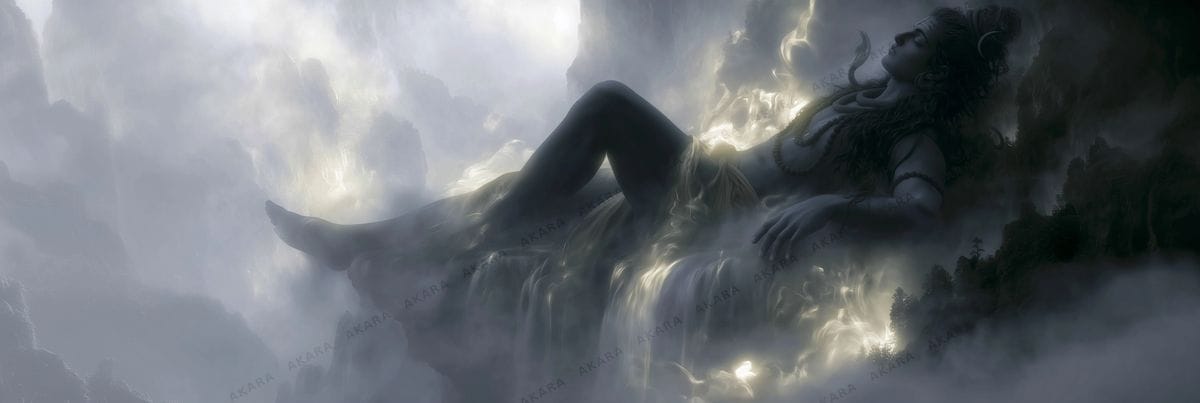
Before creation stirs, before a single syllable is spoken into the void, there is stillness. Sanatana Dharma names that stillness Shiva. Not absence, not mere emptiness — but the fullness that holds every possibility within itself, the way a deep mountain lake holds the sky without grasping it. On Mondays, which tradition designates as Somavara, the day belonging to Shiva, temples fill with the fragrance of bilva leaves, with the sound of water poured over the linga, and with the ancient syllables of Om Namah Shivaya rising like smoke into the morning air. To encounter Mahadeva — the Great God — is to encounter something that refuses to be domesticated by easy explanation. He is the destroyer who makes room for birth; the ascetic who is also a householder; the dancer whose rhythm is the pulse of every cosmos. This is his portrait, drawn from scripture, symbol, and the living breath of bhakti.
The Name Behind All Names
Shiva (Sanskrit: शिव, śiva) means literally "the auspicious one," from the root śiv, to be propitious. This is already a teaching. The tradition does not name the force of dissolution "the terrible" or "the punisher" — it names him Auspicious. Whatever Shiva dissolves, he dissolves with grace, clearing the field for the next flowering. He is also called Mahadeva (महादेव, mahādeva) — Great God — and Shankara, the one who brings welfare; Maheshvara, the Supreme Lord; Nataraja, King of the cosmic dance; Bholenath, the innocent-hearted one who is easily pleased. Each name is a window into a different chamber of the same vast dwelling.
In the Vedic corpus he appears as Rudra — the howler, the storm, the archer whose arrow brings fever and whose balm brings healing. The Shri Rudram of the Krishna Yajurveda addresses him in both his fierce and his gentle aspects in the same breath, teaching devotees that terror and tenderness are not opposites in the divine economy. By the time of the Puranas — particularly the Shiva Purana, the Linga Purana, and the Skanda Purana — Rudra has been fully recognized as Shiva, the Supreme Being of the Shaiva tradition, the Absolute himself wearing a personal face so that devotees can love him.
The Icon and Its Inner Meaning
No image in all of Hindu spirituality is more dense with meaning than the form of Shiva as tradition has refined it over millennia. Each element is a scripture in itself.
- The crescent moon (Soma) rests in his matted locks (jata), marking him as the Lord of time and of the mind, for the moon in Vedic symbolism governs both. Today's panchang notes that we sit in the nakshatra Revati, the last star of the lunar zodiac — an appropriate moment to contemplate the one who holds the moon as an ornament.
- The third eye (triksha or trinetra) on his forehead is not merely a weapon that burned Kama to ash; it is the eye of wisdom (jnana chakshu) that perceives what the two ordinary eyes of sense and intellect cannot. To open this eye within oneself is the goal of yoga.
- The Ganga flows from his matted hair. The myth is precise: the celestial river, descending with tremendous force that would have shattered the earth, was received first into Shiva's locks. He alone could absorb what no created thing could withstand.
- The serpent (naga) coiled at his throat and worn as an ornament represents kundalini shakti, the primal energy that yoga seeks to awaken — tamed not by suppression but by mastery.
- The trishula (trident) in his right hand stands for the three powers of creation, sustenance, and dissolution; for the three gunas; for the three states of waking, dream, and deep sleep that he transcends and encompasses.
- The drum (damaru) in his left hand, especially vivid in the Nataraja form, pulses with the first sound of creation — the Vedas tell us that grammar itself, the structure of all language, was revealed through the fourteen sutras sounded from Shiva's damaru.
- Vibhuti (sacred ash) smeared on his body is perhaps his most confronting ornament: the reminder that all matter returns to ash, that what we are attached to will dissolve, and that this knowledge, rightly held, is liberation rather than grief.
Two Stories the Tradition Cherishes
**The Churning of the Ocean (Samudra Manthan):** When gods and demons churned the cosmic ocean seeking amrita, the nectar of immortality, the first thing to emerge was not nectar but halahala — a poison of such terrible potency that it threatened to annihilate all creation. Neither gods nor demons could touch it. In that moment of collective helplessness, Shiva alone stepped forward, took the poison into his palm, and drank it. Goddess Parvati, his consort, caught his throat so the poison would not reach his heart. It lodged in his throat, turning it blue — hence his name Nilakantha, the blue-throated one. The story is told not as mythology but as a living truth: the one who has truly mastered himself can absorb the world's poison without being destroyed by it. Great teachers, great saints, great mothers do this every day.
Shiva and the Sage Markandeya: The young sage Markandeya was destined by his karmic configuration to die at sixteen. When Yama, the lord of death, came to claim him, Markandeya clung to the Shiva linga in the temple, crying out in devotion. Shiva emerged from the linga himself, drove Yama away, and granted Markandeya the boon of eternal youth. The Mahamrityunjaya Mantra — Om Tryambakam Yajamahe... — the great death-conquering hymn of the Rigveda — is associated with this lineage of devotion. Shiva does not conquer death by denying it; he reveals that the Self which the devotee truly is was never subject to death in the first place.
Om Namah Shivaya: The Panchakshara
Of all the mantras in the Shaiva tradition, Om Namah Shivaya (ॐ नमः शिवाय) is called the Panchakshara — the five-syllable mantra — for the five sacred syllables Na-Ma-Shi-Va-Ya that follow the Om. Each syllable corresponds to one of the five elements (panchabhutas): earth, water, fire, air, and space; and to one of the five acts of Shiva: creation, sustenance, dissolution, concealment, and grace.
Namah means not merely "I bow" but "not mine" — a surrender of the ego's claim of authorship over life. The entire mantra is thus a complete philosophy in eleven syllables: the devotee recognizes that she is made of the five elements, that all five acts are divine operations, and that the correct response to this recognition is not grasping but offering. This mantra, drawn from the eighth anuvaka of the Shri Rudram, has been chanted continuously in India for at least three thousand years.
On Somavara, devotees rise before dawn, bathe, and approach the Shiva linga with panchamrita abhisheka — a ritual bathing with milk, curd, honey, ghee, and sugar — followed by bilva (bael) leaf offerings. The bilva is sacred to Shiva because its three-lobed leaf represents the three gunas, the three eyes of Shiva, and the trinity of Brahma-Vishnu-Maheshvara. Even a single bilva leaf, offered with sincerity, is said in the Shiva Purana to surpass elaborate ritual done without feeling.
What Mahadeva Asks of the Seeker
Shiva's paradox is his gift. He is the great ascetic who sits in the snow of Kailasa in meditation — and he is the devoted husband of Parvati, the father of Ganesha and Kartikeya. He is simultaneously the ultimate renunciant and the one who shows that renunciation is an inner act, not an external one. You do not have to abandon the world to belong to Shiva. You have to abandon the illusion that the world belongs to you.
The yoga he embodies — sometimes called Shiva Yoga or simply the path of jnana fused with bhakti — asks the seeker to sit with what is difficult, to receive the poison rather than flee it, to let the third eye of discernment open slowly through practice and surrender. He does not promise comfort. He promises truth, which is ultimately the same as bliss (ananda) — though the path to that bliss sometimes winds through the cremation ground, the shmashana, where all that is false is burned away.
"He who knows Shiva knows the Self. He who knows the Self has nothing more to know." — Spirit of the Shiva Upanishad
Today, under the nakshatra Revati — the star of completion and crossing-over, presided over by Pusha, the nourisher — and in the yoga called Ganda, which the tradition marks as a time for careful, conscious action, there is particular beauty in turning toward Mahadeva. Light a lamp. Pour water. Say the name. Not because ritual compels the divine, but because the act of turning, honestly and without agenda, is itself the beginning of what Shiva has been waiting to give you all along.
Har Har Mahadeva.
He does not promise comfort. He promises truth — which is ultimately the same as bliss, though the path sometimes winds through the cremation ground.
गिरिशं गंगाधरं सोमशेखरम् giriśaṃ gaṅgādharaṃ somaśekharam
the mountain lord who holds ganga and wears the moon as his crown. bholenath makes nature his temple.
Questions & answers
Why is Monday considered Shiva's day?
Monday is called Somavara in Sanskrit — the day of Soma, the moon. Shiva bears the crescent moon in his matted locks and is intimately connected with the lunar force that governs mind, time, and tides. Tradition holds that fasting or offering worship on Somavara earns Shiva's special grace, and this observance is described in several Puranas including the Shiva Purana.
What does Om Namah Shivaya mean?
Om Namah Shivaya is the Panchakshara — the five-syllable mantra (Na-Ma-Shi-Va-Ya). 'Namah' means 'not mine' or 'I surrender,' signifying the release of ego. The five syllables correspond to the five elements and five cosmic acts of Shiva. The mantra is drawn from the Shri Rudram of the Krishna Yajurveda and is one of the most ancient continuously chanted mantras in the world.
What is the significance of Shiva's blue throat?
Shiva's blue throat earned him the name Nilakantha (blue-throated). During the churning of the cosmic ocean (Samudra Manthan), a deadly poison called halahala emerged that threatened all creation. Shiva drank the poison to protect the universe; his consort Parvati pressed his throat so it would not descend further. The blue throat is a symbol of compassion, self-mastery, and the capacity to absorb suffering without being destroyed by it.
What are bilva leaves and why are they offered to Shiva?
Bilva (Sanskrit: bilva; the bael tree, Aegle marmelos) leaves are the most sacred offering to Shiva. Their characteristic three-lobed form is said to represent Shiva's three eyes, the three gunas (qualities of nature), and the trinity of Brahma, Vishnu, and Maheshvara. The Shiva Purana states that one bilva leaf offered with genuine devotion surpasses elaborate ritual performed without feeling.
What is the Mahamrityunjaya Mantra?
The Mahamrityunjaya Mantra — 'Om Tryambakam Yajamahe Sugandhim Pushtivardhanam, Urvarukamiva Bandhanan Mrityor Mukshiya Maamritat' — is the great death-conquering hymn found in the Rigveda (7.59.12). It invokes Shiva as the three-eyed one (Tryambaka) and seeks liberation from the cycle of death and rebirth. It is particularly associated with the story of the young sage Markandeya, whose devotion to Shiva defeated Yama, the lord of death.