Shri Mahalakshmi: Grace, Abundance, and the Heart of Devotion
On this auspicious Friday, we turn to Shri Mahalakshmi — the radiant goddess whose grace is not merely fortune, but the fullness of a life well lived.
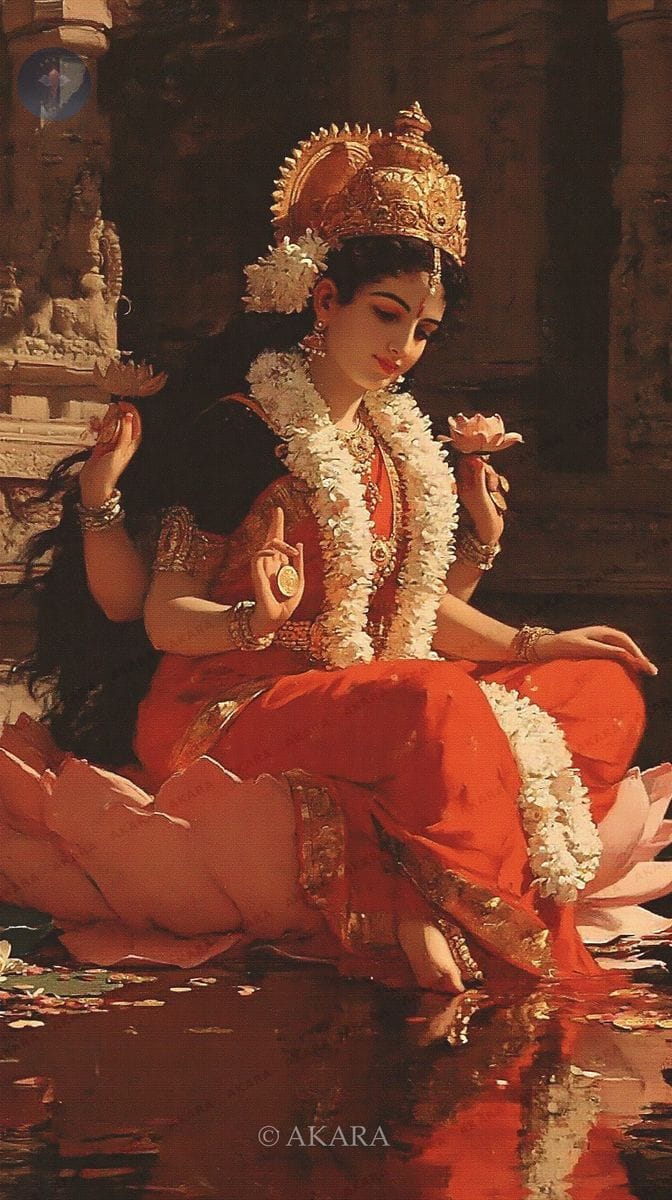
There is a moment in many Indian households, just as the sun begins its descent on a Friday evening, when a small lamp is lit before an image of Lakshmi. A handful of rice, a marigold, perhaps a streak of red kumkuma — the gesture is simple, unhurried, and ancient beyond reckoning. In that quiet act of devotion, something older than any calendar stirs. Shri Mahalakshmi — goddess of abundance, grace, and auspiciousness — does not demand elaborate ceremony. She asks, above all, for a clean heart and an open hand.
Who Is Shri Mahalakshmi?
In the vast cosmology of Sanatana Dharma, Lakshmi is among the most universally beloved of all divine presences. She is the Shri — a Sanskrit word that carries within it beauty, radiance, and all that is auspicious — whose name devotees whisper before any sacred undertaking. As the consort of Lord Vishnu, the preserver of all creation, she embodies Prakriti in her most benevolent aspect: nurturing, sustaining, flowering.
The Vishnu Purana describes her as arising from the cosmic ocean at the beginning of time, seated upon a lotus, luminous and serene. She is Mahalakshmi — the great Lakshmi — when her sovereignty extends beyond material wealth into the deeper provinces of dharmic living: courage (Veeralakshmi), wisdom (Vidyalakshmi), progeny (Santanalakshmi), victory (Jayalakshmi), food and nourishment (Dhanyalakshmi), patience and forbearance (Dhairyalakshmi), and of course prosperity (Dhanalakshmi). These eight aspects, the Ashtalakshmi, remind us that divine abundance is never one-dimensional.
The Language of Her Form
Iconography in the Hindu tradition is never decorative. Every element of a deity's image is a compressed teaching, a visual mantra. Lakshmi is almost always depicted seated or standing upon a fully bloomed pink lotus — the padma — which rises from muddy water yet remains unstained. This is her first instruction to the seeker: to live in the world fully, engaged and generous, without being soiled by its anxieties.
She is four-armed (chaturbhuja). Two hands release a shower of golden coins — the gesture called Varada mudra (the boon-giving hand) — signifying that her abundance flows freely toward those who are ready to receive it. A third hand holds a lotus bud, symbol of purity and potential. The fourth offers Abhaya mudra, the sign of fearlessness and protection: do not be afraid. Two elephants (gaja) flank her, pouring consecrated water from raised trunks — Gajalakshmi, an ancient form predating even the Puranas — representing royal dignity, the rains that bring the harvest, and the cleansing power of divine grace.
Her complexion is described as suvarna — golden — though some traditions depict her in resplendent white or the deep rose of a twilight sky. She wears red, the colour of auspiciousness and life-energy. Every detail conspires toward the same truth: she is fullness itself.
Stories from the Ocean of Scripture
The most celebrated narrative surrounding Lakshmi is the Samudra Manthan — the churning of the cosmic ocean — recorded in the Bhagavata Purana, the Vishnu Purana, and the Mahabharata. When the gods (devas) and demons (asuras) churned the primordial ocean using Mount Mandara as the churning rod and the serpent Vasuki as the rope, fourteen precious things emerged. Lakshmi was among them — arising last, seated on a lotus, bearing a garland. She surveyed all of creation before choosing Lord Vishnu as her eternal consort. The gods celebrated; the demons despaired. What the story encodes is profound: abundance does not fall indiscriminately. It settles where dharma, perseverance, and cosmic alignment meet.
A second story, less often told, concerns her departure. When King Bali — righteous but proud — conquered the three worlds, Lakshmi accompanied him, for his virtue was genuine. But when Bali's arrogance displaced the devas, Lakshmi quietly withdrew. Without her, even the mightiest kingdom withered. Lord Vishnu, in his Vamana avatar, eventually restored the cosmic order, and Lakshmi returned. The teaching is unsparing: Shri does not remain where ego crowds out gratitude. Grace is not a possession. It is a guest.
The Friday Tradition and Today's Panchang
Friday — Shukravaar — is consecrated to Lakshmi throughout the Hindu world. The planet Shukra (Venus) governs beauty, refinement, and prosperity, making Friday the natural day for her worship. Devotees wake early, bathe, and dress in fresh clothes — ideally yellow or red — before approaching the altar.
Today's panchang carries its own texture. We are in Krishna Ashtami — the waning eighth, which also honours Bhairava, Shiva's fierce guardian form — and the nakshatra is Rohini, the most beloved of the Moon's consorts, associated in Jyotisha with beauty, fertility, and material abundance. Yoga Harshana — literally "joyfulness" — blesses the day further. The Sun rests in Simha (Leo), its own rasi, conferring strength and nobility. That Lakshmi's day falls within such a confluence is itself a gentle reminder of how the cosmos conspires toward grace for those who are attentive.
Worship of Lakshmi today typically includes: the lighting of a deepa (lamp) with ghee or sesame oil; offering lotus flowers, marigolds, or any fragrant white bloom; placing fresh fruits and sweets before the image; and the recitation of the Shri Sukta — sixteen verses from the Rigveda Khila, among the oldest devotional hymns in human history — or the Lakshmi Ashtottara, her 108 names.
The Mantra: Om Shreem Mahalakshmiyei Namah
Om Shreem Mahalakshmiyei Namah — this is among the most widely recited of all Lakshmi mantras, and rightly so. Om is the primordial sound, the ground of being. Shreem is the bija — the seed syllable — of Lakshmi herself, considered by the Tantric tradition to carry within its single syllable the entire vibrational signature of the goddess. Mahalakshmiyei places her in the dative case: "to the great Lakshmi." Namah is the bow, the offering of the self.
The mantra is ideally repeated 108 times on a Tulsi or Sphatika (crystal) mala, seated facing east or north, on a Friday morning or evening. But tradition is flexible in its mercy: even a single sincere repetition, offered with a quality of bhakti — heartfelt devotion — carries its own weight. The Agamas note that the mantra is not a transaction but a turning: a re-orientation of the mind toward gratitude, sufficiency, and the recognition that all abundance is ultimately the goddess's to give and to withdraw.
What Lakshmi Asks of the Seeker
It is easy to approach Lakshmi with a list. Our tradition does not discourage petition — the Puranas are full of devoted kings and sages who asked, and received. But the deeper theology of Lakshmi worship, visible in every story and every symbol, is this: she is attracted to saucha (cleanliness and purity), karma (right action), and sattvic intention. She departs where there is miserliness, where wealth is hoarded without generosity, where the home is disordered in body or in spirit.
Akara's understanding of the devotional path holds that the goddess is not separate from the world she graces. When we clean our homes before Friday worship, we are not merely tidying. When we offer even a small portion of our abundance to another — food to the hungry, care to the lonely — we are not performing charity. We are, in the language of Sanatana Dharma, creating the conditions in which Shri can remain.
"Na so'sti pratyayo loke yah sarair api na sprishta" — there is nothing in this world untouched by her grace.
On this auspicious Friday, under a nakshatra of beauty and a yoga of joy, light your lamp. Speak her name. And let the deeper abundance — the kind that cannot be counted — find its way in.
Grace is not a possession. It is a guest — and she departs where ego crowds out gratitude.
या सा पद्मासना देवी पद्मवर्णा पद्मप्रिया yā sā padmāsanā devī padmavarṇā padmapriyā
She who sits on lotus, golden-hued, beloved of the sacred bloom.
Questions & answers
Why is Friday considered Lakshmi's day?
Friday is called Shukravaar in Sanskrit, governed by the planet Shukra (Venus). In Jyotisha (Vedic astrology), Shukra presides over beauty, prosperity, and refinement — qualities that directly mirror Lakshmi's nature. This alignment made Friday the natural day for her worship across nearly all regional Hindu traditions.
What is the meaning of the mantra Om Shreem Mahalakshmiyei Namah?
Om is the primordial sound of creation. Shreem is the bija (seed) syllable of Lakshmi, said to carry her complete vibrational essence. Mahalakshmiyei is the dative form of Mahalakshmi, meaning 'to the great Lakshmi.' Namah means 'I bow' or 'I offer myself.' Together the mantra is an act of surrender and alignment with the goddess's grace.
Who are the Ashtalakshmi?
The Ashtalakshmi are the eight principal forms of Lakshmi, each governing a different dimension of abundance: Dhanalakshmi (wealth), Dhanyalakshmi (grain and nourishment), Veeralakshmi (courage), Gajalakshmi (power and royalty), Santanalakshmi (progeny), Vijayalakshmi (victory), Vidyalakshmi (knowledge), and Dhairyalakshmi (patience and fortitude).
What is the story of the Samudra Manthan and how does it relate to Lakshmi?
The Samudra Manthan, or churning of the cosmic ocean, is described in the Bhagavata Purana and Vishnu Purana. The gods and demons churned the primordial ocean to obtain its treasures. Lakshmi emerged from the churning seated on a lotus and, after surveying all creation, chose Lord Vishnu as her consort. The story teaches that divine abundance arises through sustained dharmic effort and settles where cosmic order prevails.
How should one worship Lakshmi at home on a Friday?
Traditionally, devotees bathe early, wear fresh clean clothes (preferably yellow or red), light a ghee lamp before Lakshmi's image, offer lotus or marigold flowers, place fresh fruits and sweets, and recite either the Shri Sukta (from the Rigveda), the Lakshmi Ashtottara (108 names), or the mantra Om Shreem Mahalakshmiyei Namah 108 times on a mala. Keeping the home clean and giving some portion of one's abundance to others is considered an essential part of the worship.