Aja Ekadashi 2026: The Tithi of the Unborn, the Grace of the Eternal
On this Krishna Ekadashi in Bhadrapada, the eleventh lunar day invites every seeker to step into lightness — body, mind, and memory turned toward Narayana.
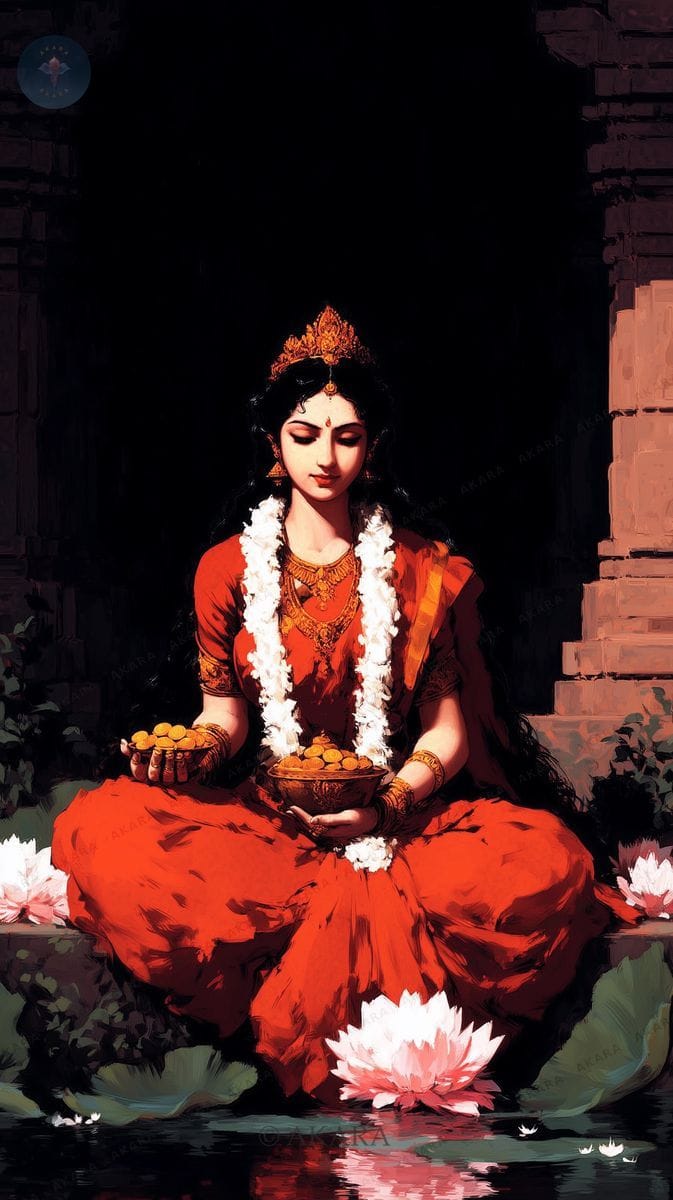
There is a moment in the Hindu lunar month when the moon has waned to its eleventh station and the sky grows very quiet. That moment is Ekadashi — the tithi the Vishnu Purana and the Markandeya Purana call, remarkably, a living form of Vishnu himself. Today, Monday, 7 September 2026, is Aja Ekadashi: the Ekadashi of Bhadrapada Krishna Paksha, named for the quality of the Lord who is Aja — the Unborn, the One who was never not. For those who observe it with understanding, it is not merely a fast day. It is an appointment with the Preserver of all worlds.
What Is Ekadashi — and What Does the Name Mean?
The word Ekadashi (एकादशी) is Sanskrit for "the eleventh" — eka (one) and dashi (ten) combining to name the eleventh day of each lunar fortnight. There are two in every lunar month: one in the bright fortnight (Shukla Paksha) and one in the dark (Krishna Paksha). Across the turning year of Sanatana Dharma, this produces twenty-four Ekadashis, each with its own name, its own vrat katha (sacred narrative), and its own particular quality of grace.
Today's Ekadashi carries a name of unusual depth. Aja (अज) means "unborn" — that which has neither beginning nor end. It is one of the thousand names of Lord Vishnu recorded in the Vishnu Sahasranama, pointing to His nature as the substratum of all existence, the Preserver who was never absent from any moment of creation. To fast on this day is, in the language of the tradition, to touch that which is beyond time while still standing within it.
<br/>
The Panchang for Today: Tithi, Nakshatra & What They Together Mean
For devotees in Pune and across Maharashtra, the precise Panchang for today is this: the Ekadashi tithi began at 7:29 PM on Sunday, 6 September, and remains present through 5:03 PM on Monday, 7 September — a window of just over twenty-one hours. Because the tithi is present at sunrise today, the vrat is observed on this day. Parana, the sacred breaking of the fast, is to be performed on Tuesday, 8 September, in the morning window between approximately 6:21 AM and 8:50 AM IST (Pune timings). Those in other cities — Mumbai, Delhi, Bengaluru, or abroad — should confirm the Parana window against a Panchang calculated for their own location, as sunrise governs the timing and it shifts across latitudes.
The Nakshatra presiding today is Punarvasu (पुनर्वसु), second pada — a constellation whose very name means "the return of light" or "becoming good again." Its ruling deity is Aditi, mother of the Adityas, goddess of boundless space and renewal. There is something quietly auspicious in this pairing: a fast devoted to the Eternal Lord, held under a star that speaks of restoration. The Yoga is Vyatipata — a sobering configuration that the tradition regards as demanding special attentiveness, making the day one for inward discipline rather than outward enterprise. The Sun stands in Simha (Leo), the royal sign, illuminating themes of sovereignty, courage, and the light that does not bow. All of this, read together in the Akara spirit, forms a day shaped for the seeker who wishes to do serious inner work.
This year, Aja Ekadashi also falls on a Monday — Somvar, the day consecrated to Lord Shiva. Many devotees mark the convergence with a simple jalabhishek (water offering) to Shiva in the early morning before turning fully to the Vishnu puja, honouring the unity within Sanatana Dharma's great river of devotion.
<br/>
The Katha: Harishchandra and the Promise Behind the Fast
Every Ekadashi has a vrat katha — a narrative the scriptures prescribe to be read or heard on the day itself, because the story is not decoration but transmission. The Katha of Aja Ekadashi, as told by Lord Krishna to King Yudhishthira in the sacred dialogue preserved in the Puranas, centres on Satyavadi Harishchandra — the king whose name itself means "moon of truth."
Harishchandra was a sovereign of impeccable righteousness. Tested beyond measure by Sage Vishwamitra, he was stripped of kingdom, wealth, wife, and child. He was sold into servitude at a cremation ground, reduced to the role of a chandala's assistant, and yet — at every turning, in every humiliation — he would not speak a single untruth. His fidelity to dharma cost him everything the world considers worth having.
It was on this very tithi of Aja Ekadashi that the sage Gautama appeared and revealed to Harishchandra the power of this fast. The king observed the vrat with complete faith, and by its grace — the grace of Vishnu, the Preserver who never abandons the righteous — all that was lost was restored: kingdom, family, honour. The scriptures hold that fasting on this day with faith earns merit equal to a thousand Ashwamedha yajnas — the sovereign sacrifice once performed only by world-conquering emperors.
The story is not a fairy tale of comfort. It is a teaching about the nature of prarabdha (accumulated fate) and the power of bhakti (devotion) to carry a soul through suffering rather than around it. Harishchandra was not spared his trial — he was sustained through it, until the turning came. That is the real promise of Aja Ekadashi.
<br/>
How to Observe the Vrat: From Dashami Eve to Parana
The observance begins gently on Dashami — the day before Ekadashi — with sattvic eating, early rest, and an inner orientation toward the next morning's fast. On Ekadashi itself, the arc of the day runs broadly as follows:
- Before sunrise: Rise early, bathe — some traditions include sesame seeds in the bath water for purification — and wear clean, preferably light-coloured clothes. Offer a lamp (diya) before dawn.
- Sankalpa: Make a formal resolve (sankalpa) to observe the fast for the full day in the name of Lord Vishnu, stating one's gotra and intention.
- Puja: Set the altar with an image or murti of Lord Vishnu. Offer tulsi leaves — said to be the single offering most beloved by Narayana — along with fresh flowers, fruit, incense, and a lit ghee diya. Recite the Vishnu Sahasranama or at minimum the ashtakshara mantra Om Namo Narayanaya (ॐ नमो नारायणाय) — the eight-syllable salutation to the Lord, each syllable said to carry a particular resonance with the body's vital centres. Read or listen to the Aja Ekadashi Vrat Katha.
- The fast itself: Those in full health observe nirahar (complete abstinence from food) or falahar (fruits and milk only). The prohibition on rice is specific and universal across traditions — the grain is understood in this context to carry an association that is deliberately set aside on the day consecrated to the purest of intentions.
- Through the day: Engage in kirtan, quiet reading of scripture, japa (repetition of the divine name), or simple mauna (silence). Temples hold special pujas; if one can attend, the collective vibration of congregational prayer deepens the personal fast.
- Jagaran: An all-night vigil (jagaran) is considered especially meritorious, though it is adapted to one's circumstances. Even an hour of mantra in the quiet after midnight carries its own weight.
- Parana on Dwadashi (Tuesday, 8 September): The fast must be broken on the twelfth day, after sunrise, within the prescribed window. Breaking it too early, too late, or on the Ekadashi tithi itself is considered a fault in the vrat. For Pune, the window is approximately 6:21 AM to 8:50 AM IST.
<br/>
Why Ekadashi Matters Now: The Preserver in an Age of Noise
Lord Vishnu — Hari, Narayana, the sustainer of dharma — is traditionally described as Jagat-palaka: the one who maintains the web of existence. In a time that can feel like undoing — ecological, social, personal — the act of fasting and turning toward the Preserver is not escapism. It is a conscious alignment with the principle that holds.
The Vishnu Purana and Markandeya Purana assert that the day of Ekadashi is itself a living form of Vishnu. Fasting, meditation, and devotion performed on this tithi are understood to bring spiritual upliftment and liberation from accumulated karma. But there is a simpler, experiential truth that any sincere practitioner will confirm: the body, rested from digestion, becomes quieter. The mind, cleared of its usual appetites, becomes more porous to something deeper. The mantra — Om Namo Narayanaya — finds a cleaner channel.
In the Akara understanding of Sanatana Dharma, every observance is both cosmic and intimate. The universe has its rhythms — solar, lunar, stellar — and the human being, a microcosm (pinda) of that larger order (brahmanda), is most alive when consciously synchronised with those rhythms. Ekadashi is one of those synchronisation points. Twenty-four times a year, the tradition asks: can you pause? Can you remember? Can you, for one day, let the Preserver carry what you habitually try to carry alone?
Aja Ekadashi answers with its name: the Unborn does not come and go. He is simply there, waiting for the moment we become still enough to notice.
<br/>
"The day of Ekadashi is itself a form of Vishnu" — Vishnu Purana and Markandeya Purana
<br/>
A Closing Reflection
This morning in Pune, as across the subcontinent and in homes of Hindu spirituality worldwide, the sandalwood paste was ground, the tulsi was offered, and the lamp was lit before the face of Narayana. In the old stotras, one of Vishnu's names is Achyuta — the One who does not fall, who never abandons. Aja Ekadashi is an invitation to remember that name not as theology but as lived experience: that even in the stripping away that Harishchandra endured, something remained unstripped. That something is what the fast is in service of. May all who observe it today, in whatever form their tradition and health permits, find the lightness that lies on the other side of restraint — and may Lord Hari, the eternal Preserver, be pleased.
The Unborn does not come and go. He is simply there, waiting for the moment we become still enough to notice.
शान्ताकारं भुजगशयनं पद्मनाभं सुरेशम् śāntākāraṃ bhujagaśayanaṃ padmanābhaṃ sureśam
The peaceful one resting on the serpent, lotus-naveled lord of the gods. Vishnu in his element — holding the universe together while looking effortlessly serene.
Questions & answers
What is Aja Ekadashi and why is it called 'Aja'?
Aja Ekadashi is the Krishna Paksha Ekadashi of the Bhadrapada month. The name 'Aja' is a Sanskrit word meaning 'unborn' — one of the thousand names of Lord Vishnu, pointing to His eternal, beginningless nature. It is one of the twenty-four Ekadashis observed each year in honour of Lord Vishnu.
When exactly is Aja Ekadashi 2026 and what are the Parana timings?
In 2026, Aja Ekadashi falls on Monday, 7 September. The Ekadashi tithi begins at 7:29 PM on 6 September and ends at approximately 5:03–5:04 PM on 7 September. The Parana (fast-breaking) is observed on Tuesday, 8 September; for Pune the window is approximately 6:21 AM to 8:50 AM IST. Timings vary by city — always confirm against a Panchang for your location.
What is the Vrat Katha (sacred story) associated with Aja Ekadashi?
The Aja Ekadashi Vrat Katha narrated by Lord Krishna to Yudhishthira in the Puranas tells of King Harishchandra — a paragon of truthfulness who was tested to the point of losing his kingdom, family, and freedom, yet would not utter a single untruth. On this very tithi, guided by Sage Gautama, he observed the Ekadashi vrat with faith, and by the grace of Lord Vishnu all that was lost was restored. The story teaches that bhakti sustains the soul through suffering, not around it.
How should one observe the Ekadashi vrat? Is fasting mandatory?
Observance ideally begins with sattvic preparations on the Dashami (previous day). On Ekadashi, devotees rise before sunrise, bathe, perform a sankalpa (resolve), and conduct Vishnu puja with tulsi, flowers, incense, and a ghee diya. The fast can be nirahar (complete abstinence) or falahar (fruits and milk only), adapted to one's health and tradition. Rice is universally avoided. The Vishnu Sahasranama or the mantra 'Om Namo Narayanaya' is chanted throughout the day. The fast is formally broken on Dwadashi morning within the prescribed Parana window.
Why is rice specifically avoided on Ekadashi?
The prohibition on rice on Ekadashi is a consistent instruction across virtually all Hindu traditions. Scripturally, rice is held to have a particular quality on this tithi that is inauspicious for the spiritual intent of the vrat. Physiologically, avoiding rice also lightens digestion, which supports the body's quietude during a day of fasting and prayer. The restriction is not a hardship but a deliberate act of restraint — one of the ways the outer fast mirrors the inner turning toward Narayana.