Bajrangbali: The Living Fire of Devotion and Strength
On this auspicious Tuesday, we enter the presence of Anjaneya — the great devotee, the matchless hero, and the protector of seekers everywhere.
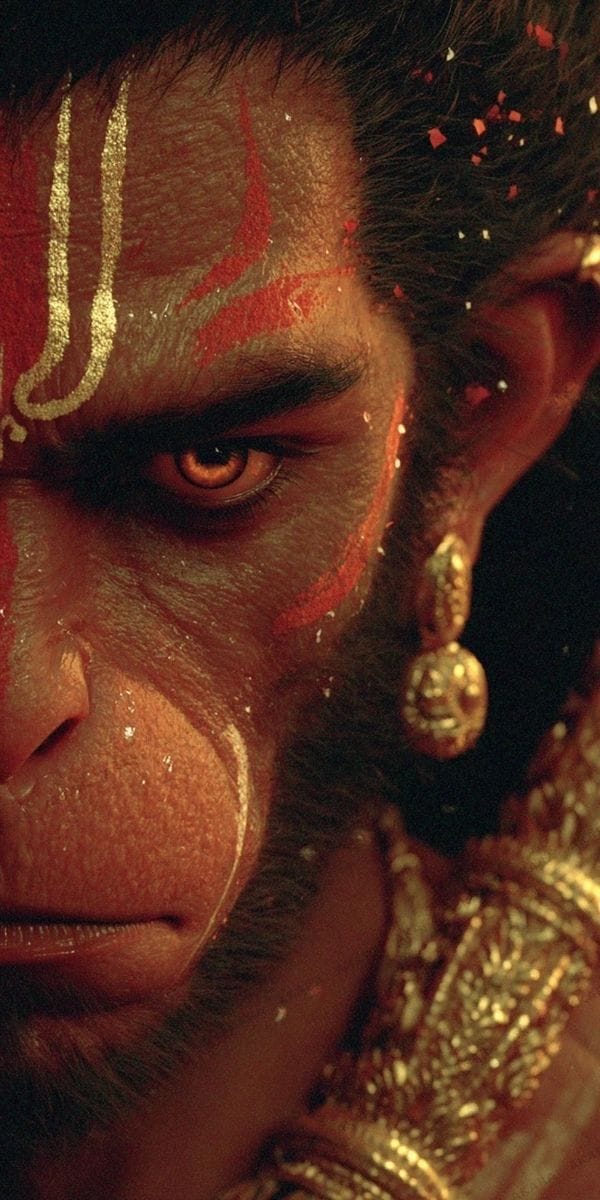
There is a moment in the Valmiki Ramayana when Sri Rama, overwhelmed by Hanuman's devotion, draws him close and says: 'There is nothing in the three worlds I can give you that would equal what you have given me.' It is a line that stops the breath. Because what Hanuman had offered was not strength, not strategy, not the burning of Lanka — it was his entire self, without remainder. On this Krishna Dwadashi Tuesday, with the moon in the steady and nourishing nakshatra of Pushya, we sit with this extraordinary being: Hanuman, Bajrangbali, Anjaneya — the one in whose heart Rama perpetually resides.
Who Is Hanuman? The Many Names, One Truth
Hanuman is addressed by dozens of names across the traditions of Sanatana Dharma, and each name is a doorway. Anjaneya — son of Anjana — reminds us of his human lineage, born of a devoted apsara. Bajrangbali — the strong-limbed one whose body shines like lightning — points to his physical might. Maruti or Pavanaputra — son of Vayu, the Wind God — tells us of his cosmic parentage and the quality of prana, life-force itself, that he embodies. Kesari Nandana — son of the Vanara king Kesari — roots him in a family, a community, a place.
In the language of Hindu spirituality, Hanuman occupies a singular position. He is a chiranjeevi — one of the eight immortals said to persist through the ages. The Muktika Upanishad records Hanuman himself listing the 108 Upanishads at Rama's request, marking him as a being of supreme learning. The Hanuman Chalisa, composed by the saint-poet Tulsidas in the sixteenth century, calls him vidyavan guni ati chatur — exceedingly wise, virtuous, and discerning. Strength and devotion in Hanuman are never separate from wisdom.
The Iconography and Its Inner Meaning
Stand before any murti of Hanuman and the symbolism speaks at once. His form is typically that of a Vanara — a divine monkey — but upright, noble, and luminous. The anjali mudra (palms joined in reverence) or the abhaya mudra (right hand raised in blessing) define his two great gifts to the seeker: his own devotion as a teaching, and his protection as a grace.
He is often depicted with a gada (mace) in one hand and the Dronagiri mountain in another — the mountain he lifted entire when searching for the life-restoring sanjeevani herb for the fallen Lakshmana. This image is not mythology dressed as spectacle; it is philosophy in stone. When the intellect cannot isolate the right remedy in a crisis, the devotee lifts everything — the whole situation — and offers it at the feet of the Lord.
The sindoor (vermilion) that reddens Hanuman's form has its own story. Seeing Sita apply sindoor to her hair for the long life of her Lord, Hanuman smeared his entire body with it — if a little brings Rama's wellbeing, he reasoned, then all of it will bring even more. It is the logic of a heart that has run out of halfway measures. To this day, devotees offer sindoor to Hanuman as an act of identification with that unguarded love.
His tail, curled and often shown ablaze, recalls the burning of Lanka. What was meant as a punishment by Ravana became the instrument of Ravana's undoing. This is the teaching of shakti channeled through bhakti: grace converts every obstacle into a vehicle.
Two Stories That Illuminate the Path
The Leap to Lanka. When the Vanaras gathered at the southern shore, paralyzed by the impossible expanse of ocean before them, it was the elder Jambavan who reminded Hanuman of his true nature. As an infant, Hanuman had leaped at the sun, mistaking it for a fruit. He had been granted every boon and every power — and had then forgotten them, humbled by a rishi's curse. At Jambavan's words, Hanuman swelled to his cosmic form, and leaped. The theological weight of this moment is immense. The devotee carries infinite capacity within; it is only the forgetting — avidya, spiritual ignorance — that makes the ocean look uncrossable. The guru's word, like Jambavan's, restores memory.
The Heart Opened. After the war, when gifts and jewels were distributed, Hanuman received a pearl necklace from Sita. He bit each pearl and peered inside. Asked why he was destroying the gift, he said he was checking whether Rama and Sita resided within — for anything not containing them held no value. When the court laughed that Rama could not be in his body either, Hanuman tore open his chest: there, within, sat Rama and Sita, enthroned. This is the hridaya akasha — the sky of the heart in which the Lord dwells — made visible. Hanuman does not seek the divine outside. He has become transparent.
The Mantra and the Practice
The root mantra of Hanuman is:
Om Hanumate Namah — Salutation to Hanuman.
Simple in syllables, vast in resonance. Hanumate is the dative form of Hanuman — 'to the one with the powerful jaw,' the one who crushed the sun in his fist. Namah is the bow, the self-offering.
On Tuesdays (Mangalavar), Hanuman temples across the country fill before dawn. The abhisheka (ritual bathing of the murti) is performed with oil and water; sindoor is freshly applied; jasmine and marigold garlands are offered. The Hanuman Chalisa is recited — its forty chaupais a complete manual of devotion, protection, and cosmology in verse. In many traditions, the Sundara Kanda — the fifth book of the Ramayana, recounting Hanuman's journey to Lanka — is read aloud on Tuesdays, its name ('beautiful chapter') pointing to the beauty of seva undertaken in pure love.
Today's panchang carries Pushya nakshatra in its third pada, a configuration traditionally considered deeply auspicious for worship, mantra recitation, and acts of protection. Pushya's presiding deity is Brihaspati — wisdom itself. To worship Hanuman on a Pushya-Tuesday is to invite both devotion and discernment.
What Hanuman Asks of the Seeker
Hanuman does not demand elaborate ritual or learned discourse. The Ramacharitmanas says his heart melts at one thing: prem, love. And yet this love is not sentiment — it is structured by total surrender (sharanagati), expressed through tireless service (seva), and disciplined by the restraint of brahmacharya and humility.
What the Bajrangbali truly asks is simpler and harder than any rite: Be useful to the Lord's work in the world. Carry the message when asked. Lift the mountain when the situation demands. Burn what needs to be burned — ego, attachment, the city of self-importance. And then return, not for praise, but because there is more to do.
In a world that prizes power as performance, Hanuman's power is always in service of something greater than himself. That is the Akara lens through which his story shines most clearly: strength is sacred when it flows from devotion, and devotion is complete when it makes the devotee selfless.
Jai Bajrangbali. Jai Shri Ram.
Hanuman does not seek the divine outside. He has become transparent.
मनोजवं मारुततुल्यवेगं जितेन्द्रियं बुद्धिमतां वरिष्ठम्। वातात्मजं वानरयूथमुख्यं श्रीरामदूतं शिरसा नमामि॥ manojavaṃ mārutatulyavegaṃ jitendriyaṃ buddhimatāṃ variṣṭham | vātātmajaṃ vānarayūthamukhyaṃ śrīrāmadūtaṃ śirasā namāmi ||
fast as thought, swift as wind, master of his senses and supreme among the wise — we bow to hanuman, son of the wind and rama's messenger.
Questions & answers
Why is Tuesday dedicated to Lord Hanuman?
Tuesday (Mangalavar) is associated with the planet Mars (Mangala), whose qualities of courage, strength, and vitality align with Hanuman's nature. Tradition also holds that Hanuman first appeared to devotees on a Tuesday, making it the most auspicious day for his worship.
What is the significance of offering sindoor to Hanuman?
Sindoor (vermilion) is offered to Hanuman in remembrance of the moment he smeared his entire body with it, having seen Sita apply it as a mark of devotion for Rama's long life. It symbolises unconditional, boundless love — the mark of the true devotee.
What does 'Om Hanumate Namah' mean?
'Om Hanumate Namah' means 'Salutation to Hanuman' — the one with the powerful jaw, the mighty devotee of Rama. Chanting this mantra is said to invoke Hanuman's protection, strength, and the grace of removing obstacles and fear.
What is the Sundara Kanda and why is it read on Tuesdays?
The Sundara Kanda is the fifth book of the Valmiki Ramayana and details Hanuman's leap to Lanka, his search for Sita, and the burning of Lanka. 'Sundara' means beautiful — referring to the beauty of pure, selfless seva. Reciting it on Tuesdays is a widely observed devotional practice believed to bring protection and blessings.
What does it mean that Hanuman is a chiranjeevi?
A chiranjeevi is an immortal — one who persists across all ages (yugas). Hanuman is one of eight such beings in the Hindu tradition. Devotees believe he is present wherever the name of Rama is sung, and that sincere worship of him invites a living, not merely historical, connection.