Ganesha: The Elephant-Headed Lord Who Opens Every Door
On a Wednesday graced by Shukla Panchami, we turn to the first among gods — Ganesha, whose blessing precedes every sacred beginning.
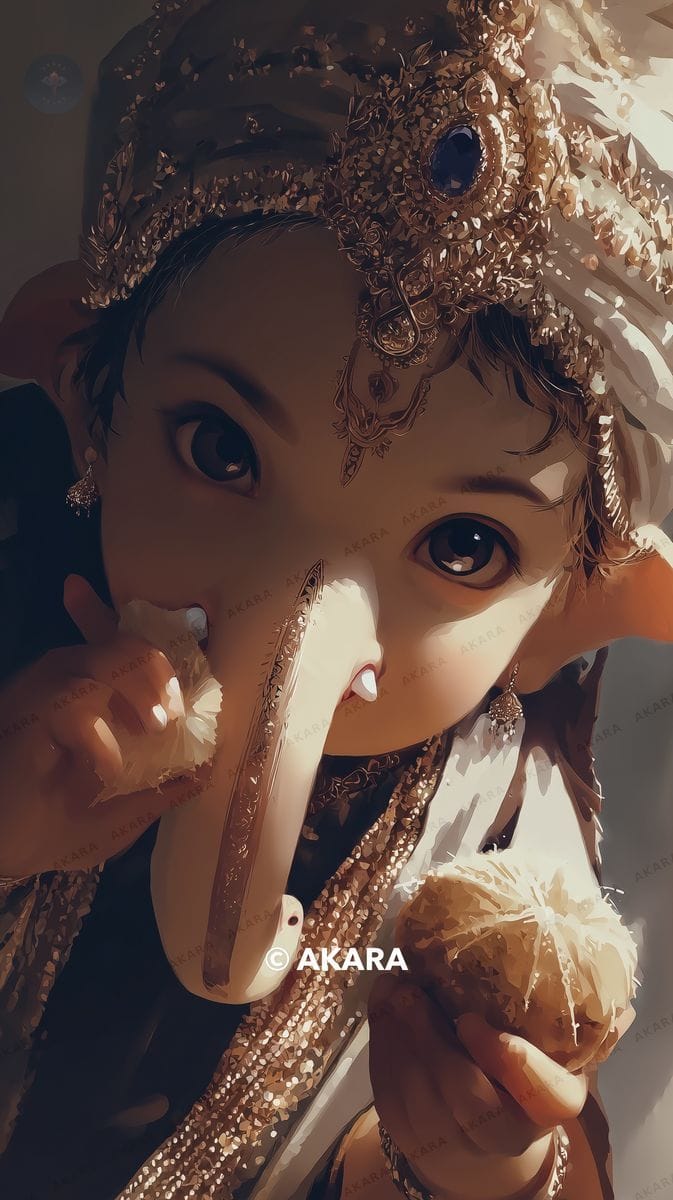
Before the first syllable of any prayer is uttered, before the ink touches the page or the plough breaks the earth, there is Ganesha. Across the vast sweep of Sanatana Dharma, no deity is invoked more universally at the start of an undertaking — whether a wedding, a business venture, a journey, a piece of music, or a student's first day of school. He is Vighneshvara, the Lord of Obstacles, who can both place them in your path and remove them — and in that paradox lies a teaching more profound than it first appears.
Who Is Ganesha?
Ganesha — known also as Ganapati, Vinayaka, Ekadanta, and by 108 other names — is the son of Shiva and Parvati, elder brother to Kartikeya, and the presiding deity of intellect, wisdom, new beginnings, and the written word. The name Ganapati (Sanskrit: गणपति) means 'Lord of the Ganas' — the ganas being the vast host of attendant beings who serve Shiva. But 'gana' carries a deeper resonance: it also means 'category' or 'class,' pointing to Ganesha's mastery over all classification, language, and thought itself. The Ganapati Upanishad, a text from the Atharva Veda tradition, elevates him to the status of Brahman — the ultimate reality from which all creation emerges and into which it dissolves.
Wednesday (Budhavara in Sanskrit) is traditionally associated with Ganesha as vaar devata — the presiding deity of that day — alongside its planetary lord Budha (Mercury), who governs intellect, commerce, and communication. The resonance is not accidental. Ganesha and Mercury share a symbolic kinship: both are patrons of the mind, of merchants, of the crossing of thresholds. Today's panchang — Shukla Panchami under the nakshatra Vishakha — adds a layer of auspiciousness. Vishakha, whose presiding deity is Indra-Agni, is a nakshatra of purposeful striving, of reaching toward a goal. Paired with the waxing fifth lunar day, it is a fine moment to establish a new intention under Ganesha's gaze.
The Iconography and Its Hidden Language
Ganesha's form is one of the most intricate visual philosophies in all of Hindu spirituality. Every element of his iconic body communicates a teaching.
- The elephant head: The elephant is the embodiment of wisdom, memory, and gentle but irresistible power. The large skull denotes the capacity for vast intelligence; the capacity to discern what is essential and what is not.
- The large ears: Shrunoti — he who listens deeply. Large ears are the mark of the ideal disciple, one who receives wisdom without filtering it through ego.
- The small eyes: Focus and precision. In a world of distraction, the small eyes remind us to look at what truly matters.
- The single tusk (Ekadanta): Ganesha broke his own tusk to use as a stylus when transcribing the Mahabharata as dictated by the sage Vyasa — an act of sacrifice in service of knowledge. The broken tusk is imperfection accepted, the sacrifice made willingly for a higher purpose.
- The large belly: It contains the entire universe. The Mudgala Purana says his belly holds all creation within it, unhurried and at ease — a metaphor for the spiritual practice of holding all experience without being overwhelmed by any of it.
- The mouse (Mushika): His vehicle, or vahana, is the tiny mouse — the creature that gnaws through obstacles just as Ganesha does, and that also symbolises the restless, scurrying mind. Ganesha riding the mouse suggests the mastery of the intellect over the chattering ego-mind.
- The four hands: They typically hold a pasha (noose, to capture obstacles), an ankusha (goad, to spur us forward), a modaka (sweet dumpling, representing the bliss of liberation), and one hand in abhaya mudra (the gesture of fearlessness and blessing).
This is not decoration. This is philosophy made visible — what Indian tradition calls murtividya, the science of sacred form.
Stories from Scripture
The most beloved story of Ganesha's birth appears in the Shiva Purana. Parvati, wishing for a devoted companion while Shiva was away, fashioned a boy from the turmeric paste she used to bathe and breathed life into him. She set him to guard her door. When Shiva returned and this unknown boy barred his way, a confrontation ensued — and Shiva, not recognising his son, severed the boy's head. Parvati's grief was incalculable. Shiva, remorseful, sent his attendants to bring the head of the first creature found sleeping with its head facing north. They returned with an elephant's head. Shiva placed it upon the boy's body, restored his life, and declared that henceforth this boy — Ganesha — would be honoured before all other deities in any act of worship or beginning.
The story of the Mahabharata transcription is equally instructive. The sage Vyasa, having conceived the entire epic in his mind, needed a scribe equal to the task. He approached Brahma, who directed him to Ganesha. Ganesha agreed — but with a condition: Vyasa must dictate without pause. Vyasa accepted — but imposed his own condition: Ganesha must not write a single word without fully understanding it. Whenever Vyasa needed time to compose the next verses, he would offer a particularly complex one, and Ganesha would pause to comprehend it deeply before writing. The result was the Mahabharata as we know it: 100,000 verses composed in the dynamic interplay between the poet's inspiration and the scribe's disciplined understanding.
The Mantra and How Devotees Worship Today
The primary mantra of Ganesha is:
Om Gam Ganapataye Namah (ॐ गं गणपतये नमः)
This is the mula mantra — the root mantra. Gam (pronounced with a slight nasal resonance) is the bija, or seed syllable, of Ganesha. It carries within it the compressed essence of his energy, much as a seed contains a whole tree. Devotees chant it 108 times on Wednesdays, at the start of journeys, before examinations, before signing contracts, or simply each morning to set the tone for the day.
Traditional Wednesday worship (Budhavar Puja) for Ganesha involves:
- Bathing the murti or image with panchamrita (five nectars: milk, curd, honey, ghee, sugar)
- Offering durva grass — the three-bladed grass held especially sacred to him — and red hibiscus flowers
- Presenting modaka sweets, believed to be his favourite
- Lighting a lamp with ghee and offering incense
- Reciting the Ganapati Atharvashirsha, a Upanishadic hymn of extraordinary beauty and depth
- Completing japa of Om Gam Ganapataye Namah, ideally 108 repetitions
In the spirit of bhakti — devotion as a living, breathing relationship — many devotees simply sit quietly before his image, share their anxieties and hopes with him as one would with a trusted elder, and then release those worries into his capable hands.
What Ganesha Asks of the Seeker
Ganesha is the deity of thresholds — he stands at every doorway between what was and what might be. But he is not merely a remover of external obstacles. Read the symbolism more carefully, and another understanding emerges: Ganesha places obstacles in our path when we are not ready, when our ego outruns our wisdom, when we rush forward without adequate preparation or humility. He removes those obstacles when we have done the inner work.
In this sense, Ganesha is the supreme teacher of discernment — viveka in Sanskrit — the capacity to tell the essential from the non-essential, the right moment from the premature one. His mouse reminds us that even the largest obstacles can be approached methodically, one small nibble at a time. His broken tusk reminds us that sacrifice in service of truth is not loss; it is transformation.
The Ganapati Upanishad closes with the declaration: Tvameva pratyaksham tatvamasi — 'Thou art verily the direct reality.' This is the ultimate teaching: the Lord of Beginnings is not separate from the seeker. He is the awareness that watches, the intelligence that discerns, the grace that opens — already present within, waiting to be invoked.
On this Wednesday, under the nakshatra of purposeful striving, light a lamp, offer a modaka, whisper the bija Gam, and begin.
Ganesha is the awareness that watches, the intelligence that discerns, the grace that opens — already present within, waiting to be invoked.
वक्रतुण्ड महाकाय सूर्यकोटि समप्रभ। निर्विघ्नं कुरु मे देव सर्वकार्येषु सर्वदा॥ vakratuṇḍa mahākāya sūryakoṭi samaprabha nirvighnaṃ kuru me deva sarvakāryeṣu sarvadā
O elephant-faced one, with a massive form radiant as millions of suns, remove all obstacles in all my endeavors, always.
Questions & answers
Why is Wednesday considered Ganesha's day?
In the Hindu panchang, each day of the week has a presiding deity called the vaar devata. Wednesday (Budhavara) is associated with Ganesha alongside its planetary lord Budha (Mercury), because both govern intellect, communication, commerce, and the crossing of thresholds. Worshipping Ganesha on Wednesdays is believed to sharpen the mind and remove obstacles from one's endeavours.
What is the meaning of the mantra 'Om Gam Ganapataye Namah'?
This is Ganesha's mula mantra, or root mantra. 'Om' is the primordial sound; 'Gam' is the bija (seed syllable) that encapsulates Ganesha's energy in its most concentrated form; 'Ganapataye' is the dative form of Ganapati, meaning 'to the Lord of the Ganas'; and 'Namah' means 'I bow' or 'I offer myself.' Together the mantra means: 'I bow to Lord Ganapati and invoke his grace.' It is chanted 108 times, ideally on Wednesdays or at the start of any new undertaking.
Why does Ganesha have an elephant's head?
According to the Shiva Purana, Ganesha was created by Parvati from turmeric paste and given life by her breath. When Shiva — not recognising this child — severed his head during a confrontation, Parvati's grief moved Shiva to restore the boy. The first creature found sleeping with its head pointing north was an elephant; its head was brought and placed on the boy's body by Shiva, who then declared Ganesha the foremost of all deities. Symbolically, the elephant head represents vast wisdom, a powerful memory, and the ability to clear any obstacle with calm, irresistible force.
What is the significance of the mouse (Mushika) as Ganesha's vehicle?
The mouse, or Mushika, represents the restless, scurrying quality of the ego-driven mind — always seeking, gnawing, moving without direction. Ganesha riding the mouse is a powerful symbol: the supreme intelligence is master over the chattering mind. The mouse also represents the ability to find a way through the tiniest crack in any obstacle, reminding devotees that persistence and resourcefulness — not just brute force — dissolve life's barriers.
What is the Ganapati Upanishad and why is it significant?
The Ganapati Upanishad, also called the Ganapati Atharvashirsha, is a text from the tradition of the Atharva Veda. It identifies Ganesha with Brahman — the ultimate reality — stating that he is the consciousness behind creation, sustenance, and dissolution. It contains sacred mantras, dhyana (meditation) shlokas describing his form, and closes with the declaration 'Tvameva pratyaksham tatvamasi' — 'Thou art verily the direct reality.' It is recited during Ganesha puja, especially on Wednesdays and during Ganesh Chaturthi, and is considered one of the most complete scriptural hymns to Ganesha.