Sharadiya Navratri 2026: Nine Nights, Nine Goddesses, One Eternal Flame
As the autumn sky deepens and Pitru Paksha draws to a close, the cosmos turns toward the Great Mother — and Navratri calls every seeker home.
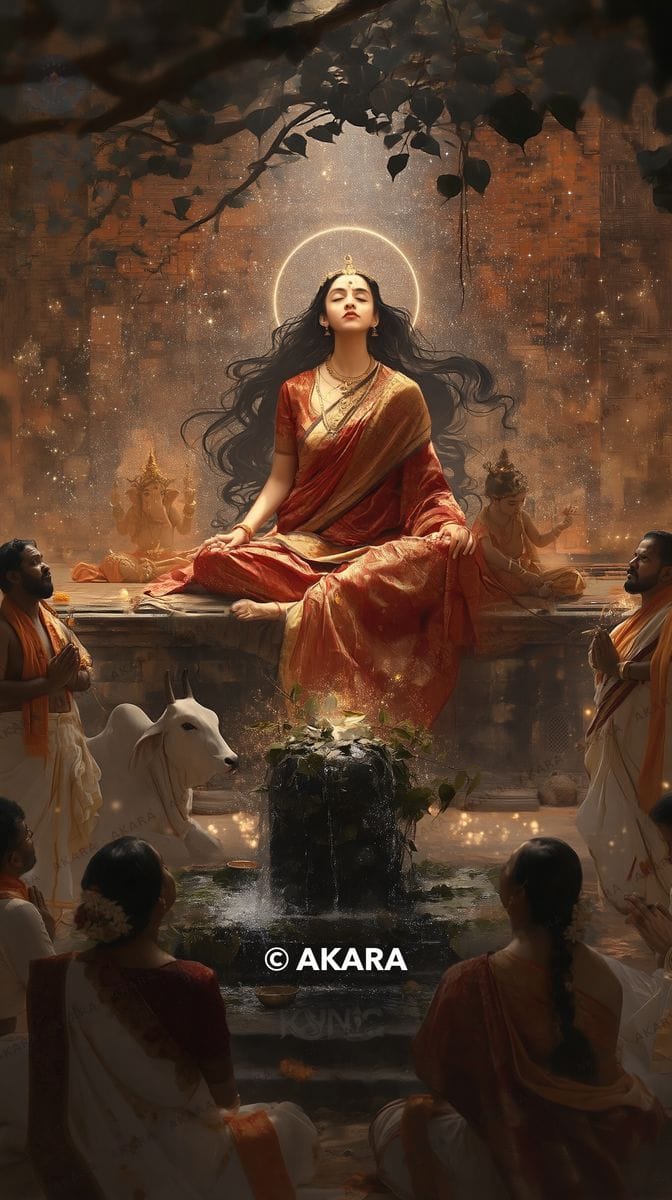
Three weeks from today, at the first blush of dawn on 11 October 2026, millions of lamps will be lit in courtyards from Varanasi to Vancouver, from Pune to Parramatta. The clay Kalash will be filled with sacred water, crowned with mango leaves and a coconut, and Devi will be formally invited to descend. Sharadiya Navratri — the nine radiant nights of the Divine Mother — is almost here, and the entire devotional world is quietly, joyfully, preparing.
The Season of Shakti: Why Autumn Belongs to the Mother
The Hindu year is punctuated by four Navratris, but it is the Sharadiya — the autumn one, observed in the bright fortnight of Ashwin — that scripture and tradition reserve as the supreme season of Shakti. <cite index="27-5">Navratri (Sanskrit: "nine nights") is held four times a year, and the Shardiya (autumn) Navratri is the most celebrated of all.</cite> <cite index="22-6,22-7">Once a year, in the Vedic cosmological framework, Sharad Navratri marks the nine nights when Shakti's transformative energy is most concentrated, most accessible, and most directly available to anyone who seeks Her.</cite>
The timing is not incidental. Autumn, in Ayurveda and in the Vedic reckoning of seasons, is a liminal moment — the earth shifts from the lushness of the monsoon to the clarity of sharad (शरद्, the cool season). The inner landscape mirrors the outer: the mind, having absorbed the nourishment of Varsha Ritu, is now ready to be refined by tapas, devotion, and the fierce, loving gaze of the Mother.
<cite index="20-2,20-3">As Sharadiya Navratri 2026 approaches, devotees across India and around the world are preparing for nine days dedicated to Maa Durga and the worship of Divine Shakti — a festival that will bring renewed attention to traditional Navratri rituals, devotional practices, and special worship at sacred Devi temples and Siddha Peeths across India.</cite>
Dates, Muhurat, and the Art of Ghatasthapana
<cite index="23-6">Sharad Navratri 2026 runs from Sunday, 11 October 2026 through Monday, 19 October 2026, culminating in Vijayadashami (Dussehra) on Tuesday, 20 October.</cite>
The festival opens with Ghatasthapana (घटस्थापन) — literally, the "establishment of the Kalash." This is no mere ritual formality; it is the formal invocation of Devi into a consecrated vessel of water, earth, and life. The Kalash (kalaśa, कलश) represents the cosmos in miniature — water as the primordial ocean, the mango leaves as the world's vegetation, the coconut as the three-eyed Lord Himself presiding, and the grain seeds buried beneath as the promise of new life. To perform Ghatasthapana at the correct moment is to synchronise one's household with the pulse of creation itself.
<cite index="27-1">Shardiya Navratri 2026 begins on Sunday, 11 October 2026, with the Ghatasthapana muhurat from 06:19 to 10:12 AM IST, and an Abhijit muhurat from 11:44 AM to 12:31 PM.</cite> Devotees outside India should consult a local panchang or trusted temple for region-adjusted timings.
Navadurga: Nine Faces of the One
At the heart of Navratri lies one of Sanatana Dharma's most luminous theological insights: that the Divine Feminine is not singular but prismatic, radiating nine distinct qualities that together compose the fullness of Shakti. These are the Navadurga (नवदुर्गा) — nine forms, each worshipped on one night, each illuminating a different facet of the soul's journey toward liberation.
<cite index="27-6">Each of the nine nights is dedicated to one form of Goddess Durga: Shailputri (Day 1), Brahmacharini (Day 2), Chandraghanta (Day 3), Kushmanda (Day 4), Skandamata (Day 5), Katyayani (Day 6), Kalaratri (Day 7), Mahagauri (Day 8), and Siddhidatri (Day 9).</cite>
Read in sequence, these nine forms trace a profound inner arc. Shailputri — daughter of the mountain — represents the grounded, rooted soul. Brahmacharini embodies austerity and seeking. Chandraghanta brings the fierce grace that dispels fear. Kushmanda, the cosmic womb, is the creatrix herself. Skandamata, mother of the warrior Kartikeya, reminds us that the deepest courage is maternal. Katyayani is the warrior who does not flinch before adharma. Kalaratri is the dark night through which all transformation passes. Mahagauri is the luminous whiteness on the other side — purity restored. And Siddhidatri is the goddess who bestows siddhi (सिद्धि) — accomplishment, fulfilment, perfection — to the devotee who has walked all nine nights in sincerity.
"Yaa Devī Sarva Bhūteṣu, Mātṛ Rūpeṇa Saṃsthitā — She who dwells in all beings as the Mother, to Her I bow, again and again." — Devi Mahatmyam, Markandeya Purana
<cite index="20-8,20-9">Each day of Sharadiya Navratri is traditionally associated with a different form of Maa Durga. The 2026 sequence begins with Maa Shailputri on 11 October and progresses through Maa Brahmacharini, Maa Chandraghanta, Maa Kushmanda, Maa Skandamata, Maa Katyayani, Maa Kalaratri, and Maa Mahagauri before concluding with Maa Siddhidatri on 19 October.</cite>
Rituals of the Nine Nights: From Kanya Puja to Siddha Peeths
Navratri is simultaneously an inward sadhana and an outward celebration — perhaps the most complete expression of bhakti yoga in the Hindu calendar. <cite index="26-5">Devotees observe fasting, chant scriptures, and perform sacred rituals seeking blessings for health, prosperity, and protection.</cite>
The akhand jyoti — the unbroken lamp kept burning for all nine nights — is the home's still centre in this festival. Around it, families recite the Devi Mahatmyam (also called the Durga Saptashati, 700 verses in praise of the Goddess), offer flowers, burn incense, and sing the ancient stotras of Adi Shankaracharya and the regional folk songs — garba in Gujarat, dandiya raas across the diaspora, jaagrans across the north. <cite index="21-7,21-8">People from various sections of society, irrespective of caste and creed, celebrate this festival by visiting temples and offering pujas at the Mother's feet, and at many places special puja of Devi is held by setting up images of Mother Durga in beautifully decorated pandals.</cite>
On the eighth day (Ashtami) or ninth day (Navami), the Kanya Puja — the worship of young girls as living embodiments of the Goddess — is performed. Nine girls are honoured, fed, and offered gifts: a ritual so ancient, so quietly radical, so entirely Sanatan.
<cite index="20-4">At sacred Siddha Peeths such as Maa Baglamukhi in Nalkheda, Madhya Pradesh, Navratri is observed as an important period for traditional Devi worship, with arrangements available for devotees seeking to participate in Puja, Havan, Mantra Japa, and Anushthan during the festival period.</cite> Across the 51 Shakti Peethas of India — from Kamakhya in Assam to Kanyakumari at the southern tip — this season pulses with an energy that even the casual visitor can feel.
Navratri and the Global Devotee: A Living Tradition
<cite index="23-13">The Sharad (autumn) Navratri in October is the most celebrated of the four Navratris that occur each year.</cite> And in 2026, it is more global than ever. <cite index="23-14">For the global Hindu diaspora, Navratri 2026 promises bigger garba events than any post-COVID year, with community organisers across Edison, Wembley, Brampton, Parramatta, Frankfurt, Dubai, Singapore, and Kuala Lumpur</cite> preparing celebrations that blend ancient ritual with contemporary community life.
For the seeker far from a traditional temple, the invitation is no less real. The Kalash can be installed in a New York apartment or a London terrace. The Devi Mahatmyam can be chanted before a simple altar lit by a single diya. The sankalpa (संकल्प) — the sincere inner resolve with which one begins — is what transforms ordinary action into yajna, sacrifice. Devi, the tradition assures us, looks not at the grandeur of the offering but at the depth of the devotion behind it.
Akara reminds its readers: this is the season to prepare your inner temple as carefully as your outer one. Light the lamp, clean the altar, still the mind. The Mother is already on her way.
A Closing Reflection: The Eternal Homecoming
Every year, Navratri arrives like an old friend who knows exactly what you need. It arrives not to overwhelm with ritual but to remind: beneath the noise of daily life, beneath ambition and anxiety and the endless scroll of the world, there is a stillness that is maternal, protective, luminous. The Devi of the Devi Mahatmyam is not merely a deity on a calendar — She is, in the language of the Kenopanishad, Uma Haimavati, the golden wisdom that illuminates the universe.
Today, on this Shukla Dwadashi under Nakshatra Shravana, the moon stands in the pada of careful listening. There is no better moment to begin your Navratri preparation: gather your resolve, choose your vrat, order the marigolds, dust the sacred texts. In eighteen days, the lamps will blaze. In the meantime, let the heart grow quietly quiet — and ready.
In eighteen days, the lamps will blaze. In the meantime, let the heart grow quietly quiet — and ready.
नमः शिवाय namaḥ śivāya
Salutations to Shiva, the Auspicious One
Questions & answers
When does Sharadiya Navratri 2026 begin and end?
Sharadiya Navratri 2026 begins on Sunday, 11 October 2026, with Ghatasthapana, and concludes with Navami on 19 October. Vijayadashami (Dussehra) follows on Tuesday, 20 October 2026.
What is the auspicious Ghatasthapana muhurat for Navratri 2026?
The principal Ghatasthapana muhurat on 11 October 2026 is from 06:19 AM to 10:12 AM IST. The Abhijit muhurat is from 11:44 AM to 12:31 PM IST. Devotees outside India should verify timings with a local panchang.
Who are the nine goddesses (Navadurga) worshipped during Navratri?
The nine forms are: Shailputri (Day 1), Brahmacharini (Day 2), Chandraghanta (Day 3), Kushmanda (Day 4), Skandamata (Day 5), Katyayani (Day 6), Kalaratri (Day 7), Mahagauri (Day 8), and Siddhidatri (Day 9). Each embodies a distinct quality of the Divine Feminine.
What scripture is traditionally recited during Navratri?
The Devi Mahatmyam — also called the Durga Saptashati, comprising 700 verses from the Markandeya Purana — is the primary scriptural text of Navratri. Many devotees complete a full reading (paath) across the nine days. The Lalita Sahasranama and various Devi stotras are also widely chanted.
Can devotees living abroad observe Navratri at home without a temple?
Absolutely. The tradition places sincerity (sankalpa) above grandeur. A simple Kalash, a diya kept burning, daily recitation of a Devi stotra or the Devi Mahatmyam, a vrat suited to one's health, and the Kanya Puja on Ashtami or Navami — all of these can be observed meaningfully in any home, anywhere in the world.