Bajrangbali: The Eternal Devotee Who Carries the World
On this Tuesday, we sit with Hanuman — the Vajra-limbed one whose every breath carries the name of Rama.
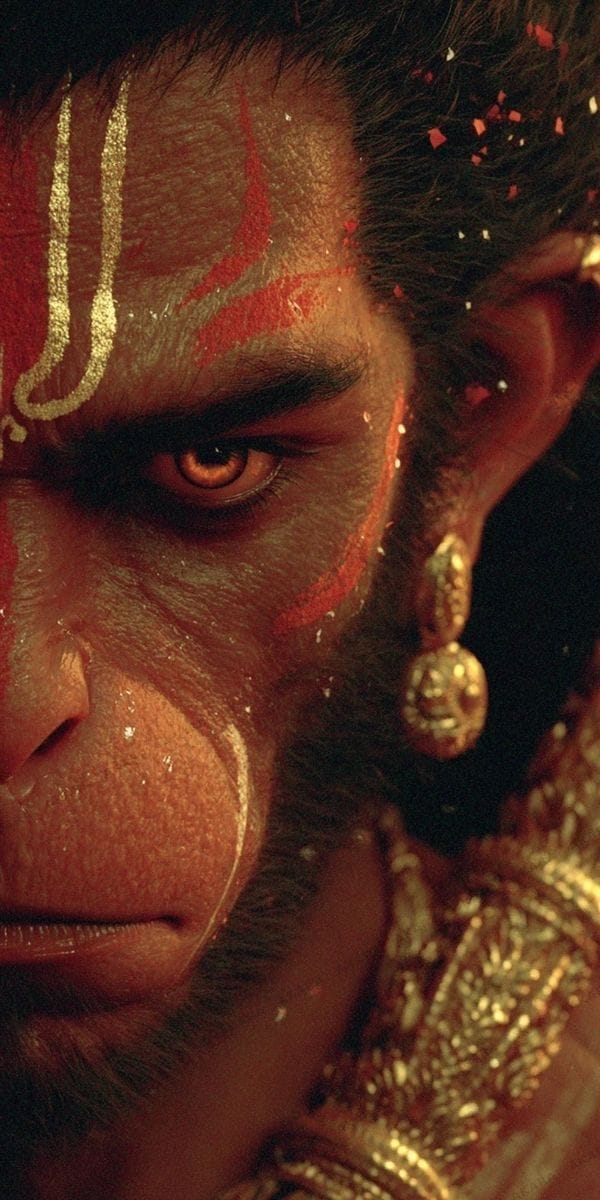
There are deities who inspire awe from a distance, and there is Hanuman. He is the one who rushes toward you. Before a prayer is half-formed on the lips, he is already present — ears wide as devotion itself, tail coiled like accumulated tapas, the mountain of Sanjeevani lifted in one effortless palm. In the long, luminous tradition of Sanatana Dharma, few figures have captured the heart of the seeker quite so completely as this son of the wind, this servant of Rama, this being in whom strength and surrender are one indivisible flame.
Who Is Hanuman? The Many Names of One Truth
Hanuman is known by a constellation of names, each a lamp illuminating a different facet of the same sun. Anjaneya — son of Anjana, the blessed apsara who received the grace of Vayu, the wind-god. Bajrang Bali or Bajrangbali — the strong-limbed one, whose body is said to be as hard and luminous as the vajra, the thunderbolt of Indra. Maruti — son of Marut, the storm-wind. Pavana-putra — child of the breeze. Kesari-nandana — delight of the lion-hearted Kesari, who raised him.
The Valmiki Ramayana introduces him first as a supremely intelligent diplomat, capable of speaking with the refinement of a Vedic scholar. The Sundara Kanda — arguably the most beloved section of that vast epic — is almost entirely his. He crosses the ocean in a single leap; he finds Sita in Ravana's Lanka; he burns the golden city with the very chain they tied to his tail; and he returns with news that restores Rama's hope. If the Ramayana is a treatise on dharma, then Hanuman is its living demonstration — the proof that bhakti, pure devotion, is itself a form of supreme power.
The Iconography and Its Inner Meaning
Every detail of Hanuman's form is a teaching, composed with the precision of a yantra.
- The red complexion or saffron-smeared body: Tradition holds that when Hanuman saw Sita applying sindoor to her hair and asked its purpose, she explained it was for the long life of her beloved Rama. Hanuman at once smeared his entire body with sindoor — thus his form, rubbed with red paste, is an act of perpetual devotion. To see Bajrangbali is to witness love made visible.
- The mace (gada): Strength in the service of righteousness. The mace is not aggression; it is protection of the vulnerable.
- The mountain held aloft: The Dronagiri mountain, plucked from the Himalayas to save Lakshmana's life, is a reminder that selfless service knows no limitation.
- The open chest: In certain celebrated depictions, Hanuman parts his chest to reveal Rama and Sita seated at his heart. He carries not a locket or a symbol — he carries the very reality of his Lord, lodged within. This is the scriptural truth of the Narada Bhakti Sutras made flesh: sa tvasmin parama-prema-rupa — that devotion is of the nature of supreme love.
- The ears and tail: His large, alert ears signify that he is ever attentive to the name of Rama; his coiled tail, the storage of prana and tapas accumulated through years of discipline.
Two Stories That Illuminate the Soul
The Leap Across the Ocean: When the entire army of monkeys stood at the southern shore staring at the vast expanse between India and Lanka, it was the elder Jambavan who reminded Hanuman of his own divine potential — which he had forgotten due to a childhood curse. This moment is worth sitting with. How often do we stand before our own vast ocean, having forgotten that we carry the capacity to cross it? Hanuman's leap is every seeker's awakening to their own latent shakti.
The Burning of Lanka: Captured and brought before Ravana, Hanuman accepted the ignominy of a burning tail calmly. Then, unbound, he used that very fire to reduce Lanka's towers to ash — converting insult into instrument of dharma. Suffering transformed into purposeful action. Every devotee who has turned their wound into wisdom walks in his footsteps.
The Mantra: A Sound That Holds the Universe
The seed mantra most commonly offered is:
Om Hanumate Namah (ॐ हनुमते नमः) "I bow to Hanuman."
Simple in syllable, oceanic in resonance. This mantra, chanted on a Tuesday with a lamp of pure ghee or sesame oil before an image of Bajrangbali, is considered extraordinarily potent for dispelling fear, removing obstacles, and cultivating both physical vitality and inner steadiness. The Hanuman Chalisa — composed by the saint-poet Tulsidas in Awadhi Hindi — remains one of the most recited texts in the Hindu world, forty verses that read as both biography and benediction.
Today's panchang places us in the Nakshatra Ashwini, its fourth pada — a quarter associated with grounding and completion. Ashwini is itself the asterism of the divine physicians, the Ashwini Kumaras, and its energy harmonises beautifully with Hanuman's role as the one who brought the healing herb that revived Lakshmana. Even the sky today conspires to make this a day for healing devotion.
How Devotees Worship on Tuesdays
The mangalvaar vrat — Tuesday observance — dedicated to Hanuman is one of the most widespread practices in Hindu spirituality. Across temples, households, and open-air shrines from Kashi to Kerala, from Rajasthan to the Tamil coast, devotees arrive before sunrise, bathe, and offer the following:
- Sindoor and sesame oil: The red paste anointed lovingly on Hanuman's image.
- Betel leaves and flowers: Especially marigold and hibiscus.
- Lamps (diyas): Ghee or sesame oil lamps.
- Recitation: The Hanuman Chalisa, the Sundara Kanda, or at minimum 108 repetitions of Om Hanumate Namah.
- Prasad: Besan laddoos or boondhi, distributed freely.
In spirit, the worship asks one thing above all: come with sincerity. Hanuman, the scriptures tell us, does not ask for elaborate ritual. He asks for a heart oriented toward its own highest truth.
What Hanuman Asks of the Seeker
There is a quiet revolution in Hanuman's example. In a world that often conflates power with domination, he shows that the greatest power is power offered in service. He was capable of defeating Ravana single-handedly — scholars of the epic have noted this — yet he waited for Rama's command. This is not weakness. This is the discipline of dasyabhava — the devotional stance of the beloved servant.
Hanuman asks the seeker to hold two things simultaneously: to cultivate strength, courage, and capability (the Bajrang in Bajrangbali) and to place that capacity entirely at the feet of the Divine (the Bali, the offering). He asks us to leap when the moment comes — and to know that the wind which bore our father will bear us too.
On this Tuesday, with a lamp lit, a name on the breath, and a heart willing to be still, we meet Anjaneya where he has always waited — inside the chest, in the space between beats, where Rama and Sita are seated, eternally.
Jai Bajrangbali.
He carries not a locket or a symbol — he carries the very reality of his Lord, lodged within.
मनोजवं मारुततुल्यवेगं जितेन्द्रियं बुद्धिमतां वरिष्ठम्। वातात्मजं वानरयूथमुख्यं श्रीरामदूतं शिरसा नमामि॥ manojavaṃ mārutatulyavegaṃ jitendriyaṃ buddhimatāṃ variṣṭham | vātātmajaṃ vānarayūthamukhyaṃ śrīrāmadūtaṃ śirasā namāmi ||
fast as thought, swift as wind, master of his senses and supreme among the wise — we bow to hanuman, son of the wind and rama's messenger.
Questions & answers
Why is Tuesday associated with Hanuman?
Tuesday (Mangalvaar) is considered Hanuman's day across much of the Hindu tradition. The planet Mars (Mangala) governs Tuesday, and Hanuman's fierce, protective energy is seen as harmonious with Martian strength. Observing a fast and offering worship on this day is believed to remove fear, confer courage, and dispel the malefic effects of Mars in the horoscope.
What does 'Bajrangbali' mean?
'Bajrang' is a folk rendering of 'Vajranga' — meaning 'one whose limbs are as hard and radiant as the vajra (thunderbolt).' 'Bali' means mighty or powerful. Together, Bajrangbali means 'the immensely powerful one with the vajra-like body' — a name that celebrates both his indestructibility and his divine strength.
How should one chant the Hanuman mantra 'Om Hanumate Namah'?
Ideally, sit facing east or north on a clean seat, light a ghee or sesame oil lamp before an image or idol of Hanuman, and chant 'Om Hanumate Namah' 108 times on a rudraksha or coral mala. Tuesday mornings, after bathing, are considered especially auspicious. Offer sindoor, flowers, and betel leaf if possible. Sincerity of intent matters more than elaborate ritual.
What is the Sundara Kanda and why is it significant to Hanuman worship?
The Sundara Kanda is the fifth book of Valmiki's Ramayana and is dedicated almost entirely to Hanuman's exploits — his ocean-crossing, discovery of Sita, confrontation with Ravana, and the burning of Lanka. 'Sundara' means beautiful, and this book is named so because it sings of the beauty of devotion in action. Reciting the Sundara Kanda, especially on Tuesdays and Saturdays, is a cherished practice believed to bring protection and peace.
Is Hanuman considered a god in his own right or only a devotee of Rama?
Both — and this is precisely what makes Hanuman theologically fascinating. He is worshipped as a deity of immense power, capable of granting boons and removing obstacles. Yet his own self-understanding, as depicted throughout scripture, is that of Rama's servant (dasa). The Valmiki Ramayana and later texts present him as an avatar of Shiva born to serve Vishnu's avatar Rama — a point where two great streams of Sanatana Dharma converge in perfect harmony.