The Symbolism of Ganesha: Every Detail Has a Meaning
From his curved trunk to the modaka in his hand, every element of Ganesha's form is a precise teaching in devotional and philosophical language.
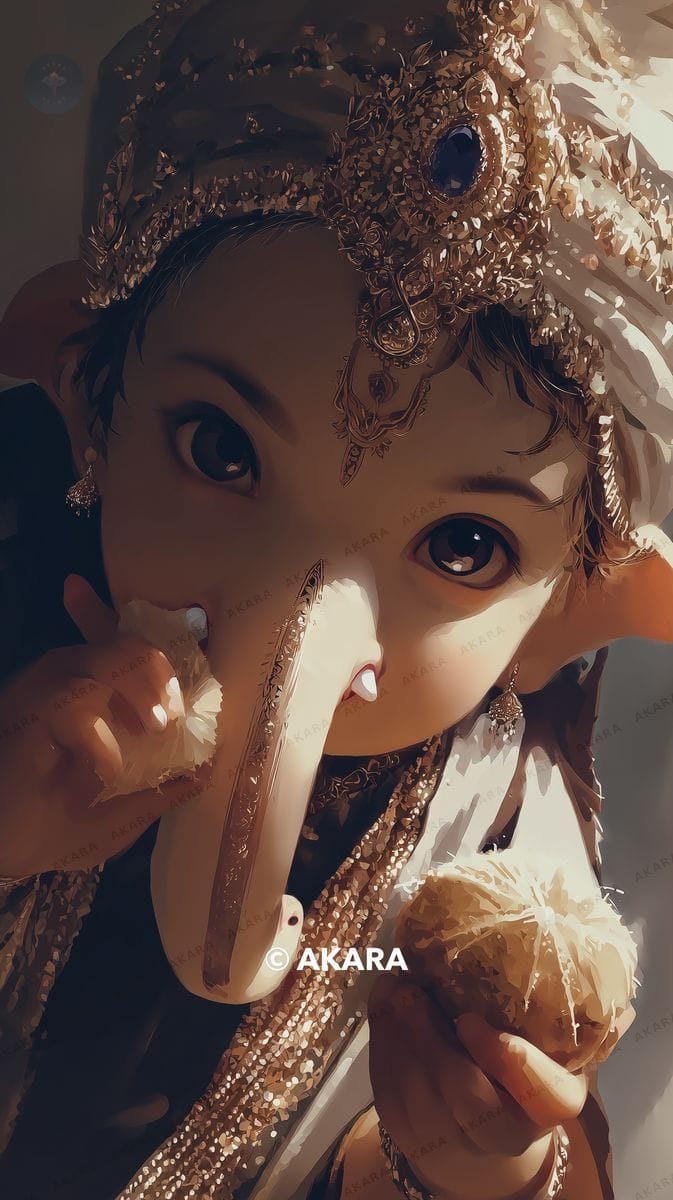
Before a journey begins, before a word is written, before a prayer is offered — Ganesha is invoked. He stands at every threshold: of temples, of homes, of the mind itself. Yet how many of us pause to ask why his head is that of an elephant, why one tusk is broken, or why a small mouse carries his immense form? The answer is not mere mythology. In Sanatana Dharma, the divine form — the murti — is a living scripture. Every curve, colour, and attribute of Lord Ganesha encodes a teaching as precise as any verse in the Upanishads. To understand his symbolism is to receive a complete map of the spiritual life.
Vighnaharta and Vighnakarta: The Paradox of the Remover
Ganesha bears two of the most illuminating names in all of Hindu spirituality: Vighnaharta (विघ्नहर्ता), the remover of obstacles, and Vighnakarta (विघ्नकर्ता), the creator of obstacles. He is both. This paradox is not a contradiction — it is the first teaching. The same divine force that clears the path for those who are aligned can place an impenetrable wall before those who proceed with ego, haste, or impurity of purpose. Ganesha tests readiness. He is not merely a divine doorman but a discerning one. In the Ganapati Atharvashirsha Upanishad — a foundational text entirely devoted to Ganesha's nature — he is identified with Brahman itself: "Tvam eva kevalam kartā'si, tvam eva kevalam dhartā'si" — "You alone are the doer, you alone are the sustainer." This is no minor deity of convenience. This is cosmic consciousness wearing a lovable form to make itself approachable.
Why the Elephant Head? The Wisdom of Gajamukha
The most immediate question any seeker asks is: why does Ganesha have the head of an elephant? The Sanskrit word gaja (गज) means elephant, and mukha (मुख) means face; hence Gajamukha, the elephant-faced one. The elephant in Indian tradition is the supreme symbol of wisdom, memory, and discriminative intelligence (viveka). An elephant navigates dense forest by finding the hidden path; it never forgets; it possesses both tremendous power and extraordinary gentleness. These are precisely the qualities of the awakened intellect.
But the symbolism deepens anatomically. The elephant's large ears, fan-like and wide, represent the capacity to listen — to hear the subtle over the gross, scripture over opinion, inner guidance over outer noise. The Mudgala Purana, one of the principal texts on Ganesha's mythology, describes his ears as winnowing fans that separate grain from chaff — the real from the illusory.
The trunk itself is perhaps the most discussed of all Ganesha's attributes. It curves, and the direction of that curve carries meaning: a trunk turned to the left (the ida or lunar channel) is considered easier to propitiate, associated with coolness and accessibility. A trunk turned right, toward the pingala or solar channel, represents a fiercer, more demanding form. Most murtis in domestic worship show a left-curving trunk for precisely this reason. But beyond direction, the trunk signifies adaptability — it can uproot a tree and also pick up a needle. The spiritually awakened mind must be capable of both the vast and the minute.
The Broken Tusk: Ekadanta, the One-Tusked
Ekadanta (एकदन्त) —
वक्रतुण्ड महाकाय सूर्यकोटि समप्रभ। निर्विघ्नं कुरु मे देव सर्वकार्येषु सर्वदा॥ vakratuṇḍa mahākāya sūryakoṭi samaprabha nirvighnaṃ kuru me deva sarvakāryeṣu sarvadā
O elephant-faced one, with a massive form radiant as millions of suns, remove all obstacles in all my endeavors, always.