Nine Nights, Nine Doors: The Inner Journey of Sharad Navratri 2026
As the autumn sky deepens and Ashwin's cool breath arrives, the great festival of the Divine Mother draws near — nine nights, nine forms, one infinite Shakti.
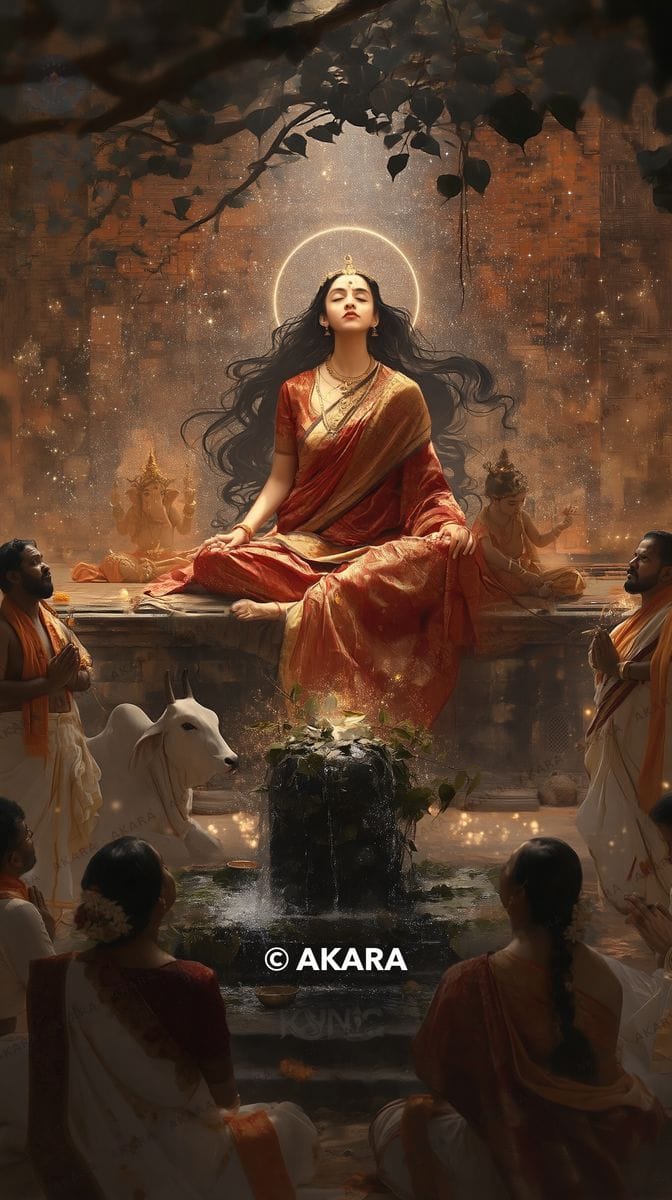
Nine days from now, on the morning of Sunday, 11 October 2026, the earth will shift almost imperceptibly — and those who are awake to it will feel it. A clay pot will be consecrated in millions of homes, barley seeds pressed into soil, and a lamp lit that will not be allowed to go out until the tenth dawn. Sharad Navratri is coming. For the Sanatana Dharma world, it is not merely the largest festival of the autumn season; it is an invitation — nine nights of descent into the self, guided by nine faces of the one Mother.
The Season Speaks First
The Panchang of this very day is, quietly, a preparation. The Sun stands in Kanya — Virgo, the sign of discernment and purification. The Nakshatra is Mrigashira, 'the deer's head,' traditionally associated with searching, seeking, gentle inquiry. Even the Yoga, Vyatipata — sometimes considered difficult — is, in the deeper grammar of astrology, a day for cutting away what no longer serves. The cosmos, it seems, is already clearing the ground.
Sharad Navratri 2026 begins on Sunday, 11 October, with the sacred rite of Ghatasthapana, and concludes with Vijayadashami — the victory of Devi — on Tuesday, 20 October. The main Ghatasthapana muhurta falls between approximately 6:19 AM and 10:12 AM, with an Abhijit window around 11:44 AM–12:31 PM for those who need it, though timings vary by city and should be confirmed with a local Panchang.
What Is Navratri, Really?
The word is transparent in Sanskrit: Nava (नव) means nine, Ratri (रात्रि) means night. But the deeper meaning is contained not in the number or the darkness — it is in what moves through both.
The festival honours the Navadurga (नवदुर्गा) — the nine forms of the Divine Mother, each worshipped on one of the nine days. These are not nine separate goddesses. As the Devi Bhagavata Purana makes emphatically clear, all nine forms are aspects of one supreme Divine Consciousness, one Adishakti (आदिशक्ति), the primordial power that underlies all creation. To encounter them in sequence over nine days is, as the tradition teaches, a complete spiritual initiation, not merely a festival.
The narrative origin of the Navadurga is given with beautiful precision in the Devi Mahatmya — the Durga Saptashati — enshrined within the Markandeya Purana. It tells how the buffalo-demon Mahishasura, armoured with a boon that no man or god could slay him, had routed the devas from heaven itself. The gods, powerless alone, combined every particle of their divine energy and from that confluence arose Devi — a power no single male force could contain. She battled his vast army for nine nights and on the tenth morning, Vijayadashami, she destroyed him. The ten days are not mythology in the thin sense. They are a map.
The Nine as a Journey Inward
Each form of Navadurga corresponds to a quality that must be awakened — in order — if the devotee is to arrive at genuine liberation. The sequence is not arbitrary. It follows the logic of the inner life.
Days 1–3: The Foundation
- Shailputri (शैलपुत्री), Daughter of the Mountain — steadiness, rootedness, the courage to begin.
- Brahmacharini (ब्रह्मचारिणी), the Devoted Ascetic — discipline, penance, the patient keeping of a vow.
- Chandraghanta (चंद्रघंटा), She Who Wears the Half-Moon Bell — courage joined with inner calm; the warrior who rings a warning to demons and a welcome to devotees.
These three form the first triad: tamas being dissolved through effort, inertia giving way to purposeful action.
Days 4–6: The Expansion
- Kushmanda (कूष्मांडा), the Cosmic Creator — she who created the universe with a single smile; invoked for health, vitality, and creative radiance.
- Skandamata (स्कंदमाता), Mother of Skanda — fierce motherly love; the reminder that spiritual power is always in service to what it loves.
- Katyayani (कात्यायनी), the Warrior Goddess — righteous strength, the refusal to compromise with adharma.
This is the Rajasic triad: creative power engaged with the world, blessing family, community, and dharmic life.
Days 7–9: The Return to Source
- Kalaratri (कालरात्रि), the Dark Night of Time — the most fearsome form, destroyer of darkness and ignorance. Her worship asks the devotee to face what is genuinely frightening within themselves, without flinching.
- Mahagauri (महागौरी), the Radiant White — what remains after every darkness is burned away: purity, grace, the luminous stillness of a liberated mind.
- Siddhidatri (सिद्धिदात्री), Giver of Accomplishment — the ninth form represents completion, the maturity of all spiritual practice, the granting of all eight siddhis to one who has made the full journey.
The arc is unmistakable: the seeker moves from groundedness through creative engagement through shadow-work to arrive, on the ninth night, at wholeness. Navratri is, in this reading, a nine-day course in what the Upanishads call atma-shuddhi — purification of the self.
How Bhakti Carries the Journey
Knowledge of the forms is beautiful. But it is bhakti — devotion — that makes the nine nights alive. Across India and in diaspora temples worldwide, this means different things in different traditions, and all of them are valid.
In the Garba circles of Gujarat, the rotating dance itself becomes a moving yantra, the devotee circling the Devi as the planets circle the sun. In Bengal, vast pandals erupt with artistry around the murti of Durga, and on the final day, idol immersion — visarjana — turns farewell into poetry. In the Devi temples of Tamil Nadu and Andhra Pradesh, the Golu (sacred display of figurines) becomes a teaching museum of the entire cosmos. In the Himalayas, at Vaishno Devi, lakhs of pilgrims walk through the night, many in the deep quiet of personal vow.
At home — wherever home is — the simplest sadhana (spiritual practice) is consistent: light a lamp each evening, recite at minimum the Devi's names, keep the intention to encounter one Navadurga per day with some genuine reflection. The tradition does not demand grandeur. It asks for sincerity.
For the Devotee Preparing Now
With nine days remaining before Ghatasthapana, this is the threshold moment — the time the Panchang, with its atmosphere of Mrigashira-seeking and Kanya-discernment, seems to have designed for preparation.
- Choose a sankalpa (संकल्प) — a clear intention for these nine days. What quality in you needs to be invoked?
- Source or set aside the materials for Ghatasthapana: a clay or metal Kalasha (pot), pure water, mango leaves, a coconut, soil, and barley seeds. These are the living symbols of abundance invited into the home.
- Select a path for daily recitation — even five minutes of the Durga Saptashati, or simply the Navadurga names sung slowly, is a genuine practice.
- **Plan one act of anna-daan** (food offering or sharing) during the nine days; the tradition connects the Goddess explicitly to nourishment and abundance.
The Devi Bhagavata Purana notes that honouring even one form of the Goddess is enough to invoke her universal presence. This is the generosity of Shakti: she meets the devotee wherever they stand.
A Closing Reflection
Every year, the Sharad Navratri arrives as the monsoon withdraws — as if the sky itself steps back to give Devi the stage. The air clears. The stars grow sharper. And across this ancient land and its diaspora worldwide, the same lamps are lit, the same names spoken, the same dance begun — a thread of living bhakti running unbroken across at least fifteen centuries of recorded practice, and immeasurably longer in oral memory.
The Navadurga do not reside only in temples. The tradition is explicit: Devi is present wherever her name is spoken with love. As you read these words — in Pune or Patna, in London or Los Angeles, in the small hours or the lunch break — the invitation is the same. Nine nights. Nine doors. One Mother, infinite and near.
Nine nights. Nine doors. One Mother, infinite and near.
नमः शिवाय namaḥ śivāya
Salutations to Shiva, the Auspicious One
Questions & answers
When does Sharad Navratri 2026 begin and end?
Sharad Navratri 2026 begins on Sunday, 11 October 2026, with Ghatasthapana, and concludes on Monday, 19 October 2026 with Maha Navami. Vijayadashami (Dussehra) follows on Tuesday, 20 October 2026.
What is the auspicious time for Ghatasthapana on 11 October 2026?
The primary Ghatasthapana muhurta is approximately 6:19 AM to 10:12 AM, with an Abhijit muhurta around 11:44 AM to 12:31 PM. Exact timings vary by city, so please verify with a local Panchang or a trusted jyotishi.
Who are the Navadurga — the nine forms of Devi worshipped during Navratri?
The nine forms, worshipped in order across the nine days, are: Shailputri, Brahmacharini, Chandraghanta, Kushmanda, Skandamata, Katyayani, Kalaratri, Mahagauri, and Siddhidatri. Together they are called Navadurga (नवदुर्गा), and all nine are aspects of one supreme Shakti.
Which scriptures describe the Navadurga and the significance of Navratri?
The primary scriptural sources are the Devi Mahatmya (also called Durga Saptashati or Chandi Path) from the Markandeya Purana, and the Devi Bhagavata Purana. The Devi Mahatmya narrates the nine-night battle against Mahishasura; the Devi Bhagavata Purana describes the nine forms as stages of the Goddess's own cosmic journey.
Can Navratri be observed at home without visiting a temple?
Absolutely. The tradition holds that the Goddess is present wherever her name is spoken with sincerity. A home practice of lighting a lamp each evening, reciting the Navadurga names, and keeping a sankalpa (intention) for the nine days is a complete and valid sadhana. Ghatasthapana with a small Kalasha can also be performed at home following standard vidhi.