Bajrangbali: The Eternal Servant Who Carries the World on His Shoulders
On this Saturday of Krishna Saptami, we turn toward Anjaneya — the one whose devotion is itself a form of liberation.
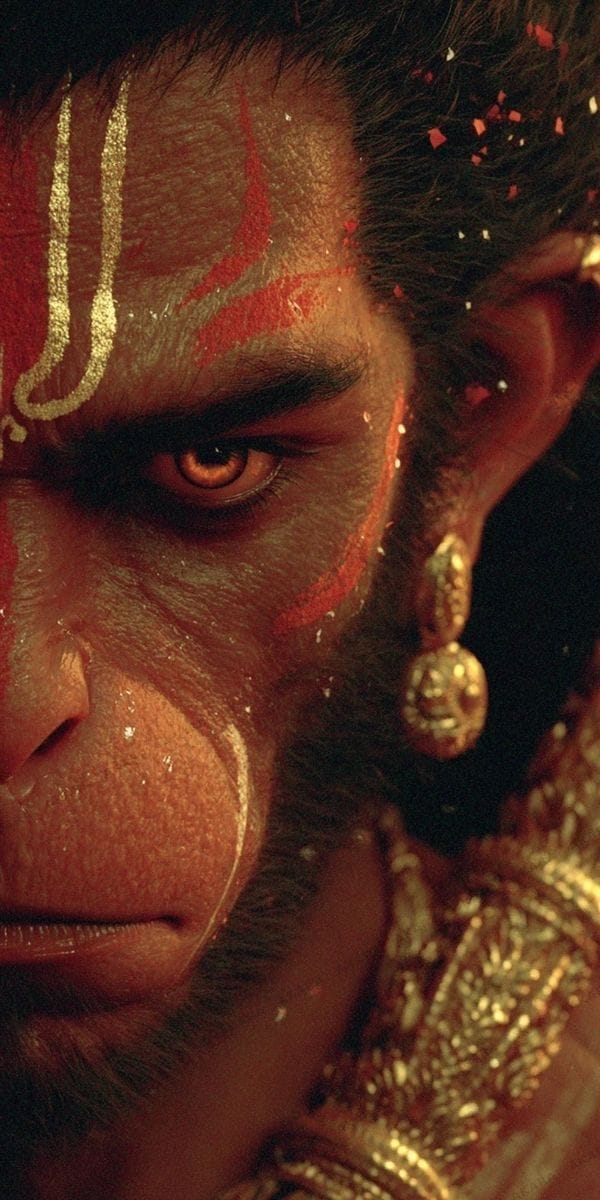
There is a moment in the Ramayana that stops the breath. Hanuman, asked by Sita to prove his identity, tears open his chest — and within, radiant and unmoving, sit Rama and Sita themselves. No philosophical treatise on bhakti has ever said it more simply or more completely: the true devotee does not merely worship the divine; the divine takes up residence inside the devotee. It is this singular image — chest open, eyes wide with love — that has drawn hundreds of millions of hearts toward Bajrangbali across millennia, and draws them still, today, on his beloved Saturday.
Who Is Hanuman? Origin and Nature
Hanuman — known variously as Anjaneya (son of Añjanā), Bajrangbali (one of thunderbolt limbs), Maruti (son of Marut, the wind god), and Pavanputra (son of Pavan, the breath) — is one of the most beloved figures in Sanatana Dharma. He is classified in the Puranas as a chiranjeevi, an immortal being who remains present on earth through every age. The Valmiki Ramayana, the Tulsidas Ramcharitmanas, and the Hanuman Chalisa together form the primary scriptural architecture around his life and nature.
Born of Añjanā, an apsara who had taken human birth, and blessed through the grace of Pavana Deva (the god of wind), Hanuman combines two inheritances: the celestial swiftness and subtlety of Vayu, and the earthly, embodied capacity for seva — selfless service. He is simultaneously shakti (power) and bhakti (devotion), muscle and mantra, roar and surrender. The Tulsidas tradition describes him as Shankara-suvan, a partial manifestation of Lord Shiva himself — the ascetic's discipline flowing into the devotee's love.
In the cosmic scheme of Sanatana Dharma, Hanuman represents the jiva — the individual soul — at its most evolved: fully capable, yet entirely surrendered. He is not weak. He is perhaps the strongest being described in Hindu scripture. He lifted a mountain. He leapt across an ocean. He reduced Lanka to ash. And yet, at every turn, he deflects all glory to Rama. This is the paradox that makes him so poignant: supreme power worn as humility.
Reading the Iconography
To stand before a murti of Lord Hanuman is to receive a teaching without words. Each element of his iconography carries layered meaning.
His red complexion — sometimes the deep red of sindoor, sometimes saffron — speaks of both shakti (active power) and tapas (the fire of spiritual discipline). Legend holds that when Sita applied sindoor to her forehead for the longevity of Rama, Hanuman covered his entire body with it out of love for his lord; this is why devotees anoint him with sindoor to this day.
The gada (mace) in one hand is the instrument of justice — the force that upholds dharma. The mountain held aloft (in the form associated with the Sanjeevani episode) speaks of selfless action: he did not know which herb would save Lakshmana, so he carried the entire mountain rather than risk choosing wrongly. Wholehearted action, leaving no margin for ego.
His tail, coiled and often depicted curled over his head, is Kundalini-energy transformed — the primal force domesticated by devotion. His open palm in abhaya mudra (gesture of fearlessness) addresses every devotee's deepest anxiety: do not be afraid.
Two Stories That Illuminate the Soul
The Crossing of the Ocean: When the search for Sita reached the southern shore and the ocean seemed impassable, it was Hanuman who leapt. Before he did, the sages and bears of Rama's army reminded him of his powers — for Hanuman, in his characteristic humility, had forgotten them. This story is not incidental. It suggests that our own deepest capacities lie dormant beneath layers of self-doubt, and that sometimes we need the voice of a trusted teacher, a sangha (community), or a moment of grace to remember who we truly are. Hanuman did not acquire his powers in that moment; he recollected them. The Sanskrit word is smarana — remembrance. Bhakti, at its core, is the practice of remembering.
The Chest Opening: When doubters at Rama's court whispered that Hanuman's devotion was merely performance, he placed his hands on his chest and parted it. Inside: Rama and Sita, luminous and present. This is the Upanishadic statement made visceral — Tat tvam asi, that thou art. The devotee who fully surrenders becomes the living shrine. Hindu spirituality does not ask us to leave the world for God; it asks us to let God fill the world we carry inside.
The Mantra and the Practice of Saturday Worship
The primary mantra is: Om Hanumate Namaḥ (ॐ हनुमते नमः) — I bow to Hanuman. Short, direct, complete. Devotees also recite the Hanuman Chalisa, the forty verses composed by Goswami Tulsidas in the sixteenth century, which remain one of the most memorised and recited texts in the world today.
Saturday — Shanivaar — is Hanuman's day. On this day, tradition holds that worship of Bajrangbali is particularly potent, offering protection from obstacles, the dispelling of fear, and the grace of Shani Deva (Saturn), whose difficult transits Hanuman is said to neutralise through his presence.
A simple Saturday puja proceeds thus:
- Sunrise: Light a sesame oil or mustard oil lamp. Offer red flowers, sindoor, and betel leaves.
- Mantra: Chant Om Hanumate Namaḥ 108 times, or recite the Hanuman Chalisa.
- Prasad: Boondi laddoos or jaggery are traditional offerings.
- Seva: Acts of service — feeding the hungry, helping the vulnerable — are considered the highest form of Hanuman puja, mirroring his own life of ceaseless seva.
Today's panchang notes Ardra Nakshatra in its first pada — a nakshatra governed by Rudra, carrying an energy of both storm and renewal. Paired with Krishna Saptami and Yoga Variyana (a yoga associated with patience under adversity), this Saturday carries a quiet, steadying quality. It is a fine day to sit with Hanuman not in triumphalism, but in the kind of still devotion he himself exemplifies.
What Hanuman Asks of the Seeker
If any deity in the Hindu pantheon embodies the possible, it is Hanuman. He did not arrive perfect. He had to be reminded of his own greatness. He made mistakes — in childhood, he reached for the sun, mistaking it for a fruit, and was struck down. He learned. He grew. He became.
What he asks of us is not genius or perfection. He asks for nishkama karma — action without attachment to outcome. He asks for loyalty to something larger than the self. He asks us to pick up the whole mountain when we cannot identify the right herb. He asks, ultimately, that we open our chests — metaphorically, daily — and ask: Is Rama living in here? Have I made room?
In an age defined by noise, speed, and the exhausting theatre of self-promotion, Hanuman is the antidote. He is the original example of what it means to be mighty and meek simultaneously — to hold tremendous power in complete service. Devotees across the world — from rural mandirs in Maharashtra to temples in Mauritius, from Houston to Hamburg — turn to Bajrangbali on Saturdays not simply for boons, but for the feeling his presence generates: that strength and surrender are not opposites but the same sacred breath.
Manojavam Marutatulyavegam, Jitendriyam Buddhimatam Varishtham — Swift as the mind, swift as the wind, master of the senses, foremost among the wise. — Hanuman Stuti, Valmiki Ramayana
Jaya Bajrangbali. Jai Shri Ram.
The true devotee does not merely worship the divine; the divine takes up residence inside the devotee.
मनोजवं मारुततुल्यवेगं जितेन्द्रियं बुद्धिमतां वरिष्ठम्। वातात्मजं वानरयूथमुख्यं श्रीरामदूतं शिरसा नमामि॥ manojavaṃ mārutatulyavegaṃ jitendriyaṃ buddhimatāṃ variṣṭham | vātātmajaṃ vānarayūthamukhyaṃ śrīrāmadūtaṃ śirasā namāmi ||
fast as thought, swift as wind, master of his senses and supreme among the wise — we bow to hanuman, son of the wind and rama's messenger.
Questions & answers
Why is Saturday considered Hanuman's day?
Saturday (Shanivaar) is associated with both Hanuman and the planet Shani (Saturn). Tradition holds that Hanuman has power over Saturn's difficult influences, and worship on this day is believed to bring protection, courage, and relief from obstacles. Devotees observe fasts, light oil lamps, and recite the Hanuman Chalisa on Saturdays.
What is the simplest Hanuman mantra for daily practice?
The most accessible mantra is 'Om Hanumate Namaḥ' — meaning 'I bow to Hanuman.' It can be chanted 108 times on a rudraksha or tulsi mala. The Hanuman Chalisa, composed by Tulsidas, is also widely recited and is considered a complete sadhana in itself.
What is the significance of applying sindoor to Hanuman's idol?
Sindoor (vermilion) is closely associated with Hanuman because of a story in the Ramcharitmanas: when Hanuman saw Sita applying sindoor for Rama's long life, he covered his entire body with it as an act of boundless love. Devotees continue this tradition by anointing the murti with sindoor, symbolising total dedication.
What does 'Bajrangbali' mean?
'Bajrang' derives from 'Vajranga,' meaning 'one whose limbs are as strong as Vajra (the thunderbolt),' and 'Bali' means 'the powerful one.' Together, Bajrangbali means 'the mighty one with limbs of steel' — a name that captures Hanuman's extraordinary physical and spiritual strength.
Is Hanuman considered a god or a devotee in Hindu tradition?
Hanuman occupies a unique and beloved position: he is simultaneously a deva (divine being), a partial manifestation of Shiva according to some traditions, and the supreme bhakta (devotee) of Rama. His greatness is understood to arise precisely from his devotion — making him both an object of worship and an ideal for every seeker to emulate.