The Bhagavad Gita in Brief: Krishna's Teaching to Arjuna
Eighteen chapters, one battlefield, and a conversation that reshaped the course of human understanding — here is what the Gita actually teaches.
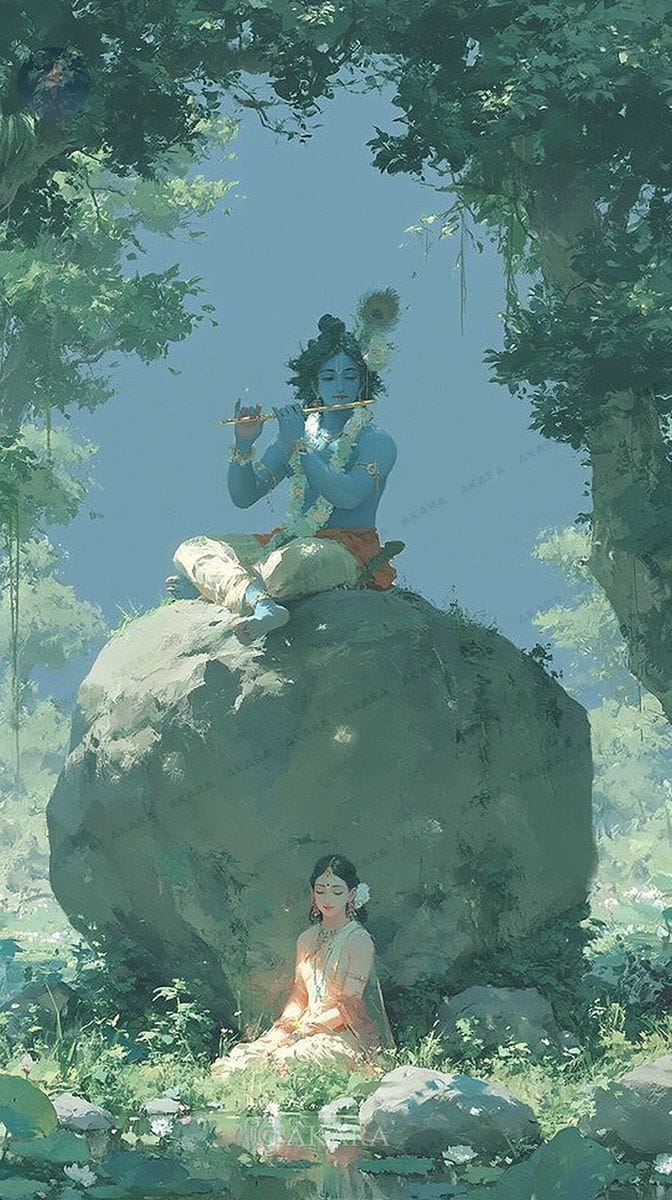
On the eve of the Kurukshetra war, a great archer lays down his bow. Arjuna, peerless warrior and devotee, is overwhelmed not by the enemy across the field but by grief, doubt, and the terrifying weight of duty. It is into this very human moment of collapse that Krishna — charioteer, friend, and the Supreme — begins to speak. What follows across eighteen chapters of the Bhagavad Gita is not merely battlefield counsel but one of the most complete and tender summaries of spiritual life ever set down in any language.
What the Bhagavad Gita Is — and Where It Lives
The Bhagavad Gita (Sanskrit: भगवद्गीता, Bhagavad Gītā, "Song of the Lord") forms chapters 23 through 40 of the Bhishma Parva within the Mahabharata, one of the two great Itihasas of Sanatana Dharma. It comprises 700 verses (shlokas) arranged across 18 chapters (adhyayas), each chapter traditionally named after a distinct yoga — a path or discipline. The dialogue unfolds between Krishna (Śrī Kṛṣṇa), the avatar of Vishnu, and the Pandava prince Arjuna (Arjuna), witnessed and narrated to the blind king Dhritarashtra by his minister Sanjaya, who has been granted divine vision by the sage Vyasa.
The Gita is not an isolated text dropped from the sky. It is the living heart of a vast epic, and it speaks precisely because it is embedded in crisis. Arjuna's collapse is not weakness — the Gita regards it as a doorway. When the ego's certainties break apart, the teaching can enter.
The Three Paths: Karma, Jnana, and Bhakti
Krishna does not offer Arjuna a single prescription. He lays out the terrain of the whole spiritual life and acknowledges that different temperaments require different routes. Three great yogas — disciplines or paths — form the backbone of his teaching.
Karma Yoga (कर्मयोग, Karma Yoga — the path of right action) is introduced in Chapter 3 and runs through the entire text. Its central instruction is deceptively simple and endlessly profound: act fully, but release attachment to the fruit of action. "You have a right to perform your prescribed duties, but you are not entitled to the fruits of your actions" (na ca māṃ tāni karmāṇi nibadhnanti, 3.9, paraphrased). This is not indifference; it is freedom. When action is offered as yajna (यज्ञ, sacred sacrifice), it purifies the actor and sustains the cosmic order (ṛta).
Jnana Yoga (ज्ञानयोग, Jñāna Yoga — the path of wisdom) runs through Chapters 4, 13, and 15. Krishna distinguishes the eternal Self (Ātman) from the body-mind complex (kṣetra, the field), and reveals that the Ātman is birthless, deathless, and indestructible. "Never was there a time when I did not exist, nor you, nor all these beings; nor will there be any future time when we shall cease to be" (2.12). This is not philosophy as abstraction but as liberation from the primal fear of death.
Bhakti Yoga (भक्तियोग, Bhakti Yoga — the path of loving devotion) emerges most fully in Chapters 9, 11, and 12, and many scholars regard it as the Gita's ultimate recommendation. In Chapter 11, Arjuna is granted the Vishvarupa Darshana — the cosmic vision of Krishna as the universe entire — and is overwhelmed. Yet Krishna then says, in what is among the most beloved verses of all scripture: "Neither by the Vedas, nor by austerity, nor by charity, nor by sacrifice can I be seen as you have seen Me. But by ananya (exclusive, undivided) devotion, O Arjuna, I can be known, truly seen, and entered into" (11.53–54). Bhakti is not mere sentiment; it is the most direct recognition of reality.
The Cosmic Vision and the Nature of the Divine
No summary of the Gita is complete without pausing at Chapter 11, the Vishvarupa Darshana Yoga. Arjuna asks to see Krishna's divine form. What he is shown shatters every category: a form containing all worlds, all beings, all time — mouths of flame consuming armies, suns blazing in every direction, the entire cosmos as the body of one Being. Arjuna trembles and begs Krishna to return to his familiar two-armed human form (dvibhuja).
This episode is not merely dramatic poetry. It carries a precise philosophical point: the personal and the universal are not rivals. The same Krishna who jokes with the cowherd boys of Vrindavan, who drives Arjuna's chariot in humble service, is also the ground of all existence. The Gita holds these two truths — saguna (with form and qualities) and nirguna (formless, beyond attributes) — in creative tension, asking the seeker to love the personal face of the divine even while understanding its infinite depth.
Dharma, Liberation, and the Relevance Today
The Gita's ethics are rooted in the concept of svadharma (स्वधर्म, "one's own duty" or calling). Krishna does not ask Arjuna to become someone else. He asks him to be, fully and fearlessly, what he already is. "Better is one's own dharma, though imperfectly performed, than the dharma of another well performed" (3.35). In our age of relentless comparison and identity anxiety, this teaching is a homecoming.
The Gita's vision of liberation (moksha, मोक्ष) is not the extinction of the person but the dissolution of false separation. The jīva (individual soul) recognizes its unity with Brahman (the universal ground). Whether this realization comes through selfless action, disciplined inquiry, or surrendered love, the destination, Krishna says, is the same.
For practitioners today — whether seated in a puja room in Pune, a meditation centre in London, or a kitchen in São Paulo — the Gita offers a daily discipline: do what is yours to do, offer it to the divine, remain equanimous in success and failure. This is not escapism but the most demanding form of presence.
How to Approach the Gita
The tradition recommends approaching the Gita with a qualified teacher (guru) and in a spirit of shravana (listening), manana (reflection), and nididhyasana (deep meditation on the truth heard). Read one chapter at a time. Let a single shloka settle into the mind for a whole day. The great commentaries — Adi Shankaracharya's Gita Bhashya (Advaita lens), Ramanujacharya's Gita Bhashya (Vishishtadvaita), Madhvacharya's commentary (Dvaita) — each illuminate different facets, and none cancels the others.
At Akara, we hold the Gita as a living scripture — not a relic to be archived but a song to be sung. The word Gita itself means song. It was not written for armchairs alone; it was spoken on a field, to a person in crisis, by a friend who was also God. That intimacy is its power, and it remains, eighteen chapters later, entirely available to you.
"Abandon all varieties of dharma and simply surrender unto Me. I shall deliver you from all sinful reactions. Do not fear." — Bhagavad Gita 18.66 (Sarva-dharmān parityajya māmēkaṃ śaraṇaṃ vraja)
The word Gita itself means song. It was spoken on a field, to a person in crisis, by a friend who was also God.
राधाकृष्णौ जगत्पाणी गोविन्दौ गोपिकाप्रिया rādhākṛṣṇau jagatpāṇī govindau gopikāpriyā
Radha-Krishna, holders of the world, beloved of the cowherd maidens—their love transcends all boundaries.
Questions & answers
How many chapters and verses does the Bhagavad Gita have?
The Bhagavad Gita contains 18 chapters (adhyayas) and 700 verses (shlokas). Each chapter is named after a yoga or spiritual discipline.
What is the central teaching of the Bhagavad Gita?
The Gita's central teaching is to perform one's duty (svadharma) without attachment to results, offered as an act of devotion to the Divine. This is expressed through three interwoven paths: Karma Yoga (right action), Jnana Yoga (wisdom), and Bhakti Yoga (devotion).
Who composed the Bhagavad Gita and where does it appear?
The Bhagavad Gita is attributed to the sage Vyasa and forms part of the Bhishma Parva of the Mahabharata. It is the dialogue between Lord Krishna and Prince Arjuna, narrated by Sanjaya to the blind king Dhritarashtra.
What is the meaning of 'Bhagavad Gita' in Sanskrit?
Bhagavad Gita (भगवद्गीता) translates as 'Song of the Lord' — Bhagavad meaning 'of the Lord' or 'of the Blessed One,' and Gita meaning 'song' or 'that which is sung.'
How should a beginner read the Bhagavad Gita?
Tradition recommends approaching the Gita one chapter at a time, ideally with a qualified teacher (guru). Spend time with a single verse through the day — hearing it (shravana), reflecting on it (manana), and meditating on its meaning (nididhyasana). Commentaries by Shankaracharya, Ramanujacharya, or Swami Vivekananda are excellent starting companions.