Amavasya: When the Sky Goes Dark and Shiva Draws Near
On this Ashvina Amavasya — Mahalaya and Shani combined — the sky empties itself so that something deeper may fill us.
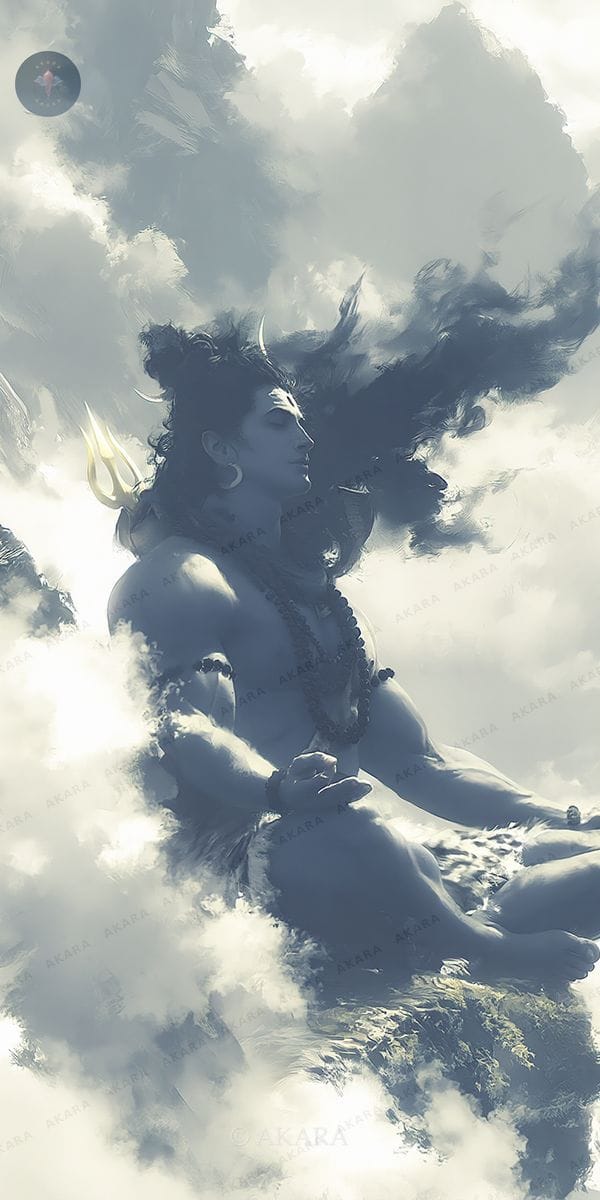
Tonight the sky holds nothing. No moon rises, no silver arc reassures the eye, and that absence, far from being a lack, is the whole point. This is Amavasya — the new-moon tithi that the Vedic calendar marks as one of the most potent moments in any lunar month. On Saturday, 10 October 2026, a rare convergence makes it more charged than most: this is Ashvina Amavasya, also called Mahalaya — the crown and close of the sixteen-day Pitru Paksha — and because it falls on a Saturday, it carries the additional name Shani Amavasya. The tithi opened at approximately 9:36 PM on 9 October and runs until 9:20 PM tonight. Nakshatra Hasta, Yoga Indra, and the Sun settled in Kanya (Virgo) frame a panchang of quiet precision, as though the cosmos itself had arranged a chamber of stillness for those willing to enter it.
What Amavasya Actually Means
The word Amavasya (अमावस्या) carries its meaning openly. One traditional derivation reads ama as "together" and vasya as "to dwell" — Sun and Moon dwelling in perfect conjunction, the lunar disc invisible against the solar body. Astronomically, the Amavasya tithi is defined as the period when the Moon lies within twelve degrees of angular distance from the Sun before their conjunction. It is the final tithi of Krishna Paksha (the dark fortnight), the moment when one lunar cycle exhales its last breath before the new crescent is born.
In Hindu culture, the Amavasya day is considered a time of significance to propitiate the Sun, the Moon, and other gods. Yet its deeper register is interior. <cr>In Hindu philosophy, the darkness of the new-moon night is not a symbol of evil but a representation of the unmanifested state of the universe.</cr> The Vedic tradition sees it as a period of stillness and potential — a time when lunar energy is at its lowest, allowing individuals to turn their focus inward. The absence of moonlight, which ordinarily agitates the emotional mind (manas), becomes an unexpected gift: <cr>because the external light of the Moon is absent, the mind is encouraged to seek the inner light, the Ātma-Jyoti — the radiance of the Self.</cr>
The Threefold Name of Today's Observance
<cr>Ashvina Amavasya is the single most important day of the year for ancestral rites. It falls at the end of Pitru Paksha — the sixteen-day period dedicated to honouring departed ancestors.</cr> The word Mahalaya (महालय) means "the great abode" or "the great dissolution," pointing both to the ancestral realm and to the cosmic principle of return. <cr>As Sarva Pitru Amavasya, it is the day observed for all forefathers, including those whose individual death-tithi is not known</cr> — an all-embracing net of remembrance cast wide enough to catch every soul.
Because the Amavasya this year holds sunrise on a Saturday, it simultaneously becomes Shani Amavasya — a day considered especially powerful for clearing karmic accumulation under the watchful, exacting eye of Shani (Saturn). The panchang for today thus carries three distinct resonances at once: ancestral honour (pitru karma), karmic reckoning (Shani's domain), and the formless stillness from which Shiva presides over all dissolution.
Shiva and the Moon: A Story Written in the Sky
No deity is more intimately woven into the meaning of Amavasya than Mahādeva — the Great God, Shiva. <cr>According to the Shiva Purāṇa, the epithet Chandrashekhara — "he who bears the crescent moon on his crest" — is a standard iconographic feature from the period when Rudra rose to prominence as a major deity.</cr> The myth behind it is tender and instructive.
The Moon-god Chandra, cursed by Daksha to wane unto extinction, sought refuge with Shiva. Moved by his devotion, the Lord partially modified the curse: <cr>Shiva decreed that Chandra would wane for fifteen days but then wax for fifteen days, establishing the lunar cycle we observe today. As a symbol of his grace, Shiva adorned his matted locks with a crescent moon, where Chandra found permanent refuge.</cr> Every new-moon night, then, is the moment of Chandra's most complete surrender — the point of maximum waning before Shiva's grace turns the tide toward light again.
This is why <cr>Lord Shiva, who wears the crescent Moon on his head, presides over the dark moon's transformative energy, and worshipping Shiva on Amavasya is said to grant liberation from the cycle of birth and death.</cr> <cr>In Hindu cosmology, Shiva performs the Tāṇḍava — the cosmic dance of creation and dissolution. Amavasya represents a mini-dissolution within the lunar month, a momentary return to the void from which new creation emerges.</cr> The night is not an ending; it is the pivot.
There is also a protective dimension. <cr>Vedic texts suggest that Amavasya can be spiritually challenging due to increased tāmasic energies. Lord Shiva, who consumed the Halahala poison to protect creation, is invoked on this night for protection against negative influences and to transmute spiritual darkness into light.</cr> The great Mahādeva does not flee darkness — he digests it.
How to Observe: Ritual, Vrat, and Mantra
Pitru Tarpan — the first offering. <cr>Memorial rituals such as tarpana — the offering of water with black sesame seeds and kusha grass — and the offering of pinda (cooked rice balls mixed with ghee and sesame) are performed for the oblation of the departed souls of the forefathers.</cr> The practitioner faces south, the direction of Pitru Loka and the realm of Yama. Even those far from a river can perform a simplified tarpan at home: a clean vessel of water, a few sesame seeds, and the heartfelt utterance "Sarvebhyaḥ pitṛbhyo namaḥ — tṛpyat" (salutation to all ancestors — may they be satisfied). <cr>Tarpan can be performed at home with a clean vessel, water, black sesame seeds, and kusha grass.</cr> For Mahalaya, this is the day of Pitra Visarjan — the formal, loving farewell to ancestral spirits as Pitru Paksha closes and Devi Paksha dawns tomorrow.
Shiva Puja — the heart of the night. Bathe early. Offer bilva leaves (bel patra) — sacred to Shiva, said to represent the three eyes of the Lord and the triune nature of existence. Pour a slow stream of water or milk over a Shivalinga, letting each drop be a breath surrendered. Light a deepa (oil lamp), for on this moonless night the hand-lit flame becomes the only moon the shrine needs.
Vrat — the fast of willingness. Many devotees observe an Amavasya fast from sunrise to sunset, taking only fruit and water. The fast is not primarily about deprivation; it is a reorientation of appetite from the outer world to the inner. <cr>It is a day to release old patterns, seek forgiveness, and set intentions for the upcoming waxing cycle.</cr>
Om Namah Shivaya — the mantra for this night. The Panchakshara (पञ्चाक्षर — "five syllables": Na, Ma, Shi, Va, Ya) is the mantra of Shiva's five elements, five acts (pañcakṛtya), and five directions of consciousness. <cr>Chanting this mantra during Amavasya aligns the practitioner with cosmic rhythms, facilitating ego dissolution and expansion into universal consciousness.</cr> Sit in a clean, quiet space after the evening lamps are lit. Let the breath slow. Begin japa — repetition — of Om Namah Shivaya at an unhurried pace: 108 times, or as many rounds on a rudraksha mala as the night allows. There is nothing to achieve. There is only the sound, the silence between the syllables, and the One who is both.
"Na" is the earth. "Ma" is water. "Shi" is fire. "Va" is air. "Ya" is ether — the sky above this moonless night, vast and ready to receive whatever we finally release.
Why It Matters Now
In an age of relentless stimulation — screens that never dim, feeds that never empty, minds that never pause — the annual rhythm of Amavasya offers something almost countercultural: the invitation to stop. To sit with what cannot be seen. To remember that every person walking beside us carries a lineage of ancestors who once loved, grieved, and prayed as we do now.
<cr>This period of Shūnya — emptiness — provides the necessary space for spiritual renewal, allowing devotees to align their personal energy with the natural rhythm of the cosmos.</cr> The new moon is not a night to dread but a night to use. Mahalaya Amavasya in particular opens simultaneously toward the past — in gratitude and tarpaṇa for those who have gone — and toward the future: in Kolkata and across Bengal, tonight the eyes of the Durga idols are painted open in the Chokkhu Daan ritual, and tomorrow Devi Paksha begins. The ancestors are honoured and released; the Goddess arrives. Dissolution and auspiciousness, Shiva and Shakti, the dark and the kindled lamp — all held together in one sacred Saturday.
Light a lamp tonight. Pour water. Speak the names of those who came before you. Then sit, breathe, and chant. The formless is not empty — it is full of Shiva.
Om Namah Shivaya.
The new moon is not a night to dread but a night to use — full of Shiva, full of the formless, full of everything we have been too bright to see.
Questions & answers
When exactly is Amavasya in October 2026, and what is its tithi timing?
Ashvina Amavasya 2026 falls on Saturday, 10 October 2026. The Amavasya tithi began at approximately 9:36 PM IST on 9 October and ends at approximately 9:20 PM IST on 10 October. Because it falls on a Saturday it is also called Shani Amavasya, and as the final day of Pitru Paksha it is known as Mahalaya or Sarva Pitru Amavasya.
Why is Lord Shiva especially worshipped on Amavasya?
Shiva bears the crescent moon — Chandra — on his matted hair, a symbol rooted in the Shiva Purana's account of the Moon-god's curse and rescue. Every Amavasya marks the Moon's deepest waning, the moment of its surrender before Shiva's grace turns the cycle again. Shiva, as lord of dissolution and transformation, presides over this liminal point between one lunar cycle and the next, making him the preeminent deity for new-moon worship and inner transformation.
What is the significance of Mahalaya Amavasya specifically?
Mahalaya Amavasya is the final and most potent day of Pitru Paksha, the sixteen-day period dedicated to ancestral rites. It is also called Sarva Pitru Amavasya because it is the day for honouring all ancestors — including those whose individual death-tithi is unknown. According to tradition, the veil between the earthly plane and the ancestral realm (Pitru Loka) is thinnest on this day, and offerings made now are said to reach all departed forefathers with the grace of Yama.
How can someone observe Amavasya at home if they cannot visit a temple or river?
A meaningful home observance includes: (1) bathing before sunrise; (2) performing a simplified tarpan — offering water mixed with black sesame seeds from a clean vessel, facing south, with the prayer 'Sarvebhyah pitṛbhyo namaḥ — tṛpyat'; (3) lighting an oil lamp near a Tulsi plant or Peepal tree; (4) offering bilva leaves to a Shivalinga or Shiva image with slow Japa of Om Namah Shivaya (108 times); and (5) donating food or clothes to the needy in the name of one's ancestors. Sincerity of intention is, in the Vedic view, the highest ingredient of any ritual.
Is Amavasya inauspicious — should one avoid new beginnings on this day?
Amavasya is often misunderstood as inauspicious. The Vedic tradition holds it as deeply sacred, though with a specific orientation: it is not suitable for starting new worldly ventures such as marriages or business launches, but it is supremely auspicious for spiritual practices — ancestral rituals, Shiva and Devi worship, deep meditation, fasting, charity, and inner reflection. The darkness is understood not as a curse but as the unmanifested ground from which all light arises.