Lord Surya: The Eternal Light at the Heart of Sanatana Dharma
On this Sunday of Shukla Pratipada, we turn toward the one deity who never requires us to seek him — for he is already shining.
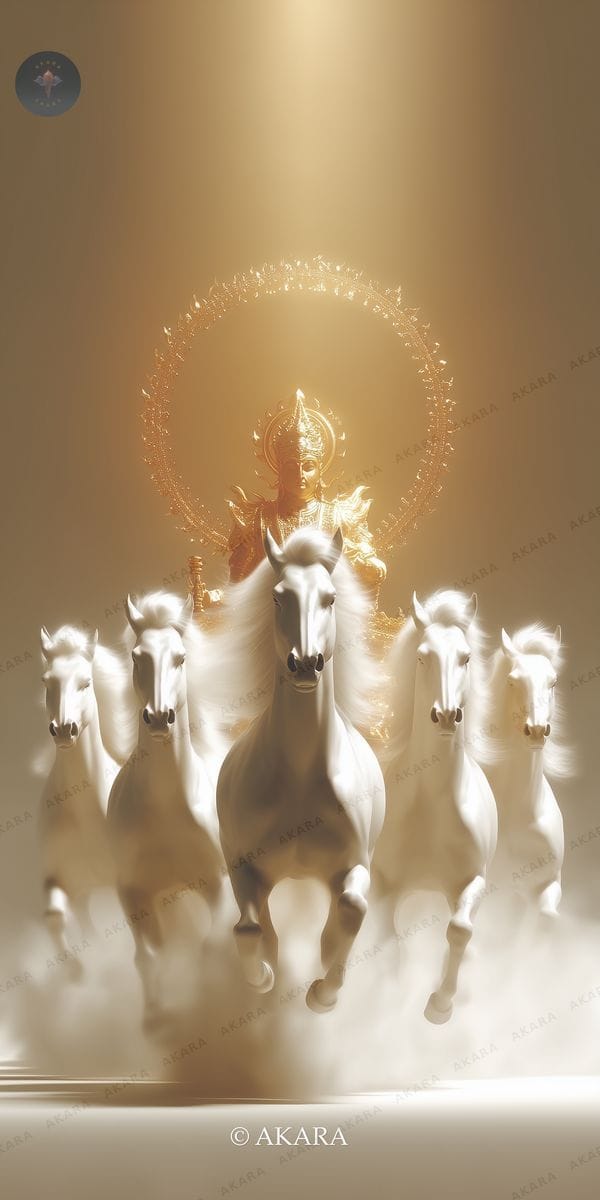
Before the first temple was built, before the first hymn was composed, there was light. The Rigveda opens its eyes to Surya — the radiant one, the witness of all worlds, the self-luminous principle that makes every other act of seeing possible. Across the vast sweep of Sanatana Dharma, no deity is more immediately present than Lord Surya, and perhaps none is more quietly taken for granted. Today, a Sunday blessed by Shukla Pratipada and the creative energy of Nakshatra Chitra, is an auspicious moment to truly look — with intention, with gratitude, with bhakti — at the one who has been looking after us since before memory began.
Who Is Surya? The Many Names of the Radiant One
Surya is known by one hundred and eight names in the ancient tradition, each revealing a different facet of his nature. He is Aditya — son of Aditi, the infinite mother, and therefore the embodiment of boundlessness itself. He is Bhaskar, the maker of light. He is Savitr, the stimulator and vivifier of all life — the name used in the immortal Gayatri Mantra, which is addressed specifically to the solar principle as the source of divine intelligence. He is Ravi, whose day (Ravivar) we observe each Sunday. He is Mitra, the cosmic friend, and Aryaman, the upholder of noble order.
The Rigveda, the most ancient layer of revealed scripture, contains entire hymns dedicated to Surya. The Suryopanishad, a minor Upanishad, goes further: it declares Surya to be none other than Brahman — the supreme, self-subsisting reality — clothed in luminosity. This is not mere poetry. The ancient rishis perceived that light is not simply a physical phenomenon; it is the outer garment of consciousness itself. To worship Surya is to worship the intelligence that illuminates both the external cosmos and the inner world of the mind.
The Iconography and Its Meaning
Surya is depicted standing upright in his solar chariot, drawn by seven horses. Each horse represents one of the seven colours of visible light — the same spectrum that modern physics would later confirm through a prism — and also the seven days of the week, the seven chakras of the subtle body, and the seven metres (chhandas) of Vedic verse. The chariot has a single wheel with twelve spokes, signifying the twelve months of the solar year.
He holds a lotus (padma) in each raised hand — the lotus being the symbol of purity that rises unstained from muddy water, a reminder that divine grace operates even in the densest conditions of earthly life. He wears the northern garment (Uttariya) and is often shown with two attendants: Danda (the rod of law) and Pingala (the reddish luminosity of dawn). His charioteer is Aruna, the rosy one — the god of dawn himself, who precedes his master each morning as a herald of mercy, softening the full intensity of the solar radiance before it arrives in fullness.
What is most striking about Surya's iconography is the absence of weapons. Unlike many deities who carry instruments of battle or protection, Surya carries only lotuses. His power is not coercive — it is irresistible simply by virtue of being what it is. The sun does not argue. It simply shines.
Stories from Scripture: The Chariot, the Son, and the Sage
Two stories from the Puranas illuminate Surya's character with particular beauty.
The first is the story of Sanjana and Chhaya. Surya's wife, Sanjana, found his radiance so intense that she could not remain near him. She fashioned a shadow-form of herself — Chhaya, meaning shade — to serve as his companion in her place, and herself retreated to a forest to practise tapas. When Surya discovered the truth, he was moved not to anger but to compassion. He agreed to have a portion of his effulgence shaved away by Vishwakarma, the divine architect. From the shavings of Surya's light, the Sudarshana Chakra of Vishnu was fashioned, along with the trident of Shiva and the lance of Kartikeya. The story holds a profound teaching: even pure light, when unmediated, can overwhelm. Wisdom — like a good teacher, like a good parent — knows when to dim itself so that another may grow toward it.
The second story is that of Karna, the tragic hero of the Mahabharata. Born to Kunti before her marriage, the son of Surya himself, Karna was gifted at birth with a natural armour (kavacha) and earrings (kundala) of solar gold — symbols of inherent dignity that no circumstance of birth or society could strip away. Karna's life is a meditation on this theme: that the child of light carries that light within, regardless of whether the world acknowledges it. Surya himself visits Karna in a dream to warn him of Indra's plot to take his armour, demonstrating his role as the caring, witnessing father — ever present, ever watching.
The Mantra and the Practice of Surya Worship
The most accessible Surya mantra is the simple and complete Om Suryaya Namah — I bow to Surya, the luminous one. Chanted facing east at sunrise, ideally while offering water (arghya) from cupped hands so that the light refracts through the stream, this practice is one of the oldest forms of devotion in Sanatana Dharma. The Rigveda (I.50) sings: Ud u tyam jātavedasam devam vahanti ketavaḥ — "The rays carry aloft that god, Jatavedas, the all-knowing one."
The Aditya Hridayam, found in the Yuddha Kanda of the Valmiki Ramayana, is the great Surya stotra par excellence. The sage Agastya recites it to Rama on the battlefield of Lanka, at the moment when Rama faces Ravana and feels momentarily overwhelmed. Agastya's counsel is essentially this: turn to the sun within you. The Aditya Hridayam is a complete theology of the solar deity and a practical tool for restoring courage, clarity, and vitality.
For devotees today, Surya worship need not require elaborate ritual. On this Sunday, with the Sun transiting Kanya (Virgo) and the nakshatra Chitra activating the energies of craft and precise beauty, the practice can be as simple as:
- Rising before or at sunrise and standing quietly, eyes gentle, facing east
- Offering a copper vessel of water, allowing it to stream in the direction of the rising sun
- Reciting Om Suryaya Namah twelve times, or the Gayatri Mantra, or simply breathing with awareness of the light entering the body
- Spending a moment in gratitude — not performed gratitude, but the real recognition that this light sustains every breath, every thought, every act of love
What Surya Asks of the Seeker
Surya is the deity of dharma in its most elemental sense — he illuminates without partiality. The sun rises equally on the saint and the sinner, the palace and the slum. His light does not choose. And this, the tradition tells us, is his deepest instruction to those who worship him: to cultivate an inner light that does not play favourites, that does not illuminate only what is convenient.
He is also the deity of witness consciousness — Sakshi. In Vedantic philosophy, Surya is often used as the image of the unchanging awareness that illuminates all mental activity without being disturbed by it, just as the sun illuminates clouds without becoming a cloud. To sit in Surya bhakti is, at its depth, to practise being that witness — present, luminous, undisturbed.
Sun in Kanya today brings Surya into the sign of discernment, of service, of careful attention to the real. It is a fitting placement for a reflection on how we use the light we have been given. Are we illuminating the lives of those around us? Are we offering what we know, what we see, what we understand — with the same quiet constancy that the sun offers its warmth?
Tamaso mā jyotir gamaya — Lead me from darkness to light. (Brihadaranyaka Upanishad 1.3.28)
This ancient prayer is addressed, at its root, to the principle of Surya — the one who has never, not once, failed to rise.
The sun does not argue. It simply shines.
त्र्यम्बकं यजामहे सुगन्धिं पुष्टिवर्धनम् tryambakaṁ yajāmahe sugandhiṁ puṣṭivardhanam
We worship the three-eyed one (Shiva), who is fragrant and nourishes all beings.
Questions & answers
Why is Sunday (Ravivar) considered Lord Surya's day?
Sunday — Ravivar or Ravivara — takes its name from Ravi, one of the twelve names of Surya. In Vedic tradition, each day of the week is presided over by a planetary deity (vaar devata), and Sunday belongs to the Sun. Worship offered on Sunday is believed to be especially potent for health, vitality, confidence, and clarity of purpose.
What is the significance of offering water to the sun (Surya arghya)?
Offering arghya — a stream of water from a copper vessel — at sunrise is one of the oldest devotional practices in Sanatana Dharma. As the water streams from the hands toward the sun, it refracts light into a visible spectrum, a moment of visible grace. The act is also symbolic: we are returning to Surya the gift of water that his warmth has drawn from the earth as rain. It is an act of reciprocal gratitude.
What is the Aditya Hridayam and when should it be recited?
The Aditya Hridayam is a hymn of 31 verses found in the Yuddha Kanda of Valmiki's Ramayana. The sage Agastya teaches it to Rama before his final battle with Ravana, as a complete meditation on Surya's nature and a means of restoring inner strength. It is traditionally recited on Sunday mornings, during illness, or at moments of fatigue and self-doubt. Regular recitation is said to promote health, courage, and mental clarity.
What does Om Suryaya Namah mean and how do I use it?
Om Suryaya Namah means 'I bow to Surya, the radiant, self-luminous one.' It is a simple, powerful salutation mantra. Devotees chant it twelve times (representing the twelve solar months and the twelve Adityas) while facing east at sunrise, ideally while offering arghya. It can also be used as a quiet, continuous japa (repetition) throughout the day to maintain solar awareness — a sense of clarity, warmth, and right direction.
How does Surya relate to the Gayatri Mantra?
The Gayatri Mantra (Rigveda 3.62.10) is addressed to Savitr — the vivifying, stimulating aspect of Surya — and asks the solar deity to inspire and illuminate our intelligence (dhiyo yo nah prachodayat). The Gayatri is therefore both a solar mantra and a mantra of awakened intellect, recognising that the light which illuminates the outer world is the same principle that illuminates understanding within us.