Lord Vishnu: The Eternal Preserver Who Holds the Cosmos Together
On Vishnu's own day, we turn toward the blue-hued Lord who sustains all creation — and ask what it truly means to dwell in his protection.
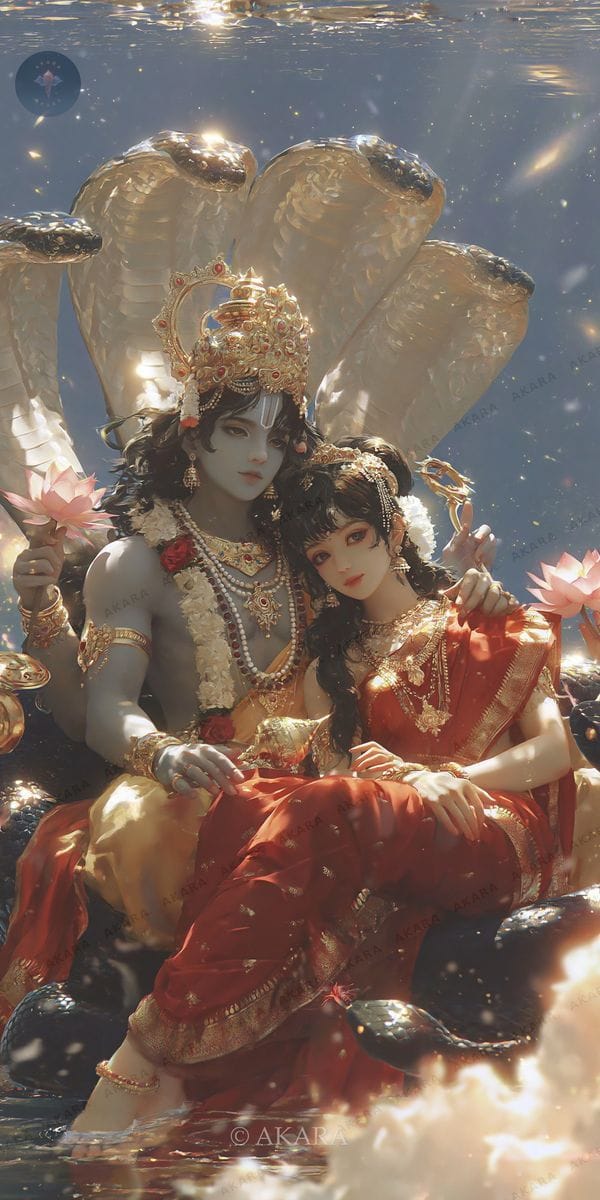
There is a stillness at the centre of the universe. The Bhagavata Purana describes it as the vast, milk-white ocean of Kshirasagara, where Lord Vishnu reclines upon the great serpent Adi Shesha, one hand resting in effortless repose, the lotus of creation spiralling from his navel. This image — serene yet sovereign, restful yet radiant with power — is perhaps the most complete symbol Sanatana Dharma offers of what it means to truly sustain the world: not through force or anxiety, but through an unbroken, luminous presence.
Who Is Vishnu? The Name and the Nature
The name Vishnu (विष्णु) derives from the Sanskrit root viś — to pervade, to enter, to spread throughout. He is Sarva-Vyāpī, the all-pervading one. Where Brahma creates and Shiva dissolves, Vishnu preserves — he is the steady ground between arising and passing away. The Vishnu Sahasranama, that magnificent garland of a thousand names from the Mahabharata's Anushasana Parva, opens with the declaration: Vishvam Vishnur Vashatkaro — he is the universe itself, the Lord of all, the one who sanctifies.
He is also called Narayana (नारायण) — literally, 'he who dwells in the waters of consciousness' or, in the Mahabharata's own gloss, 'the abode of all beings.' And he is Hari (हरि), the one who removes — who takes away sin, suffering, and the bondage of ignorance with a grace so gentle that the devotee scarcely notices the weight has lifted.
In the tradition of Sanatana Dharma, Vishnu is not merely a supernatural personality. He is the cosmic principle of dharma itself given form — the force that ensures the universe does not fly apart into chaos, that seasons return, that justice eventually prevails, that love is not extinguished.
The Iconography: Every Detail a Teaching
Visualize Lord Vishnu as the shastras describe him: a figure of deep blue-black (shyama) complexion — the colour of the infinite sky, of the deep ocean, of that which has no boundary. He stands or reclines in divine ease, four-armed, each hand holding an object whose meaning repays contemplation.
- Shankha (conch shell) — the Panchajanya, from which emerges the primordial sound, the Nada that underpins all creation. It is also the call to the awakened life.
- Chakra (discus) — the Sudarshana, 'the beautiful vision,' spinning eternally, symbolising the wheel of time and the power to cut through illusion (maya) with the precision of discernment.
- Gada (mace) — the Kaumodaki, representing the power of knowledge and the authority of natural law; it reminds us that dharma is not without strength.
- Padma (lotus) — purity arising from the waters of existence, beauty unblemished by the mud from which it grows — the very promise of spiritual liberation.
He wears the Kaustubha gem at his heart — said to represent the pure self, Atman — and the Vaijayanti garland of five-coloured flowers around his neck, symbolising the five elements. His vehicle, the eagle Garuda, is the swift, soaring wind of devotion (bhakti) that carries the seeker to the divine.
Two Stories That Reveal His Heart
Gajendra Moksha — When the Elephant Cried Out
Of all the stories the Bhagavata Purana tells of Vishnu, perhaps none is more beloved than this. Gajendra, the king of elephants, is seized by a crocodile in a sacred lake. He struggles for a thousand years. Finally, exhausted, he lets go of his pride, his strength, his elephant-self. He raises a single lotus blossom toward the sky and calls out — not with a precisely formulated prayer, but with the raw cry of a soul that has nowhere else to turn: Adi Mule Namah. Before the word is complete, Vishnu arrives. He does not wait for Gajendra to be worthy. He comes because the call was genuine.
This story is the heart of Vaishnava theology: sharanagati — complete surrender. Lord Vishnu, the Bhagavata tells us, is bhakta-vatsala, one who is bound by love to his devotees. The seeker's tears move him faster than any ritual.
The Vamana Avatar — Dharma Through Humility
When King Bali's virtue and power grew so great that it threatened to overwhelm the cosmic balance, Vishnu appeared not as a warrior but as Vamana, a small Brahmin boy — the fifth of the Dashavatara, the ten principal descents. He asked Bali for only three steps of land. The generous king agreed. In three steps, Vamana covered the earth, the heavens, and — finding no third space — gently placed his foot upon Bali's own head, sending him to the netherworld. But he did so with honour: Bali's righteousness was recognised; he was given sovereignty over Sutala, a realm of even greater peace.
The lesson is delicate and profound: dharma is not defeated by power, nor is generosity without wisdom enough. The universe has an order. Vishnu's role is to restore it — always with grace, never with cruelty.
The Mantra: Om Namo Narayanaya
The eight-syllable Ashtakshara Mantra — Om Namo Narayanaya (ॐ नमो नारायणाय) — is among the most ancient and venerated in all of Sanatana Dharma, appearing in the Taittiriya Upanishad and elaborated throughout the Pancharatra Agama tradition. Each syllable corresponds to a quality of the divine; together they mean: I bow to Narayana, I take refuge in the Lord who dwells in all beings.
To chant this mantra — with a calm mind, perhaps on a Tulsi mala of 108 beads — is not merely to recite words. It is, as the acharyas teach, to remind the self of its true nature. The one who chants and the one who is called are, at the deepest level, not separate. So'ham — That I am.
Thursday: Vishnu's Day, and How Devotees Worship
Thursday (Brihaspativara or Guruvara) is consecrated to Lord Vishnu across the breadth of Hindu tradition. The planet Jupiter (Brihaspati) governs this day, and Jupiter — guru of the gods, lord of wisdom and expansion — is considered Vishnu's regent in the planetary realm.
Today's panchang adds particular grace: Shukla Panchami brings the waxing lunar energy of growth and auspiciousness; Nakshatra Jyeshtha, 'the eldest,' carries authority and divine protection; Yoga Saubhagya means 'fortunate union' — a day when effort and grace meet naturally.
Devotees across India and the world mark Thursday with distinctive forms of worship (puja):
- Tulsi Puja — the Tulsi plant is sacred to Vishnu; offering its leaves to his image or shaligrama stone is considered especially powerful.
- Yellow offerings — yellow flowers (especially marigold and champa), yellow sweets, yellow cloth — Jupiter's colour, the colour of ripened wisdom.
- Vishnu Sahasranama parayana — the recitation of the thousand names, a practice that many families maintain every Thursday without fail.
- Reading or listening to the Bhagavata — especially the tenth canto, the Dashama Skandha, which narrates the life of Krishna, Vishnu's most intimate avatar.
- Fasting until evening, then breaking the fast with sattvic food.
Mangalam Bhagavan Vishnur, Mangalam Garunadhvajah, Mangalam Pundarikhaksho, Manglaya Tano Harih — 'Auspicious is Lord Vishnu, auspicious is he whose banner bears Garuda, auspicious is the lotus-eyed one, may Hari be the source of all auspiciousness.'
This ancient shloka is sung in homes and temples at dawn on Thursdays, and its vibration seems to reach across centuries without diminishing.
A Reflection: What Vishnu Asks of the Seeker
Lord Vishnu does not ask for spectacular austerity. He does not require the renunciation of the world. What he asks for — and this is the quiet revolution at the heart of Vaishnavism — is bhakti: love, presence, remembrance. The Bhagavad Gita, in Krishna's own words, makes this explicit: Ananyāś cintayanto māṁ ye janāḥ paryupāsate — 'Those who worship me with undivided devotion, meditating on my transcendent form — I carry what they lack and preserve what they have.'
To walk in Vishnu's path is to practice a kind of interior steadiness. It is to hold dharma — right relationship, right action, right awareness — not as a rule imposed from outside, but as the natural expression of a heart that has glimpsed the all-pervading Lord. It is to trust, as Gajendra trusted, that the call of a sincere heart is always heard.
This Thursday, whether you light a lamp, chant a mantra, or simply sit in quiet remembrance of Narayana, know that the very act of turning toward the Preserver is itself preservation. You are not only seeking the Lord. In some ancient, unspeakable way, the Lord is seeking you.
The one who chants and the one who is called are, at the deepest level, not separate.
शान्ताकारं भुजगशयनं पद्मनाभं सुरेशं śāntākāraṁ bhujagaśayanaṁ padmanābhaṁ sureśaṁ
In peaceful form, resting on the serpent, lotus-naveled Lord of gods — the eternal protector who sustains all creation through divine repose.
Questions & answers
Why is Thursday considered Vishnu's day?
Thursday (Brihaspativara or Guruvara) is associated with the planet Jupiter (Brihaspati), who is considered Vishnu's regent in the planetary order. Jupiter governs wisdom, expansion, and divine grace — qualities that mirror Vishnu's sustaining, dharmic nature. Devotees across India observe special pujas, chant the Vishnu Sahasranama, and fast on Thursdays in his honour.
What does the mantra Om Namo Narayanaya mean?
'Om Namo Narayanaya' (ॐ नमो नारायणाय) translates as 'I bow to Narayana' or 'I take refuge in Narayana.' Narayana means 'he who dwells in all beings' or 'the abode of all souls.' This eight-syllable (Ashtakshara) mantra appears in the Taittiriya Upanishad and is one of the most ancient Vaishnava mantras, traditionally chanted on a Tulsi mala of 108 beads.
What are the four objects held by Vishnu and what do they symbolise?
Vishnu's four hands hold: the Shankha (conch) representing the primordial sound of creation; the Sudarshana Chakra (spinning discus) symbolising time and the cutting of illusion; the Kaumodaki Gada (mace) representing the authority of dharma and knowledge; and the Padma (lotus) symbolising purity and liberation. Together they form a complete teaching on the nature of cosmic order.
Who is Garuda and why is he Vishnu's vehicle?
Garuda is the great eagle who serves as Vishnu's vahana (vehicle). Spiritually, Garuda represents swift, soaring bhakti — devotion that carries the seeker directly to the divine. He is also the natural enemy of serpents, symbolising the soul's power to transcend the binding coils of ego and illusion. Garuda's image on Vishnu's banner (the Garudadhvaja) signals Vishnu's presence and protection.
What is the story of Gajendra Moksha and why is it important?
Gajendra Moksha, from the Bhagavata Purana, tells of Gajendra the elephant king who is seized by a crocodile. After struggling for a thousand years and exhausting all his own strength, he surrenders completely and calls out to Vishnu with a heartfelt cry, offering a lotus. Vishnu arrives instantly and rescues him. The story is central to Vaishnava theology because it teaches sharanagati (complete surrender) — the understanding that sincere devotion and genuine surrender move Vishnu more swiftly than any formal qualification or ritual perfection.