Jyeshtha Nakshatra & Shashthi Tithi: Today's Panchang Guidance
What the stars and the sacred almanac counsel for a day shaped by Jyeshtha's sovereign energy and the sixth tithi's quiet power.
Every morning, long before the first lamp is lit or the first mantra whispered, the cosmos has already arranged itself into a precise configuration — tithi, nakshatra, yoga, karana, and the position of the wandering planets all folding together into what the tradition calls the Panchang, the five-limbed body of time. Today, that configuration carries the mark of Jyeshtha, the 'eldest' among the nakshatras, anchored in the deep waters of Vrishchika rashi, while the Sun moves steadily through analytical Kanya. For those who look to Vedic jyotish not for fortune-telling but for attunement, this is a day that rewards composure, quiet authority, and sincere devotion.
The Panchang at a Glance
The Panchang — from pancha (five) and anga (limb) — is the traditional Vedic almanac that measures time through five qualities: Tithi (lunar day), Vara (weekday), Nakshatra (lunar mansion), Yoga (luni-solar combination), and Karana (half-tithi). Together they form the spiritual weather of a day, not as deterministic fate, but as the quality of the moment — its rasa, its texture. Today's five limbs read: Tithi Shukla Shashthi, Nakshatra Jyeshtha (fourth pada), Yoga Shobhana, with the Moon in Vrishchika and the Sun in Kanya. Each element speaks, and together they form a coherent counsel for the sincere seeker.
Jyeshtha Nakshatra: The Eldest Star
Jyeshtha — meaning 'the eldest' or 'the chief' — spans from 16°40' to 30°00' of Vrishchika (Scorpio) and is ruled by Mercury, with Indra, the king of the gods, as its presiding deity. Its symbol is a circular amulet (kundala) or an umbrella, both emblems of protection and sovereign dignity. The fourth pada of Jyeshtha, where the Moon rests today, falls in the Pisces navamsha, lending this otherwise fierce nakshatra a current of deep inward feeling and spiritual receptivity.
Traditionally, Jyeshtha carries a formidable energy — it is associated with seniority, authority, and the weight of responsibility. The Taittiriya Brahmana and later texts on Vedic astrology describe Indra's nakshatra as a place of courage and consequence. This is not a soft star; it demands that we rise to what is ours to carry. At the same time, the Piscean fourth pada dissolves some of that martial intensity into empathy and surrender. The moon in Vrishchika deepens perception, heightens intuition, and can make emotions feel unusually concentrated — like light through a lens. This is not a day for scattered attention.
Shukla Shashthi: The Sixth of the Waxing Moon
The Tithi today is Shukla Shashthi, the sixth lunar day of the bright fortnight. In the classical framework, Shashthi is associated with Karttikeya — also known as Skanda or Murugan — the six-faced commander of the celestial armies, son of Shiva and Parvati. The number six in the lunar calendar carries the quality of sthira (stability) and bala (strength). The Shashthi tithi is traditionally considered auspicious for acts requiring courage, resolve, and the beginning of sustained effort.
In domestic and ritual life, Shashthi is the day on which the goddess Shashthi Devi — protector of children and households — is also honoured in many regional traditions, particularly in Bengal and South India. The broader principle holds: the sixth tithi is a day to establish protection, whether over one's family, one's spiritual practice, or one's state of mind.
"Tithi is the body of the Panchang. Without right tithi, even auspicious actions lose their ground." — Traditional jyotish maxim
Yoga Shobhana: The Auspice of Beauty
The Yoga for today is Shobhana, which translates simply as 'beautiful' or 'radiant.' In the system of 27 yogas — each formed by dividing the sum of the Sun's and Moon's longitudes — Shobhana is generally regarded as auspicious and conducive to works of beauty, craft, worship, and genuine expression. The name itself is a quiet instruction: whatever you do today, bring beauty to it. Not ornamentation, but care. Shobhana asks that the inner state match the outer act.
What This Day Traditionally Favours
Reading the Panchang is not about restriction; it is about timing one's energies wisely, the way a gardener reads the season. Taken together, today's configuration suggests the following:
- Worship and devotion (bhakti): The combination of Jyeshtha's Indra-ruled sovereignty and Shashthi's Karttikeya connection makes today particularly suited for prayer, mantra recitation, and offerings at the home altar. If you have a practice, deepen it today rather than expand it.
- Matters requiring resolve: Beginning a difficult conversation, completing a task that has been postponed, or taking a decisive step within an ongoing project — Jyeshtha's energy supports the courageous move.
- Craft and creative work: Yoga Shobhana adds a quality of aesthetic refinement to whatever is made today. Those who work with art, music, devotional writing, or sacred design may find the creative current flows cleanly.
- Deep reading and study: Moon in Vrishchika with Mercury-ruled Jyeshtha is a fine combination for concentrated study — particularly of texts in philosophy, scripture, or the healing sciences.
Where patience is counselled: The Moon in Vrishchika can intensify reactions and make it easy to read threat into neutral situations. Jyeshtha's proud energy can, if unchecked, tip toward defensiveness or the need to assert seniority. Today is not ideal for negotiations where ego is already entangled, or for issuing ultimatums. Let the intensity serve depth, not drama.
A Reflective Practice for Today
The tradition offers a simple form of daily attunement: before beginning work, sit for a few minutes in stillness. Acknowledge the tithi — Shukla Shashthi — and its deity Karttikeya, the embodiment of disciplined spiritual valor. Recite, even quietly, the Skanda Shashthi blessing or simply hold the intention: "May I carry my responsibilities with grace today. May I protect what is sacred in my life and my practice."
If you have a home altar or devotional space, light a lamp. The lamp — deepa — is one of Sanatana Dharma's most enduring symbols: a small flame that neither hoards its light nor is diminished by giving it. That, in essence, is what Jyeshtha at its best teaches — that true seniority is generous, not possessive.
For those drawn to sound, the Jyeshtha nakshatra resonates with the bija syllable and the vibration of Mercury. A brief recitation of the Gayatri Mantra at sunrise, directed toward the Sun now in Kanya — the sign of discernment and service — harmonises the solar and lunar currents of the day beautifully.
Closing Reflection
The Panchang is one of Sanatana Dharma's most elegant gifts to daily life: a living reminder that we do not stand outside the cosmos, managing it from a distance, but move within it, shaped by its rhythms and shaping them in return. Today's nakshatra, Jyeshtha, invites us to wear our responsibilities like that ancient amulet — not as a burden, but as a mark of dignity. The Shashthi tithi steadies us. Yoga Shobhana reminds us to bring beauty to the ordinary.
This is traditional guidance, not prediction. The stars do not compel; they illuminate. How we walk through this day remains, as always, ours to choose.
The stars do not compel; they illuminate. How we walk through this day remains, as always, ours to choose.
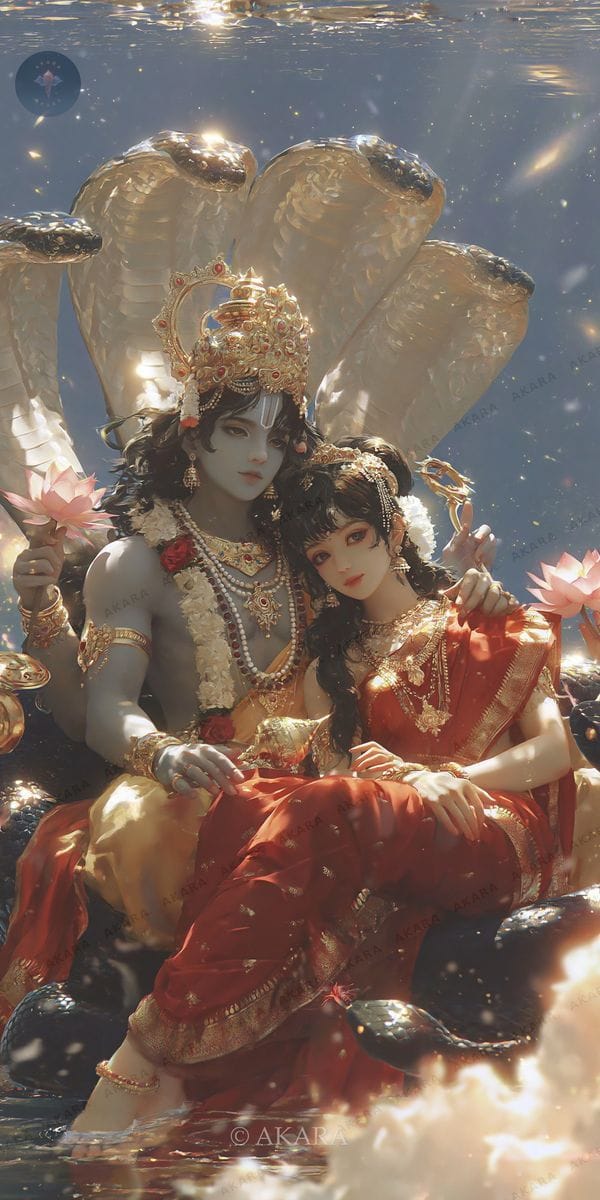
शान्ताकारं भुजगशयनं पद्मनाभं सुरेशं śāntākāraṁ bhujagaśayanaṁ padmanābhaṁ sureśaṁ
In peaceful form, resting on the serpent, lotus-naveled Lord of gods — the eternal protector who sustains all creation through divine repose.
Questions & answers
What is Jyeshtha nakshatra and who is its ruling deity?
Jyeshtha is the 18th nakshatra in Vedic astrology, spanning 16°40' to 30°00' of Vrishchika (Scorpio). Its ruling planet is Mercury and its presiding deity is Indra, king of the gods. Its symbol — an amulet or umbrella — points to protection, authority, and sovereign responsibility.
What does Shukla Shashthi tithi signify in the Panchang?
Shukla Shashthi is the sixth lunar day of the waxing (bright) fortnight. It is associated with Karttikeya (Skanda or Murugan) and traditionally favours acts of courage, protection, and sustained effort. The goddess Shashthi Devi, protector of households and children, is also honoured on this tithi in many regional traditions.
Is today auspicious for worship and devotion?
Yes, according to traditional Vedic guidance, the combination of Jyeshtha nakshatra, Shashthi tithi, and Yoga Shobhana makes today particularly well-suited for bhakti practices — prayer, mantra recitation, lamp offering, and deepening an existing spiritual practice.
What does Yoga Shobhana mean in the daily Panchang?
Shobhana is one of 27 yogas in the Vedic Panchang, formed by the combined longitudes of the Sun and Moon. Its name means 'beautiful' or 'radiant,' and it is considered auspicious for creative work, worship, and any act performed with genuine care and inner alignment.
Is the Panchang a form of fortune-telling or prediction?
No. The Panchang is a traditional almanac rooted in Vedic jyotish that describes the quality of time — not a deterministic fate. It offers guidance on which energies are active on a given day and how to align one's actions accordingly. The tradition consistently teaches that human effort (purushartha) and devotion shape our path; the Panchang illuminates the moment, it does not control it.