The Trimurti: Brahma, Vishnu, and Shiva Explained
The three great forms of the Divine — creator, preserver, and transformer — are not a pantheon of rivals but a single cosmic breath.
At the heart of Sanatana Dharma lies a vision of the universe so elegant that it has captivated seekers for millennia: that creation is not a single act but a continuous rhythm, and that this rhythm is held in three sacred forms — Brahma the Creator, Vishnu the Preserver, and Shiva the Transformer. Together they constitute the Trimurti (Sanskrit: त्रिमूर्ति, tri = three, mūrti = form or embodiment), the threefold manifestation of the one absolute reality known as Brahman. To understand the Trimurti is to understand how the cosmos breathes.
The Word Itself: What Does Trimurti Mean?
The word Trimurti appears in classical Sanskrit literature as a compound of tri (three) and mūrti (form, embodiment, or icon). It is sometimes rendered in English as the "Hindu Trinity," though that translation carries Christian overtones that can mislead. The Trimurti is not a council of three co-equal gods debating creation; it is one undivided cosmic intelligence expressing itself through three modal functions — srishti (creation), sthiti (preservation or sustenance), and laya or samhāra (dissolution or transformation).
The Matsya Purana, the Kurma Purana, and the Vishnu Purana all describe these three functions as inherent to the nature of reality itself. The Vishnu Purana (1.2) is particularly clear: "From Brahman, which is both the efficient and material cause of the universe, proceed the qualities of creation, preservation, and dissolution, represented by Brahma, Vishnu, and Shiva." None of the three is prior or superior in essence — they are, as the Mahanirvana Tantra puts it, "one fire burning with three flames."
Brahma: The Principle of Creation
Brahma (ब्रह्मा) — note the long ā, distinguishing him from the neuter absolute Brahman — embodies srishti, the outpouring of existence from potential into form. He is classically depicted with four faces (chaturmukha) oriented to the four directions, symbolising the all-encompassing nature of creative intelligence, and four arms holding the Vedas, a kamaṇḍalu (water pot), a mālā (rosary), and a sruk (sacrificial ladle). His vehicle is the haṃsa, the sacred goose — a creature said to possess the ability to separate milk from water, representing the discriminative wisdom (viveka) that underlies genuine creation.
Brahma is less commonly worshipped in a personal devotional (bhakti) mode than Vishnu or Shiva, a fact that Puranic lore explains through mythological narratives — most famously the curse said to have been pronounced after a dispute with Shiva. Scholars also note that the creative principle, once creation has unfolded, recedes into the background: we do not pray to the sunrise after the day is bright. Yet Brahma remains theologically indispensable; without the creative impulse, neither preservation nor dissolution has anything to act upon.
Vishnu: The Principle of Preservation
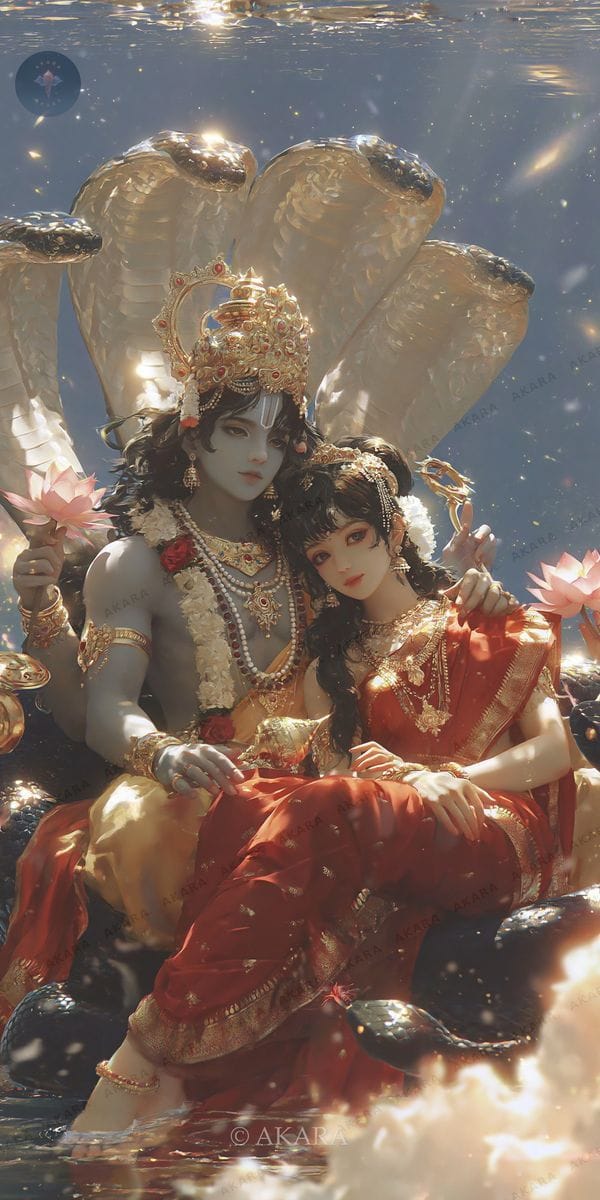
Vishnu (विष्णु) — from the root viś, to pervade — is the all-pervasive sustainer. His sthiti function is the force that holds the cosmos in its ordered beauty, that maintains dharma, that nurtures life between the first breath and the last. He is most often depicted in a beautiful blue form resting on the great serpent Ādi Śeṣa upon the cosmic ocean Kṣīrasāgara, holding the śaṅkha (conch), cakra (discus), gadā (mace), and padma (lotus) — instruments of auspiciousness, righteousness, sovereign order, and purity respectively.
The doctrine of the Daśāvatāra — the ten principal descents (avatāra) of Vishnu — captures beautifully what preservation means in practice. Whenever dharma is overwhelmed, Vishnu descends: as Matsya the fish who saves the Vedas from the deluge, as Kurma the tortoise who stabilises the churning cosmos, as Rama the righteous king, as Krishna the divine beloved who delivers the Bhagavad Gita. This is preservation not as mere maintenance but as active, compassionate intervention — a teaching that resonates as powerfully in the present age as it did in any other.
Shiva: The Principle of Transformation
Shiva (शिव) — whose very name means "auspicious" — holds the samhāra or laya function, a word better rendered as transformation or dissolution than destruction. The cosmos cannot be endlessly accumulated; what is created must in time be returned to its source so that the next cycle of creation can arise, fresher and more luminous. Shiva's tāṇḍava, his cosmic dance, does not depict wanton annihilation but the rhythmic pulse of time itself, the mahāpralaya (great dissolution) that is simultaneously an act of mercy and liberation (mokṣa).
Shiva is perhaps the most paradoxical figure in the Trimurti — simultaneously the great ascetic (Mahāyogi) sitting in deep meditation on Mount Kailāsa and the lord of passionate energy (śakti). He wears the crescent moon in his matted locks (jaṭā), carries the trident (triśūla) representing the three functions of the Trimurti themselves, and holds the ḍamaru (small drum) whose sound is said to be the primordial nāda from which creation arises. His third eye, when opened, dissolves illusion — an image that in our own time speaks to the need to see through the superficial and perceive reality as it truly is.
The Unity Beneath the Three Forms
The deepest teaching of the Trimurti is non-dualistic: the three forms are real and meaningful at the level of cosmic function and personal devotion, yet they are not ultimately separate. The Shaiva Agamas describe Shiva as containing Brahma and Vishnu within himself; the Vaishnava texts describe Vishnu as the ground in whom all three functions rest; the Shakta tradition teaches that the divine Mother (Shakti) animates all three, and that without Shakti — the feminine creative energy — the Trimurti would be inert. This plurality within unity is itself one of the most philosophically sophisticated contributions of Sanatana Dharma to world thought.
For the devotee on the path of bhakti, the practical consequence is profound: whichever form of the Divine one approaches — whether through a Shiva lingam at dawn, a Vishnu archana at noon, or a Brahma stotra at twilight — one is touching the same underlying reality. The Trimurti is not an obstacle to monotheism; it is a map of how the one expresses itself through the many.
Living the Teaching Today
The Trimurti offers a lens for our own inner life. Within each of us, srishti operates as creative thought and initiative; sthiti as discipline, relationship, and care; samhāra as the willingness to let go — of habits, of ego, of what no longer serves growth. The ancient rishis who articulated the Trimurti were not merely describing cosmic geography; they were offering a template for conscious living.
At Akara, we find in this teaching an invitation to approach the Divine not as a distant sovereign but as the very rhythm of existence — present in the first idea of the morning, in the steady keeping of a promise through the afternoon, and in the graceful release that comes with sleep. Creation. Preservation. Transformation. These are not events that happened once at the beginning of time. They are happening now, in every breath.
"The one who knows the Trimurti as the three modes of the one Self attains the supreme peace." — paraphrased from the Kurma Purana
The Trimurti is not an obstacle to monotheism; it is a map of how the one expresses itself through the many.
शान्ताकारं भुजगशयनं पद्मनाभं सुरेशं śāntākāraṁ bhujagaśayanaṁ padmanābhaṁ sureśaṁ
In peaceful form, resting on the serpent, lotus-naveled Lord of gods — the eternal protector who sustains all creation through divine repose.
Questions & answers
What is the Trimurti in Hinduism?
The Trimurti (Sanskrit: त्रिमूर्ति) is the threefold manifestation of the one absolute reality — Brahman — through three cosmic functions: Brahma as creator (srishti), Vishnu as preserver (sthiti), and Shiva as transformer (samhara). It represents the continuous rhythm of existence rather than three separate deities in competition.
Is the Trimurti the same as the Christian Trinity?
While 'Hindu Trinity' is a common English translation, the parallel is imperfect. The Christian Trinity refers to three persons of one God in a theological relationship. The Trimurti refers to three functional expressions of one absolute cosmic reality (Brahman) — creation, preservation, and dissolution — operating as universal principles within the cycle of existence.
Why is Brahma rarely worshipped compared to Vishnu and Shiva?
Puranic tradition offers mythological explanations, most involving a dispute that led to a curse limiting Brahma's worship. Philosophically, the creative principle, once creation is manifest, naturally recedes; we engage more actively with sustenance (Vishnu) and transformative grace (Shiva) in daily devotional life. Brahma's role remains theologically essential even if his temples are fewer.
What does Shiva's role as 'destroyer' actually mean?
The word 'destroyer' is a common but misleading translation of samhara or laya. Shiva's function is better understood as transformation or dissolution — the returning of all manifest forms to their source so that new creation can arise. His cosmic dance, the Tandava, represents the rhythmic pulse of time itself, and dissolution in this sense is an act of liberation (moksha), not annihilation.
How can the Trimurti guide everyday spiritual practice?
The three functions of the Trimurti mirror our inner life: Brahma's srishti is present in every creative thought and new beginning; Vishnu's sthiti is alive in our discipline, relationships, and care for others; Shiva's samhara is the wisdom to release what no longer serves. Consciously attuning to these three rhythms — creating, sustaining, and letting go — is itself a form of living spirituality.