Mahadeva: Who Is Shiva and What Does He Ask of Us?
On this auspicious Monday, we turn toward the one who holds the universe in stillness and the cosmos in dance.
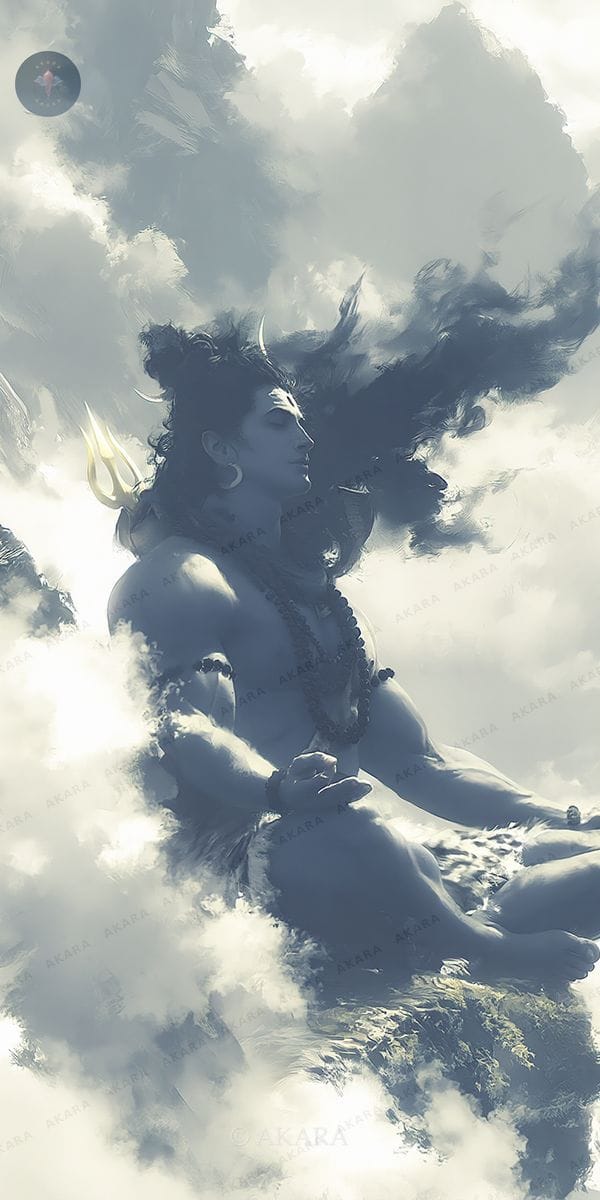
Before the first word was spoken, before the first star ignited, there was silence — and in that silence, Shiva. He is the ash-smeared ascetic on the mountain, the ecstatic dancer in the cremation ground, the tender husband cradling Parvati, and the infinite, attribute-less awareness that underlies all of it. Mahadeva — the Great God — is perhaps the most paradoxical, most complete, and most demanding of the great presences of Sanatana Dharma. On this Monday, his sacred day, with the nakshatra Uttara Ashadha lending its quality of unshakeable resolve, we sit at his threshold and ask: who is Shiva, and what does devotion to him truly require of us?
The Many Faces of the One Without a Second
In Sanskrit, the name Shiva (शिव) means simply "the auspicious one." Yet no single adjective can contain him. The Shiva Purana enumerates 1,008 names, each one a window into a different facet of his nature. He is Mahadeva (the Great God), Mahakala (the lord of time and death), Neelakantha (the blue-throated one who drank poison to save creation), Bholenath (the innocent, easily pleased lord), and Nataraja (the king of cosmic dance). In the Rigveda, his prototype Rudra is called upon with trembling reverence — a deity of storms and wildness, of sudden grace and sudden dissolution. By the time of the Upanishads and the great Shaiva Agamas, that fierce deity has become the supreme Brahman itself, the ground of all being.
What Shaiva philosophy teaches — and what the seeker slowly discovers through practice — is that these apparent contradictions are not contradictions at all. Shiva integrates what ordinary consciousness keeps separate: creation and destruction, silence and sound, form and formlessness, householder and renunciant. He is the model of wholeness, not perfection in the conventional sense but purnatva, completeness.
Reading the Iconography: A Grammar of the Sacred
Every element of Shiva's classical form is a teaching compressed into image.
- The crescent moon (Chandra) resting in his matted hair (jata) marks him as the master of time, carrying even the waxing and waning of the moon as an ornament, never its prisoner.
- The Ganga flowing from those locks signals his capacity to receive what is overwhelming — the celestial river's full force — and release it gently to the world. What would have shattered the earth, Shiva absorbs and transforms.
- The third eye (triksha or trinetra) is the eye of direct perception, jnana-chakshu, the eye of wisdom. Tradition holds that it opens in meditation and can reduce the unreal to ash — including Kamadeva, the god of desire, when desire becomes an obstacle to truth.
- The serpent Vasuki coiled at his throat speaks of mastery over the most primal forces: fear, death, and the kundalini energy that lies dormant in every seeker.
- The trishula (trident) represents his sovereignty over the three gunas — tamas, rajas, and sattva — the three qualities that constitute all of manifest existence.
- Vibhuti (sacred ash) smeared across his body is perhaps the most radical teaching: everything returns to ash. Ego, attachment, the body itself — all of it. To wear ash is to have made peace with impermanence.
Two Stories the Scriptures Tell
The Drinking of the Halahala: When gods and demons churned the cosmic ocean (Samudra Manthan) in search of amrita, the nectar of immortality, the first thing to emerge was halahala, a poison capable of annihilating all creation. Neither gods nor demons could bear it. Shiva alone stepped forward, received the poison in his palm, and held it in his throat — neither swallowing it nor spitting it out, lest it harm any being. His throat turned blue, earning him the name Neelakantha. This story is not mythology in the dismissive sense. It is a map of the spiritual path: the one who can hold what is unbearable without being destroyed by it, without passing it on to others, is the one who has realised the deepest stillness.
Ardhanarishvara: In another beloved form, Shiva appears as Ardhanarishvara — literally "the lord who is half woman" — the right half of his body Shiva, the left half Parvati. The Skanda Purana and artistic tradition from Elephanta to Chidambaram celebrate this form as the union of Purusha (pure consciousness) and Prakriti (active, manifest nature). Neither is complete without the other. This is Sanatana Dharma's answer to any philosophy that denigrates matter or exalts spirit at matter's expense: reality is their sacred marriage.
Om Namah Shivaya: The Maha Panchakshara Mantra
Of all the gifts the Shaiva tradition offers, the five-syllabled mantra Na-Ma-Shi-Va-Ya (preceded by the pranava Om) stands foremost. The Shiva Purana and the Krishna Yajurveda's Sri Rudram both celebrate it. Each syllable corresponds to one of the five tattvas or elements — earth, water, fire, air, space — and to one of Shiva's five acts: srishti (creation), sthiti (preservation), samhara (dissolution), tirodana (concealment), and anugraha (grace).
Namah means "I bow, I am not the doer, I surrender." The mantra is therefore not a petition but a declaration of ontological humility. To chant Om Namah Shivaya is to rehearse, breath by breath, the truth that the small self is not the ultimate subject. Many devotees observe pradosh vrat on Mondays or the trayodashi tithi, sitting with a Shivalinga, offering bilva leaves (the three-leafed wood apple, sacred because its three leaves represent the three eyes and the three gunas brought into offering), water, milk, and this mantra, repeated 108 times or in flowing japa.
How Devotees Worship on Monday
Somavar — Monday, the day of the moon, of Soma — belongs to Shiva. Today the panchang further blesses us: Uttara Ashadha nakshatra carries the quality of dhruva, the fixed star, steadfastness. Yoga Dhriti means "holding, sustaining" — a fitting sky for deepening practice.
A typical Monday Shiva puja in a home or temple follows this arc: early bath, offering of water (abhisheka) to the Shivalinga with the chanting of Rudrashtakam or Sri Rudram, decoration with bilva patra, dhatura flowers, and white flowers, lighting of a ghee lamp, and recitation of the Maha Mrityunjaya Mantra — Om Tryambakam Yajamahe... — the mantra of liberation from the fear of death. Many devotees observe a fast (upavasa), eating only once or abstaining from salt, as an act of tapas, a conscious turning of the body toward the sacred.
Today is also Masik Durgashtami, the monthly eighth tithi sacred to Devi in her fierce form. Shiva and Shakti are inseparable — the tradition recognises this naturally. One may offer prayers to both, understanding that Durga's fierce protective grace and Shiva's dissolving awareness are two movements of the same ultimate reality.
What Shiva Asks of the Seeker
Many deities in the Hindu tradition are approached with a petition: grant health, grant wealth, grant success. Shiva receives those prayers too — Bholenath is known for his easy grace — but his deeper invitation is more searching. He asks the seeker to sit with what they most fear: impermanence, loss, the dissolution of the very self that is doing the seeking.
His abode is the cremation ground not because he is morbid but because that is the only place where pretence falls away completely. No social role, no ambition, no fear of what others think survives there. In the Vivekachudamani, Adi Shankaracharya — himself a great Shaiva — points to this same truth: the spiritual life begins in earnest when the seeker stops clinging.
"What is real cannot be destroyed. What can be destroyed was never ultimately real."
This is the ash on Shiva's forehead speaking. This is the crescent moon saying: phases pass, awareness remains. Bhakti — devotion — to Shiva is not an escape from the world's difficulty but a training in bearing it with grace, in finding, beneath every ending, the silence that has never been disturbed.
On this Monday morning, wherever you are — lighting a lamp, folding hands, or simply pausing in awareness — that is already a meeting with Mahadeva. Om Namah Shivaya.
His abode is the cremation ground not because he is morbid but because that is the only place where pretence falls away completely.
Questions & answers
Why is Monday considered sacred to Lord Shiva?
Monday is called Somavar in Sanskrit — the day of Soma, the moon. The crescent moon is inseparable from Shiva's iconography, resting in his matted hair as a mark of his mastery over time. Devotees observe fasts, perform abhisheka (ritual bathing of the Shivalinga), and chant Om Namah Shivaya on this day as a traditional form of weekly worship.
What does the mantra Om Namah Shivaya mean?
Om Namah Shivaya is the Panchakshara or five-syllable mantra of Shiva (the five syllables being Na-Ma-Shi-Va-Ya). 'Namah' means 'I bow' or 'I am not the doer,' expressing surrender of the ego. Each syllable also corresponds to one of the five elements. Together the mantra is a declaration of humility and a reminder of the divine presence within all of existence.
What is the significance of Shiva's third eye?
Shiva's third eye, called trinetra or jnana-chakshu (the eye of wisdom), represents direct, undistorted perception beyond the ordinary senses. According to tradition, it opens in deep meditation and can burn away illusion — most famously illustrated when it reduced Kamadeva, the god of desire, to ash when desire threatened cosmic order. It is a symbol of awakened consciousness.
How does the story of Neelakantha relate to spiritual practice?
When the cosmic ocean was churned (Samudra Manthan), the first thing to emerge was halahala, a deadly poison. Shiva alone consumed it, holding it in his throat without swallowing or releasing it, turning his throat blue — hence the name Neelakantha, the blue-throated one. Spiritually, this story teaches the capacity to hold pain, difficulty, or the world's poison without being destroyed by it and without passing the harm on to others — a quality cultivated through steady practice and inner stillness.
Can one worship both Shiva and Devi on the same day, as on Masik Durgashtami falling on a Monday?
Absolutely. Shaiva and Shakta traditions are deeply intertwined. The Ardhanarishvara form — half Shiva, half Parvati — is itself a statement that consciousness (Shiva) and power (Shakti/Devi) are inseparable. When Masik Durgashtami coincides with Monday, many devotees honour both Shiva and Devi, understanding them as two aspects of one ultimate reality. Prayers, lamps, and mantras dedicated to both are considered auspicious and mutually reinforcing.