Navadurga: The Nine Sacred Forms of Goddess Durga
From Shailaputri to Siddhidatri, each face of the Divine Mother reveals a distinct grace — and a complete path to liberation.
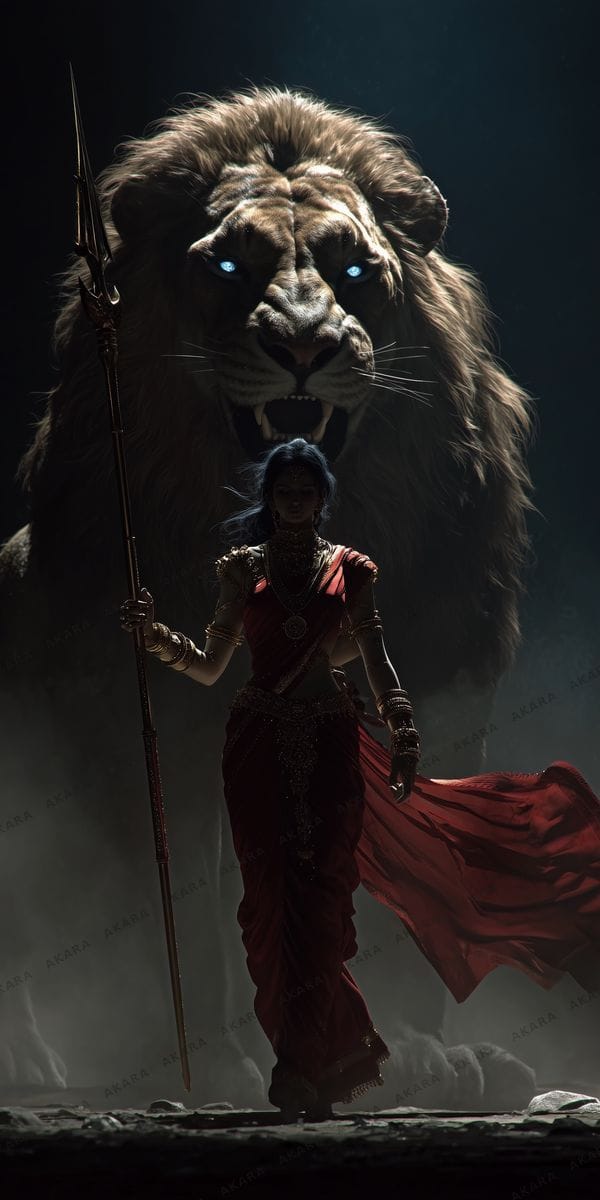
In the vast cosmology of Sanatana Dharma, the Divine Mother does not arrive as a single, fixed image. She comes in waves — nine of them — each bearing a different name, a different weapon, a different lesson. These nine forms, collectively known as Navadurga, are worshipped across nine sacred nights of Navratri and contemplated across an entire lifetime. To know them is not merely an exercise in mythology; it is a map of the soul's journey from matter to moksha, from the mountain cradle of Shailaputri to the perfected silence of Siddhidatri.
The Source: Where Navadurga Originates
The canonical enumeration of the Navadurga appears in the Devi-Bhagavata Purana and is reinforced by the Markandeya Purana's celebrated Devi Mahatmyam (also called the Durga Saptashati), one of the most authoritative scriptures on Shakti worship. The verse that names all nine forms reads:
Prathamam Shailaputri cha, Dwitiyam Brahmacharini, Tritiyam Chandraghanta cha, Chaturtham Kushmanda. Panchamam Skandamata cha, Shashtham Katyayani cha, Saptamam Kalaratri cha, Ashtamam Mahagauri. Navamam Siddhidatri cha, Navadurga prakirtitah.
This verse — recited during Navratri puja across temples and households — is both a liturgical invocation and a curriculum. Each name is a precise Sanskrit compound carrying layers of meaning.
The Nine: Names, Meanings, and Grace
1. Shailaputri (Shaila = mountain; putri = daughter) is the first and foundational form. She is Parvati, daughter of Himavan, the king of the Himalayas, mounted on a bull and holding a trident and lotus. She embodies rootedness — the earth element, Muladhara chakra, the very ground from which spiritual life springs. On the first night of Navratri, devotees meditate on her stabilising grace.
2. Brahmacharini (Brahma = the Absolute or sacred practice; charini = one who moves in, or observes) represents the Goddess in her austere, tapas-performing aspect — the Parvati who practised severe penance to win Shiva. She walks barefoot, holds a rosary (japa mala) and a water pot (kamandalu), and teaches that sustained, single-pointed devotion — bhakti rooted in discipline — is the second rung of the inner ascent.
3. Chandraghanta (Chandra = moon; ghanta = bell) wears a crescent moon on her forehead shaped like a bell. Seated on a tiger, ten-armed, she produces a fierce sound that destroys evil. She is the Goddess of courage — the grace that transforms inner anxiety into fearless action. The third day of Navratri is dedicated to her.
4. Kushmanda (Ku = small; ushma = warmth/energy; anda = cosmic egg) is the creator form. She is said to have created the universe with a mere smile in a moment of primordial darkness. Eight-armed and radiant as the sun, she rules the solar plexus and Anahata region. She reminds the seeker that creation itself is an act of joy, not struggle.
5. Skandamata (Skanda = the war-god Kartikeya; mata = mother) holds the infant Skanda on her lap, reminding us that divine power is inseparable from divine tenderness. Seated on a lion and holding a lotus, she is the mother who does not flinch even in battle. Spiritually, she governs the purification of the mind and the nurturing of nascent wisdom.
6. Katyayani is named for the sage Katyayana, in whose hermitage she manifested in answer to his long penance. She is the warrior Goddess in her most potent form — the one who slew the buffalo-demon Mahishasura according to tradition. Bright as the rising sun, mounted on a lion, she is invoked for courage, clarity, and the destruction of ego-born obstacles.
7. Kalaratri (Kala = time or darkness; ratri = night) is perhaps the most formidable of the nine. Dark-complexioned, with dishevelled hair and three eyes blazing like the cosmos, she rides a donkey and wields a sword and a noose. Yet her gesture — the abhaya mudra (fear not) — tells the complete story: she destroys all fear by becoming it. She represents the dissolution of illusion, the Goddess who clears the path at the darkest hour.
8. Mahagauri (Maha = great; gauri = fair, radiant) is luminous white, serene, four-armed, mounted on a bull. She is the purified, beautified Parvati who emerged after her long austerity. She grants purification of accumulated karma and symbolises the soul's return to its natural brilliance after the darkness of Kalaratri. Her grace is described in tradition as cooling, pacifying, and liberating.
9. Siddhidatri (Siddhi = supernatural accomplishment or spiritual perfection; datri = the giver) is the ninth and final form — the Goddess who bestows all eight classical siddhis (Anima, Mahima, Garima, Laghima, Prapti, Prakamya, Ishitva, Vashitva) as described in the Devi-Bhagavata Purana. She sits on a lotus and is worshipped by gods, humans, and siddhas alike. She is the culmination: the Mother who, having taught the entire curriculum of nine, gives freely of her fullness.
The Inner Map: Navadurga as Spiritual Progression
Read sequentially, the Navadurga trace a profound inner itinerary. One begins in Shailaputri's earth — grounded, embodied — then disciplines oneself through Brahmacharini's tapas. Chandraghanta's courage is earned; Kushmanda's creative joy discovered. Skandamata teaches compassion; Katyayani, the warrior's discernment. Kalaratri dismantles what is false; Mahagauri restores what is true; Siddhidatri completes the circle with the gift of wholeness.
This is not merely a theological sequence. Many practitioners of bhakti in the Hindu spirituality tradition use the nine days of Navratri — observed in Chaitra (spring) and Ashvin (autumn) — as a genuine retreat, aligning each day's meditation, mantra, and colour with one form of the Mother. The Akara approach to devotion honours this: let beauty, colour, sound, and intention work together to open the seeker to each dimension of the Divine.
Worship, Mantra, and Living Practice
Each of the Navadurga has her own dhyana shloka (meditation verse), mantra, and associated colour — a tradition especially vivid during Navratri, when devotees across India wear the prescribed colour of the day. Each form is also linked to a specific chakra in the subtle body, making Navadurga worship a complete system touching physiology, psychology, and the spirit.
Practical guidance for seekers:
- Begin each day with the Devi Kavacham or the relevant dhyana shloka for that form.
- Offer flowers, fruit, and a lighted lamp (deepa) with sincere intention — the Goddess receives the offering of the heart before the hand.
- Recite the Devi Mahatmyam or even a single chapter of it; tradition holds that its sound itself is protective and transformative.
- Meditate on the associated quality — groundedness, courage, creative joy — and carry it into the day as a living practice.
A Reflection for the Seeker
The nine forms of Durga are not nine separate goddesses. They are nine facets of one light refracted through the prism of human need and divine compassion. In each form, the Mother says: I see where you are. This is the grace you need here. Shailaputri meets us at the base of the mountain. Siddhidatri waits at the summit. The path between them is the whole of a devout human life — and the Mother walks every step of it with us, wearing the face we most need to see.
May the nine-fold grace of the Divine Mother illuminate all who seek her.
The nine forms of Durga are not nine separate goddesses. They are nine facets of one light refracted through the prism of human need and divine compassion.
Questions & answers
What are the Navadurga?
Navadurga are the nine sacred forms of Goddess Durga worshipped sequentially during the nine nights of Navratri. They are Shailaputri, Brahmacharini, Chandraghanta, Kushmanda, Skandamata, Katyayani, Kalaratri, Mahagauri, and Siddhidatri, each representing a distinct aspect of the Divine Mother's grace and power.
Which scripture describes the nine forms of Durga?
The nine forms are enumerated in the Devi-Bhagavata Purana and are deeply connected to the Devi Mahatmyam (Durga Saptashati), which is part of the Markandeya Purana. A key verse beginning 'Prathamam Shailaputri cha…' lists all nine by name and is recited during Navratri puja.
Why are the Navadurga worshipped during Navratri?
Navratri (nine nights) is structured precisely around the nine forms — one for each night. The festival occurs twice yearly, in Chaitra (spring) and Ashvin (autumn). Worshipping each form in sequence is considered a complete spiritual practice, progressively invoking different divine qualities from groundedness to liberation.
What is the significance of the colours associated with each Navadurga?
Each of the nine forms has an associated colour worn by devotees on that day of Navratri — such as yellow for Shailaputri and white for Mahagauri. The colours serve as a contemplative aid, aligning the devotee's awareness with the specific quality and energy of each form of the Mother.
How is Kalaratri, the fearsome seventh form, considered auspicious?
Despite her fierce appearance — dark-complexioned, wild-haired, riding a donkey — Kalaratri always makes the abhaya mudra (the gesture of fearlessness). Tradition teaches that she destroys darkness, evil forces, and all fear by fully embodying and transcending them. Her fierceness is maternal protection in its most radical form.